Comparison
Cave Salamander vs Texas Blind Salamander
Cave Salamander (Eurycea lucifuga) and Texas Blind Salamander (Eurycea rathbuni) both belong to the genus Eurycea (brook salamander) and part ways below it. Both are recorded in 1 country.


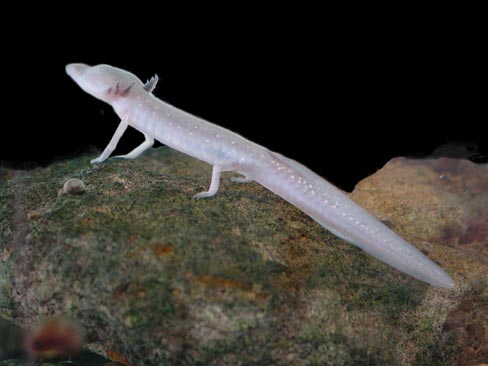
Texas Blind Salamander
Eurycea rathbuni
Photograph courtesy of Joe N. Fries, U.S. Fish and Wildlife Service, Public domain, via Wikimedia Commons

Side by side
| Cave Salamander | Texas Blind Salamander | |
|---|---|---|
| Scientific name | Eurycea lucifuga Rafinesque, 1822 | Eurycea rathbuni (Stejneger, 1896) |
| English name | Cave Salamander | Texas Blind Salamander |
| Group | Amphibians | Amphibians |
| Class | Amphibia Amphibians | Amphibia Amphibians |
| Order | Caudata Salamanders | Caudata Salamanders |
| Family | Plethodontidae Lungless Salamanders | Plethodontidae Lungless Salamanders |
| Genus | Eurycea Brook Salamander | Eurycea Brook Salamander |
| Named in | 1822 | 1896 |
| Red List category | Least Concern | Critically Endangered |
| Countries on record | 1 country | 1 country |
| GBIF occurrence records | 7,689 records | 388 records |
Rows where the two agree are shown in grey.
Where each is found
Both recorded in 1 country
From Catalogue of Life checklists and GBIF occurrence records. A country missing from a list means no record is held, which is not proof of absence.
Checked facts
| Cave Salamander | Texas Blind Salamander | |
|---|---|---|
| Appearance |
|
|
| Size | No checked fact yet |
|
| Habitat |
|
|
| Diet |
|
|
| Behaviour |
|
|
| Reproduction |
|
|
| Conservation |
|
|
| Uses | No checked fact yet |
|
| Similar species |
|
|
| Other |
| No checked fact yet |
In brief
Cave Salamander
The Cave Salamander (Eurycea lucifuga Rafinesque, 1822) is an amphibian in the family Plethodontidae, order Caudata, and class Amphibia. It inhabits limestone caves, rocky crevices and woodland habitats near bluffs, springs, moist rocks and logs. Full profile
Texas Blind Salamander
Eurycea rathbuni inhabits underground water-filled caves in the Edwards Aquifer. It has vestigial eyes covered by skin, red external gills, and a white body with little skin pigment. Full profile
Compare something else
Page built on 28 November 2026 from the data on the two species pages, where every source is listed.
Cite this page
ScientificNames.org. (2026). Cave Salamander vs Texas Blind Salamander. Retrieved November 28, 2026, from https://scientificnames.org/compare/cave-salamander-vs-texas-blind-salamander
“Cave Salamander vs Texas Blind Salamander.” ScientificNames.org, 2026, scientificnames.org/compare/cave-salamander-vs-texas-blind-salamander. Accessed 28 Nov. 2026.
ScientificNames.org. “Cave Salamander vs Texas Blind Salamander.” Accessed November 28, 2026. https://scientificnames.org/compare/cave-salamander-vs-texas-blind-salamander.
@misc{scientificnames_cave_salamander_vs_texas_blind_salamander,
  author = {{ScientificNames.org}},
  title = {Cave Salamander vs Texas Blind Salamander},
  year = {2026},
  url = {https://scientificnames.org/compare/cave-salamander-vs-texas-blind-salamander},
  note = {Accessed 2026-11-28}
}