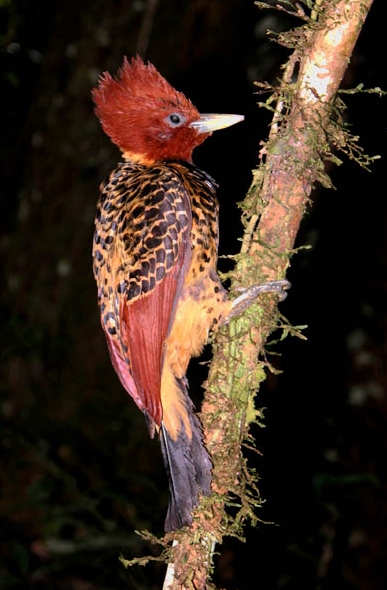
| Appearance | - Both sexes of both subspecies have a rufous-chestnut head. English Wikipedia
- Adult males have a deep red malar patch and a larger red patch on their bushy crest. English Wikipedia
- Females lack the red malar patch and have at most a trace of red on the crest. English Wikipedia
- The species has a cream-buff neck patch extending down the sides of the breast, with a black lower throat and breast. English Wikipedia
- The hindneck and upper back are creamy buff to pale cinnamon-yellow with broad black bars. English Wikipedia
- The bill is pale yellowish or grayish ivory, the iris is deep red-brown, and the legs are olive green to grayish. English Wikipedia
- Juveniles have darker bills, more blackish coloration on the front of the head, and more red on the crown than adults. English Wikipedia
| - Males of all subspecies have a broad, bright red malar area and cheek, whereas females lack red coloration in these areas. English Wikipedia
- Adult nominate-subspecies individuals of both sexes have a buffish-cream forehead, crown, and crest. English Wikipedia
- The nominate subspecies has a deep chestnut-brown chin and throat. English Wikipedia
- The nominate subspecies has deep rufous-chestnut upperparts and a cream-buff rump and uppertail coverts. English Wikipedia
- The nominate subspecies has blackish-brown flight feathers with rufous bars near their bases. English Wikipedia
- The nominate subspecies has wing coverts marked with small white spots. English Wikipedia
- The nominate subspecies has predominantly blackish tail feathers, with some rufous coloration on the outermost pair. English Wikipedia
- The nominate subspecies has dark chestnut-brown underparts, sometimes with a lighter belly and vent. English Wikipedia
- The flanks of the nominate subspecies are creamy cinnamon-buff and often have indistinct darker bars. English Wikipedia
- Adult individuals have an ivory-to-yellow or greenish-yellow bill. English Wikipedia
- Adult individuals have a red-brown to red iris. English Wikipedia
- Adult individuals have olive to dark-gray legs. English Wikipedia
- Juveniles have a dull blackish face and darker mottling on their underparts compared with adults. English Wikipedia
- The hellmayri subspecies is darker overall than the nominate subspecies, particularly on its crown. English Wikipedia
- The deltanus subspecies has a darker crown than hellmayri. English Wikipedia
- The leotaudi subspecies is paler and brighter than the nominate subspecies, with a tawny crown and yellower rump. English Wikipedia
- The jumanus subspecies has a shorter crest, rufous-tipped back feathers, unspotted wing coverts, and more rufous flight feathers than the nominate subspecies. English Wikipedia
- The citreopygius subspecies has a short crest and is generally blacker with less rufous coloration. English Wikipedia
- The species is described as medium-sized and predominantly rufous, with a shaggy crest. ebird.org
|
|---|
| Size | - The Rufous-headed Woodpecker measures approximately 26–28 cm in length. English Wikipedia
- The subspecies Celeus spectabilis exsul weighs approximately 111 g. English Wikipedia
| |
|---|
| Habitat | - The species inhabits humid tropical rainforest, particularly along rivers and on river islands. English Wikipedia
- In Peru and Brazil, the species is often associated with Chusquea and Guadua bamboo. English Wikipedia
- In Ecuador, the species favors landscapes with Cecropia trees and an understorey of Gynerium cane and abundant Heliconia. English Wikipedia
- The species occurs at elevations up to approximately 300 m. English Wikipedia
| - The Chestnut Woodpecker inhabits both the interior and edges of dense and lighter forests. English Wikipedia
- Its forest habitats include terra firme, gallery, and várzea forests. English Wikipedia
- The species also occurs in secondary forests and cocoa plantations. English Wikipedia
- In Venezuela, the species occurs from sea level to elevations of 1,000 m. English Wikipedia
- In Colombia, the species occurs up to 500 m elevation. English Wikipedia
- In Peru, the species occurs up to 1,100 m elevation. English Wikipedia
- In Ecuador, the species occurs up to 700 m elevation, although it is usually found below 500 m. English Wikipedia
|
|---|
| Diet | | - Ants and termites are the primary foods of the Chestnut Woodpecker. English Wikipedia
- Fly larvae and fruit are also significant components of the species' diet. English Wikipedia
|
|---|
| Behaviour | - The species typically forages alone or in pairs. English Wikipedia
- The species forages at all forest levels and on fallen logs. English Wikipedia
- The species probes and forcefully pecks trunks, branches, and bamboo to expose prey. English Wikipedia
- The species remains resident throughout its geographic range throughout the year. English Wikipedia
- Its song consists of a loud squealing call followed by a bubbling series of notes. English Wikipedia
- The species also produces a mewing chuckle. English Wikipedia
- When agitated, the species gives harsh squawks. English Wikipedia
- Its drumming consists of evenly pitched rolls that are loud when produced on hollow bamboo. English Wikipedia
| - The Chestnut Woodpecker is resident throughout its range throughout the year. English Wikipedia
- The species forages alone, in pairs, or in small loose groups. English Wikipedia
- The Chestnut Woodpecker frequently joins mixed-species feeding flocks. English Wikipedia
- The species mainly forages between the understory and sub-canopy, usually on tree trunks and large limbs. English Wikipedia
- The species obtains prey by gleaning it from trees and breaking open arboreal termite nests. English Wikipedia
- Both sexes produce a loud, frequent double-rap drumming sound during the breeding season. English Wikipedia
|
|---|
| Reproduction | - The breeding season in Peru includes at least June through August. English Wikipedia
- One recorded nest was approximately 3 m above the ground in a dead snag. English Wikipedia
- Another recorded nest was approximately 2 m above the ground in a living Cavanillesia tree. English Wikipedia
- One documented nest contained a single chick that was provisioned by a male. English Wikipedia
| - On Trinidad and in French Guiana, the Chestnut Woodpecker breeds in April and May. English Wikipedia
- In Venezuela and northwestern Brazil, the breeding season includes at least January and February. English Wikipedia
- The species excavates its nest cavity in a dead tree or tree stub. English Wikipedia
- The Chestnut Woodpecker lays a clutch of three eggs. English Wikipedia
|
|---|
| Distribution | | - The Chestnut Woodpecker occurs on Trinidad and throughout mainland South America except Argentina, Chile, Paraguay, and Uruguay. English Wikipedia
|
|---|
| Conservation | - The species is classified as Least Concern by the IUCN. English Wikipedia
- The species has a fairly large geographic range, but its population size and population trend are unknown. English Wikipedia
- No immediate threats have been identified for the species. English Wikipedia
- The species is generally rare, although it is not uncommon within its small Brazilian range. English Wikipedia
| - The IUCN classifies the Chestnut Woodpecker as a species of Least Concern. English Wikipedia
- The species has a very large geographic range, but its population size is unknown and believed to be decreasing. English Wikipedia
- No immediate threats to the species have been identified. English Wikipedia
- The species occurs in several protected areas. English Wikipedia
|
|---|
| Similar species | - Kaempfer's Woodpecker was formerly included as a third subspecies of the Rufous-headed Woodpecker. English Wikipedia
| - The subspecies citreopygius and jumanus have been found in some studies to be more closely related to the Blond-crested Woodpecker than to other Chestnut Woodpecker subspecies. English Wikipedia
- The Chestnut Woodpecker is distinguished from the Scale-breasted and Waved Woodpeckers in the eBird description. ebird.org
|
|---|
| Other | - Molecular analysis confirmed reciprocal monophyly between Celeus obrieni and Celeus spectabilis. pmc.ncbi.nlm.nih.gov
- Genetic divergence values support the classification of Celeus obrieni and Celeus spectabilis as independent species. pmc.ncbi.nlm.nih.gov
| No checked fact yet |
|---|