Species · Birds
Rufous-headed Woodpecker Celeus spectabilis
The scientific name of the Rufous-headed Woodpecker is Celeus spectabilis. It is a species of bird in the family Picidae (woodpecker), order Piciformes. The name dates from 1880.
- Scientific name
- Celeus spectabilis P. L. Sclater & Salvin, 1880
- Common name
- Rufous-headed Woodpecker
- Genus
- Celeus
- Family
- Picidae (Woodpecker)
- Order
- Piciformes
- Class
- Aves
- Red List category
- LC Least Concern
- Recorded in
- 5 countries
- Name status
- accepted in the Catalogue of Life
Overview
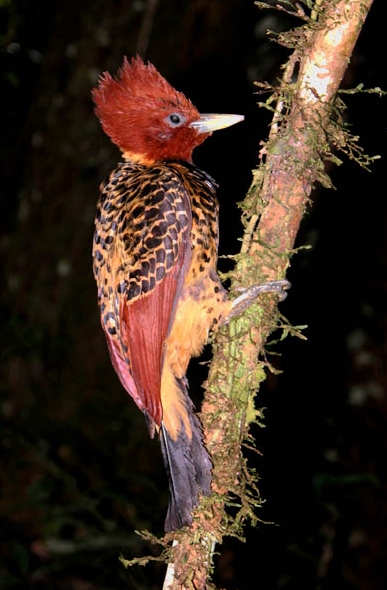
Celeus spectabilis occurs in Bolivia, Brazil, Ecuador, and Peru. Both sexes have a rufous-chestnut head and a cream-buff neck patch extending down the sides of the breast.
Written 26 November 2026 from the sources listed below. Each statement was checked against the passage it cites; statements that could not be supported were removed.
Appearance
The Rufous-headed Woodpecker measures approximately 26–28 cm in length. The subspecies Celeus spectabilis exsul weighs approximately 111 g.[1][2]
Both sexes of both subspecies have a rufous-chestnut head. Adult males have a deep red malar patch and a larger red patch on their bushy crest, while females lack the red malar patch and have at most a trace of red on the crest.[3][4][5]
The species has a cream-buff neck patch extending down the sides of the breast, with a black lower throat and breast. The hindneck and upper back are creamy buff to pale cinnamon-yellow with broad black bars.[6][7]
The bill is pale yellowish or grayish ivory, the iris is deep red-brown, and the legs are olive green to grayish. Juveniles have darker bills, more blackish coloration on the front of the head, and more red on the crown than adults.[8][9]
Habitat
The Rufous-headed Woodpecker inhabits humid tropical rainforest, particularly along rivers and on river islands. It occurs at elevations up to approximately 300 m.[10][11]
In Peru and Brazil, the species is often associated with Chusquea and Guadua bamboo. In Ecuador, it favors landscapes with Cecropia trees and an understorey of Gynerium cane and abundant Heliconia.[12][13]
Diet
The Rufous-headed Woodpecker is believed to feed mainly on bamboo ants. Its diet probably includes insects other than bamboo ants.[14][15]
Behaviour
The species typically forages alone or in pairs, at all forest levels and on fallen logs. It probes and forcefully pecks trunks, branches, and bamboo to expose prey.[16][17][18]
The Rufous-headed Woodpecker remains resident throughout its geographic range throughout the year. Its song consists of a loud squealing call followed by a bubbling series of notes, and it also produces a mewing chuckle.[19][20][21]
When agitated, the species gives harsh squawks. Its drumming consists of evenly pitched rolls that are loud when produced on hollow bamboo.[22][23]
Reproduction and life cycle
The breeding season in Peru includes at least June through August. One recorded nest was approximately 3 m above the ground in a dead snag, while another was approximately 2 m above the ground in a living Cavanillesia tree.[24][25][26]
One documented nest contained a single chick that was provisioned by a male.[27]
Conservation
The Rufous-headed Woodpecker is classified as Least Concern by the IUCN. It has a fairly large geographic range, but its population size and population trend are unknown.[28][29]
No immediate threats have been identified for the species. It is generally rare, although it is not uncommon within its small Brazilian range.[30][31]
Similar species
Kaempfer's Woodpecker was formerly included as a third subspecies of the Rufous-headed Woodpecker.[32]
Molecular analysis confirmed reciprocal monophyly between Celeus obrieni and Celeus spectabilis. Genetic divergence values support their classification as independent species.[33][34]
Classification of the Rufous-headed Woodpecker
| Kingdom | Animalia |
|---|---|
| Phylum | Chordata |
| Subphylum | Vertebrata |
| Infraphylum | Gnathostomata |
| Parvphylum | Osteichthyes |
| Megaclass | Tetrapoda |
| Class | Aves (Bird) |
| Order | Piciformes (Woodpeckers) |
| Family | Picidae (Woodpecker) |
| Subfamily | Picinae |
| Genus | Celeus (Neotropical Crested Woodpeckers) |
| Species | Celeus spectabilis P. L. Sclater & Salvin, 1880 |
Where the Rufous-headed Woodpecker is found
Checklists and occurrence records place Celeus spectabilis in 5 countries across South America. GBIF holds 1,994 georeferenced records of it.
Countries
Regions and cities with the most records
- Madre de Dios, Peru 598
- Sucumbíos, Ecuador 258
- Acre, Brazil 236
- Orellana Province, Ecuador 195
- Putumayo Department, Colombia 187
- Napo, Ecuador 144
- Cuzco Department, Peru 141
- Puerto Asís, Colombia 114
- Tambopata, Peru 105
- Tena, Ecuador 70
- Rio Branco, Brazil 58
- Loreto, Peru 48
- Puerto Maldonado, Peru 48
- Cauca Department, Colombia 45
- San Martín Department, Peru 29
- Senador Guiomard, Brazil 27
- Ucayali, Peru 20
- Rioja, Peru 19
- Nueva Loja, Ecuador 18
- Morona-Santiago Province, Ecuador 12
- Pastaza Province, Ecuador 11
- Requena, Peru 9
- La Paz Department, Bolivia 8
- Moyobamba, Peru 7
- Puerto Francisco de Orellana, Ecuador 7
- Boca Suno, Ecuador 5
- Caquetá, Colombia 5
- Cochabamba, Bolivia 5
- Pando, Bolivia 5
- Amazonas, Peru 4
- Beni Department, Bolivia 4
- Huánuco Department, Peru 4
- Iquitos, Peru 4
- Pucallpa, Peru 4
- San Fernando, Peru 4
- San Juan, Peru 4
Range as the checklists state it
South America
A number beside a place is its count of GBIF occurrence records. A place without a number comes from a checklist alone. Records show where a species has been observed or collected, which can include escapes and vagrants.
Common names
English
- Rufous-headed Woodpecker
Names in 24 other languages
- Catalan
- picot de cap rogenc
- Chinese
- 棕头啄木鸟, 棕頭啄木
- Croatian
- smeđokrila žuna
- Czech
- datel rezavohlavý
- Danish
- Rødtoppet Spætte
- Dutch
- Oranjekopspecht
- Esperanto
- rufkapa pego
- Estonian
- bambuse-tutträhn
- Finnish
- keikaritikka
- French
- Pic à tête rousse
- German
- Zimtkopfspecht
- Italian
- Picchio testarossiccia
- Japanese
- ムナグロテンニョゲラ
- Lithuanian
- rausvagalvis kuoduotasis genys
- Norwegian
- fakkelspett
- Polish
- dzięcioł rdzawoczuby
- Portuguese
- pica-pau-de-cabeça-ruiva, pica-pau-lindo
- Russian
- Рыжеголовый дятел-гренадер, Рыжеголовый целеус
- Slovak
- vlikáč ozdobný
- Spanish
- Carpintero cabecirrufo, carpintero de cabeza rufa
- Swedish
- fackelspett, rödtofsad kastanjespett
- Turkish
- Kızıl Kafalı Ağaçkakan
- Ukrainian
- ятла рудоголова
- Welsh
- cnocell benwinau
Synonyms
One other scientific name has been used for this species and is now treated as a synonym of Celeus spectabilis.
- Celeus spectabalis spectabalis Salvin, O; Sclater, PL, 1880
Subspecies and varieties
- Celeus spectabilis exsul subspecies
- Celeus spectabilis spectabilis subspecies
Related species
-
 Chestnut-colored WoodpeckerCeleus castaneus
-
 Cream-colored WoodpeckerCeleus flavus
-
 Blond-crested WoodpeckerCeleus flavescens
-
 Chestnut WoodpeckerCeleus elegans
-
 Cinnamon WoodpeckerCeleus loricatus
-
 Helmeted WoodpeckerCeleus galeatus
-
 Waved WoodpeckerCeleus undatus
-
 Ringed WoodpeckerCeleus torquatus
Compare
Questions and answers
What is the scientific name of the Rufous-headed Woodpecker?
The scientific name of the Rufous-headed Woodpecker is Celeus spectabilis. Written with its author, the full name is Celeus spectabilis P. L. Sclater & Salvin, 1880.
Which family does the Rufous-headed Woodpecker belong to?
Celeus spectabilis belongs to the family Picidae, in the order Piciformes and the class Aves.
Where is the Rufous-headed Woodpecker found?
Checklists and occurrence records place Celeus spectabilis in 5 countries: Peru, Ecuador, Brazil, Colombia and Bolivia.
What is the conservation status of the Rufous-headed Woodpecker?
The IUCN Red List category recorded for Celeus spectabilis is Least Concern (LC).
Sources
Passages the profile rests on
- The Rufous-headed Woodpecker measures approximately 26–28 cm in length. Source passage: “The rufous-headed woodpecker is about 26 to 28 cm (10 to 11 in) long.” — English Wikipedia
- The subspecies Celeus spectabilis exsul weighs approximately 111 g. Source passage: “Subspecies C. s. exsul weighs about 111 g (3.9 oz)” — English Wikipedia
- Both sexes of both subspecies have a rufous-chestnut head. Source passage: “Both sexes of both subspecies have a rufous-chestnut head.” — English Wikipedia
- Adult males have a deep red malar patch and a larger red patch on their bushy crest. Source passage: “Adult males of both subspecies have a deep red malar patch and a larger one on their bushy crest” — English Wikipedia
- Females lack the red malar patch and have at most a trace of red on the crest. Source passage: “females do not have the red malar and have at most a trace of red on the crest.” — English Wikipedia
- The species has a cream-buff neck patch extending down the sides of the breast, with a black lower throat and breast. Source passage: “They have a cream-buff patch low on the neck that extends down the side of the breast and a black lower throat and breast.” — English Wikipedia
- The hindneck and upper back are creamy buff to pale cinnamon-yellow with broad black bars. Source passage: “Their hindneck and upper back are creamy buff to pale cinnamon-yellow with very wide black bars.” — English Wikipedia
- The bill is pale yellowish or grayish ivory, the iris is deep red-brown, and the legs are olive green to grayish. Source passage: “Both subspecies' bills are pale yellowish or grayish ivory, their iris deep red-brown, and their legs olive green to grayish.” — English Wikipedia
- Juveniles have darker bills, more blackish coloration on the front of the head, and more red on the crown than adults. Source passage: “Juveniles resemble adults but have a darker bill, more blackish on the front of the head, and more red on the crown.” — English Wikipedia
- The species inhabits humid tropical rainforest, particularly along rivers and on river islands. Source passage: “The species inhabits humid tropical rainforest, usually along rivers and on their islands.” — English Wikipedia
- The species occurs at elevations up to approximately 300 m. Source passage: “In elevation it ranges only as high as about 300 m (1,000 ft).” — English Wikipedia
- In Peru and Brazil, the species is often associated with Chusquea and Guadua bamboo. Source passage: “In Peru and Brazil it is often associated with Chusquea and Guadua bamboo” — English Wikipedia
- In Ecuador, the species favors landscapes with Cecropia trees and an understorey of Gynerium cane and abundant Heliconia. Source passage: “in Ecuador if favors landscapes with Cecropia trees, and an understorey of Gynerium cane with much Heliconia.” — English Wikipedia
- The species is believed to feed mainly on bamboo ants. Source passage: “The rufous-headed woodpecker is believed to feed mainly on bamboo ants” — English Wikipedia
- Its diet probably includes insects other than bamboo ants. Source passage: “though its diet probably includes other insects as well.” — English Wikipedia
- The species typically forages alone or in pairs. Source passage: “It typically forages singly or in pairs” — English Wikipedia
- The species forages at all forest levels and on fallen logs. Source passage: “at any level of the forest and also on fallen logs.” — English Wikipedia
- The species probes and forcefully pecks trunks, branches, and bamboo to expose prey. Source passage: “It probes and very forcefully pecks at trunks, branches, and bamboo to reveal its prey.” — English Wikipedia
- The species remains resident throughout its geographic range throughout the year. Source passage: “The rufous-headed woodpecker is a year-round resident throughout its range.” — English Wikipedia
- Its song consists of a loud squealing call followed by a bubbling series of notes. Source passage: “a loud squealing 'skweeah' followed by bubbling 'kluh-kluh-kluh-kluh-kluh' series” — English Wikipedia
- The species also produces a mewing chuckle. Source passage: “a mewing chuckle, 'wur-hee-hrr-hrr-hrr'” — English Wikipedia
- When agitated, the species gives harsh squawks. Source passage: “when agitated 'harsh squawks'.” — English Wikipedia
- Its drumming consists of evenly pitched rolls that are loud when produced on hollow bamboo. Source passage: “It drums 'rolls being evenly pitched' and loud when the substrate is hollow bamboo.” — English Wikipedia
- The breeding season in Peru includes at least June through August. Source passage: “The rufous-headed woodpecker's breeding season in Peru includes at least from June to August” — English Wikipedia
- One recorded nest was approximately 3 m above the ground in a dead snag. Source passage: “one was about 3 m (10 ft) up in a dead snag” — English Wikipedia
- Another recorded nest was approximately 2 m above the ground in a living Cavanillesia tree. Source passage: “the other about 2 m (7 ft) up in a live Cavanillesia tree.” — English Wikipedia
- One documented nest contained a single chick that was provisioned by a male. Source passage: “The second held one chick that was being provisioned by a male.” — English Wikipedia
- The species is classified as Least Concern by the IUCN. Source passage: “The IUCN has assessed the rufous-headed woodpecker as being of Least Concern.” — English Wikipedia
- The species has a fairly large geographic range, but its population size and population trend are unknown. Source passage: “It has a fairly large range but its population size and trend are not known.” — English Wikipedia
- No immediate threats have been identified for the species. Source passage: “No immediate threats have been identified.” — English Wikipedia
- The species is generally rare, although it is not uncommon within its small Brazilian range. Source passage: “It is considered generally rare though not uncommon in its small Brazilian range.” — English Wikipedia
- Kaempfer's Woodpecker was formerly included as a third subspecies of the Rufous-headed Woodpecker. Source passage: “What is now Kaempfer's woodpecker (C. obrieni) was included as a third subspecies until the early 2000s.” — English Wikipedia
- Molecular analysis confirmed reciprocal monophyly between Celeus obrieni and Celeus spectabilis. Source passage: “The results confirm the reciprocal monophyly between the specimens of C. obrieni and C. spectabilis.” — pmc.ncbi.nlm.nih.gov
- Genetic divergence values support the classification of Celeus obrieni and Celeus spectabilis as independent species. Source passage: “The genetic divergence values for the two taxa also support their classification as independent species” — pmc.ncbi.nlm.nih.gov
Data
- Catalogue of Life, 2026-10-16 XR cc by
- Global Biodiversity Information Facility CC BY 4.0
- Wikidata CC0
- GeoNames CC BY 4.0
- Wikimedia Commons per image; credit shown with each image
- Within the Catalogue of Life, this name comes from The Integrated Taxonomic Information System cc0
References
- On New Birds Collected by Mr. C. Buckley in Eastern Ecuador. (1880). Proceedings of the Zoological Society, 1880, 155–161. https://doi.org/10.1111/j.1469-7998.1880.tb06545.x Link where the name was published
- Gill, Frank, & and Minturn Wright. (2006). Birds of the World: Recommended English Names.
This species in other databases
Page built on 27 November 2026. See how the catalog is made and all sources and licences.
Cite this page
ScientificNames.org. (2026). Celeus spectabilis (Rufous-headed Woodpecker). Retrieved November 27, 2026, from https://scientificnames.org/species/celeus-spectabilis
“Celeus spectabilis (Rufous-headed Woodpecker).” ScientificNames.org, 2026, scientificnames.org/species/celeus-spectabilis. Accessed 27 Nov. 2026.
ScientificNames.org. “Celeus spectabilis (Rufous-headed Woodpecker).” Accessed November 27, 2026. https://scientificnames.org/species/celeus-spectabilis.
@misc{scientificnames_celeus_spectabilis_rufous_headed_woodpecker,
  author = {{ScientificNames.org}},
  title = {Celeus spectabilis (Rufous-headed Woodpecker)},
  year = {2026},
  url = {https://scientificnames.org/species/celeus-spectabilis},
  note = {Accessed 2026-11-27}
}