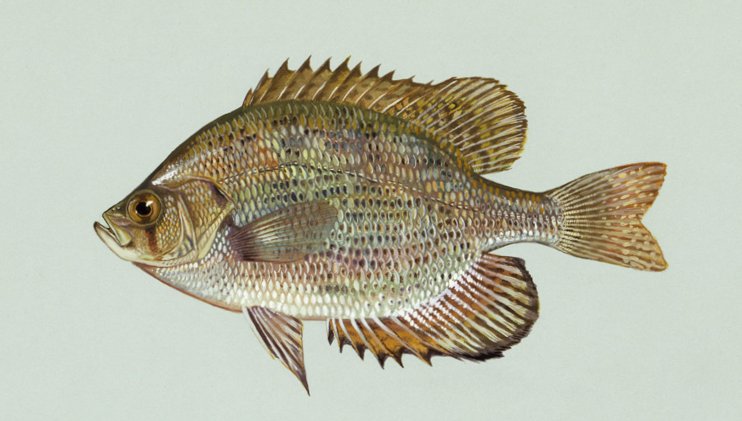
| Appearance | - The flier has a strongly compressed body and a moderately sized oblique mouth. English Wikipedia
- The dorsal fin has 11–13 spines and 12–14 soft rays. English Wikipedia
- The anal fin has 7–8 spines and 13–15 soft rays. English Wikipedia
- The flier has olive upperparts, a pale underside, and scattered dark spots along its flanks. English Wikipedia
- A dark vertical marking extends through the eye and continues below it in a teardrop pattern. English Wikipedia
- Individuals shorter than approximately 45 mm standard length have a dark dorsal-fin eyespot with a reddish margin. English Wikipedia
- The pectoral and pelvic fins are dusky and have paler reticulations. English Wikipedia
| - The smallmouth bass has a slender, muscular, elongated body adapted for powerful swimming. English Wikipedia
- Its dorsal coloration ranges from golden-olive to dark brown and fades to yellowish white on the underside. English Wikipedia
- Its body typically has dark brown vertical bars or blotches, while its head has dark brown horizontal bars. English Wikipedia
- The protruding jaw generally does not extend behind the eyes, which are red or brown. English Wikipedia
- The fish has two dorsal fins separated by a shallow notch, with 9–11 spiny rays in the front fin and 13–15 soft rays in the rear fin. English Wikipedia
- Its sides have golden flecks on most scales and vertical bars that may be broken or vary in visibility. dfo-mpo.gc.ca
- Its dorsal fins appear joined together as one fin. dfo-mpo.gc.ca
- Its body colour becomes darker with more pronounced contrasting markings in clear water and lighter with less distinct markings in cloudy water. dfo-mpo.gc.ca
|
|---|
| Size | | |
|---|
| Habitat | - Flier inhabit clear, acidic waters in swamp ponds, sloughs, oxbows, and slow-flowing creeks and streams. English Wikipedia
- Flier habitats generally have heavy vegetation and average water temperatures of 23–29 °C. English Wikipedia
- In Virginia, flier commonly occupy dark, tannic, acidic backwaters in coastal swamps, creeks, ponds, and canals. dwr.virginia.gov
- Flier in Virginia are associated with low-gradient tributaries in the coastal plain. dwr.virginia.gov
- Flier in Virginia thrive in areas with thick vegetation and can tolerate low dissolved oxygen levels. dwr.virginia.gov
- Riparian protection and vegetation cover are optimal habitat features for Virginia's swamp-dwelling flier. dwr.virginia.gov
| - The species typically inhabits cool, clear rivers and lakes with rocky or sandy substrates. animaldiversity.org
- It prefers cool water and commonly occupies shoals, submerged logs, and moderately shallow rocky or sandy areas. dfo-mpo.gc.ca
- In streams, the species typically occupies areas with relatively swift currents. animaldiversity.org
- In lakes, it uses structures such as logs, rocky outcroppings, and pier posts as habitat. animaldiversity.org
- The species is seldom found in dense aquatic vegetation. dfo-mpo.gc.ca
|
|---|
| Diet | - Flier feed primarily on invertebrates, including insects, snails, worms, and leeches. English Wikipedia
- Flier also consume smaller fishes and some phytoplankton. English Wikipedia
- The diet of flier in Virginia includes insect larvae, small crustaceans, worms, small fishes, and algae. dwr.virginia.gov
| - Its diet includes crayfish, amphibians, insects, and smaller fish. English Wikipedia
- Smallmouth bass also consume tadpoles, frogs, and plant material. dfo-mpo.gc.ca
- Fry and juveniles primarily feed on zooplankton and insect larvae. animaldiversity.org
- Adults sometimes consume the young of other parents belonging to their species. animaldiversity.org
|
|---|
| Behaviour | No checked fact yet | - Smallmouth bass are highly visual predators that actively seek clear water. animaldiversity.org
- Individual fish may occupy territories extending several hundred yards and containing multiple large structures used as cover. animaldiversity.org
- When water temperatures fall below 16 °C, smallmouth bass often migrate towards deeper pools and enter a semi-hibernation state. English Wikipedia
- During cold-weather semi-hibernation, the fish move sluggishly and feed very little. English Wikipedia
- Individual smallmouth bass may travel 12 miles in a single day in a stream, creek, or river. English Wikipedia
|
|---|
| Reproduction | - Flier breeding normally takes place between March and May when water temperatures reach 14–17 °C. English Wikipedia
- Breeding has been recorded as early as February. English Wikipedia
- Gravid females have been collected from debris-filled ditches with soft bottoms, gravel-bottomed streams, and vegetated sand and gravel pits. English Wikipedia
- Flier spawn in conditions ranging from clear or turbid flowing water to stagnant ditches and pools. English Wikipedia
- Flier construct nests among rocks or gravel and enclose their eggs in a round adhesive envelope. English Wikipedia
- Flier are colonial nesters and establish closely spaced nests in aggregations. English Wikipedia
- Flier reach sexual maturity at approximately one year of age and 70 mm in length. English Wikipedia
- Male flier guard eggs and newly hatched fry. English Wikipedia
- In Virginia, flier spawn in spring, sometimes beginning in February when water temperatures reach 55°F. dwr.virginia.gov
- Male flier build nests and defend nesting sites and newly hatched young territorially. dwr.virginia.gov
| - Smallmouth bass generally begin spawning in spring or early summer when water temperatures reach 15–18 °C. English Wikipedia
- Successful spawning requires a clean substrate consisting of stone, rock, or gravel. English Wikipedia
- Females can lay as many as 21,100 eggs, which males guard in their nests. English Wikipedia
- Males excavate and guard small, round nests. animaldiversity.org
- Females may deposit eggs in the nests of several different males, while several females may also spawn in one male's nest. animaldiversity.org
- Females lay more than 2,000 eggs during each spawning event. animaldiversity.org
- Smallmouth bass eggs typically hatch within four to six days. animaldiversity.org
- Newly hatched fry remain in the nest for approximately two weeks before dispersing. animaldiversity.org
- Male smallmouth bass are solely responsible for parental care and guard both eggs and fry. animaldiversity.org
|
|---|
| Lifespan | No checked fact yet | |
|---|
| Distribution | No checked fact yet | - The native range includes the upper and middle Mississippi River basin, the Saint Lawrence River–Great Lakes system, the Champlain Valley, and the Hudson Bay basin. English Wikipedia
|
|---|
| Conservation | No checked fact yet | - Smallmouth bass is not considered a conservation concern. animaldiversity.org
- Accidental introductions through live-bait use and unauthorized transfers between waterbodies contribute to the species' recent spread. dfo-mpo.gc.ca
|
|---|
| Uses | No checked fact yet | |
|---|
| Similar species | No checked fact yet | - The largemouth bass (Micropterus salmoides), spotted bass (Micropterus punctulatus), and Coosa bass (Micropterus coosae) are identified as similar species. animaldiversity.org
|
|---|
| Other | | No checked fact yet |
|---|