Comparison
Long-wattled Umbrellabird vs Capuchinbird
Long-wattled Umbrellabird (Cephalopterus penduliger) and Capuchinbird (Perissocephalus tricolor) both belong to the family Cotingidae (contingas) and part ways below it. Both are recorded in 1 country.
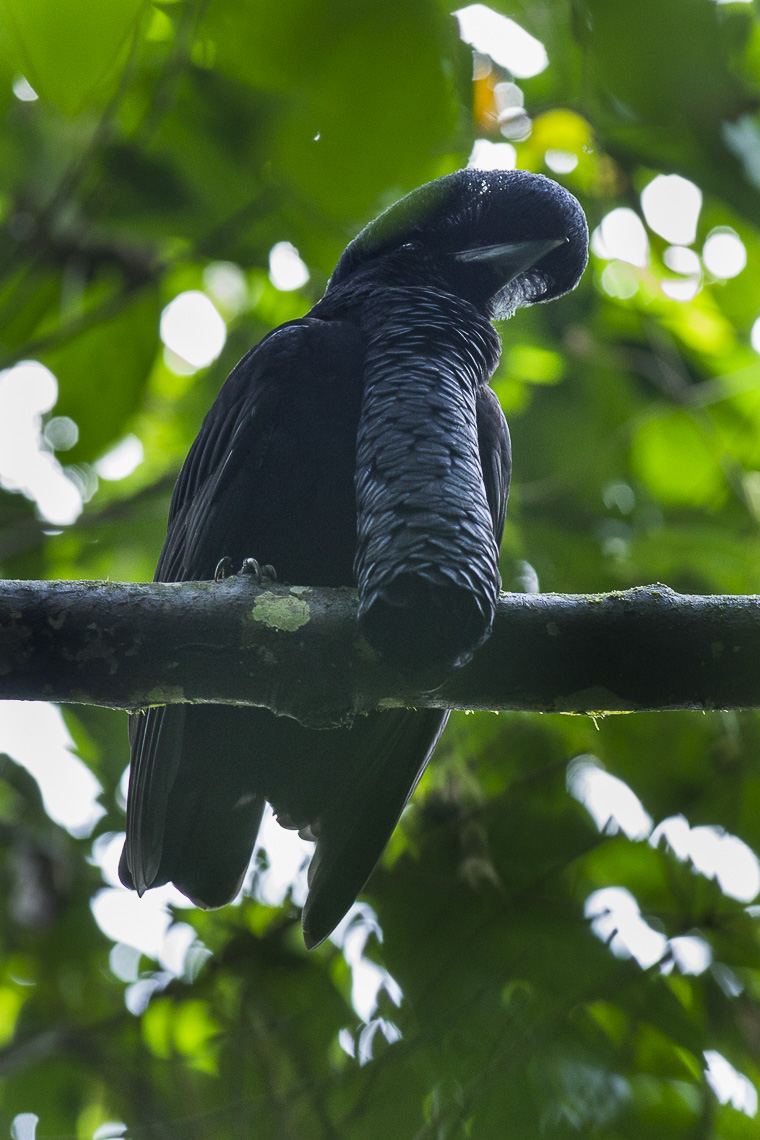
Long-wattled Umbrellabird
Cephalopterus penduliger
Francesco Veronesi from Italy, CC BY-SA 2.0, via Wikimedia Commons


Side by side
| Long-wattled Umbrellabird | Capuchinbird | |
|---|---|---|
| Scientific name | Cephalopterus penduliger P. L. Sclater, 1859 | Perissocephalus tricolor (P. L. S. Müller, 1776) |
| English name | Long-wattled Umbrellabird | Capuchinbird |
| Group | Birds | Birds |
| Class | Aves Bird | Aves Bird |
| Order | Passeriformes Passerine | Passeriformes Passerine |
| Family | Cotingidae Contingas | Cotingidae Contingas |
| Genus | Cephalopterus Umbrellabird | Perissocephalus |
| Named in | 1859 | 1776 |
| Red List category | Vulnerable | Least Concern |
| Countries on record | 2 countries | 6 countries |
| GBIF occurrence records | 3,989 records | 3,241 records |
Rows where the two agree are shown in grey.
Where each is found
Both recorded in 1 country
Only Long-wattled Umbrellabird (1)
Only Capuchinbird (5)
From Catalogue of Life checklists and GBIF occurrence records. A country missing from a list means no record is held, which is not proof of absence.
Checked facts
| Long-wattled Umbrellabird | Capuchinbird | |
|---|---|---|
| Appearance |
|
|
| Size |
|
|
| Habitat |
|
|
| Diet |
|
|
| Behaviour |
|
|
| Reproduction |
|
|
| Distribution |
|
|
| Conservation |
|
|
| Name origin |
| No checked fact yet |
| Other |
| No checked fact yet |
In brief
Long-wattled Umbrellabird
Cephalopterus penduliger inhabits humid to wet premontane and cloud forests, as well as humid montane forests at elevations of 1,500–1,800 m above sea level. Males are distinguished by a prominent feathered throat wattle that can be retracted during flight. Full profile
Capuchinbird
Perissocephalus tricolor occurs in northeastern South America, almost entirely north of the Amazon River and east of the Rio Negro, and inhabits humid forests at elevations reaching 1,400 metres. It is the largest suboscine passerine apart from the Amazonian and long-wattled umbrellabirds. Full profile
Compare something else
Page built on 29 November 2026 from the data on the two species pages, where every source is listed.
Cite this page
ScientificNames.org. (2026). Long-wattled Umbrellabird vs Capuchinbird. Retrieved November 29, 2026, from https://scientificnames.org/compare/long-wattled-umbrellabird-vs-capuchinbird
“Long-wattled Umbrellabird vs Capuchinbird.” ScientificNames.org, 2026, scientificnames.org/compare/long-wattled-umbrellabird-vs-capuchinbird. Accessed 29 Nov. 2026.
ScientificNames.org. “Long-wattled Umbrellabird vs Capuchinbird.” Accessed November 29, 2026. https://scientificnames.org/compare/long-wattled-umbrellabird-vs-capuchinbird.
@misc{scientificnames_long_wattled_umbrellabird_vs_capuchinbird,
  author = {{ScientificNames.org}},
  title = {Long-wattled Umbrellabird vs Capuchinbird},
  year = {2026},
  url = {https://scientificnames.org/compare/long-wattled-umbrellabird-vs-capuchinbird},
  note = {Accessed 2026-11-29}
}