Species · Birds
Capuchinbird Perissocephalus tricolor
The scientific name of the Capuchinbird is Perissocephalus tricolor. It is a species of bird in the family Cotingidae (contingas), order Passeriformes. The name dates from 1776.
- Scientific name
- Perissocephalus tricolor (P. L. S. Müller, 1776)
- Common name
- Capuchinbird
- Genus
- Perissocephalus
- Family
- Cotingidae (Contingas)
- Order
- Passeriformes
- Class
- Aves
- Red List category
- LC Least Concern
- Recorded in
- 6 countries
- Name status
- accepted in the Catalogue of Life

Overview
Perissocephalus tricolor occurs in northeastern South America, almost entirely north of the Amazon River and east of the Rio Negro, and inhabits humid forests at elevations reaching 1,400 metres. It is the largest suboscine passerine apart from the Amazonian and long-wattled umbrellabirds.
Written 26 November 2026 from the sources listed below. Each statement was checked against the passage it cites; statements that could not be supported were removed.
Appearance
The Capuchinbird has a large, thick-set body and a relatively heavy bill. Adults have predominantly rich brown plumage, with orange tones on the belly and undertail coverts, black flight feathers and a short black tail.[1][2][3]
Its head is bare and covered in dull blue skin. Juveniles resemble adults but have some downy feathers on their heads.[4][5]
Habitat
The Capuchinbird inhabits humid forests at elevations reaching 1,400 metres. Most individuals occur in forests below 600 metres.[6][7]
It occurs in northeastern South America, almost entirely north of the Amazon River and east of the Rio Negro. Its recorded distribution includes Colombia, Venezuela, Brazil and the Guianas.[8][9]
Diet
Capuchinbirds feed mainly on fruits and insects.[10]
Behaviour
Capuchinbirds gather in leks and produce unusual vocalizations described as singing. Their song has been compared to the distant sound of a chainsaw and to the sound of a young cow mooing.[11][12][13]
Reproduction and life cycle
The Capuchinbird builds a small and rather scanty nest. Nests are normally located close to the lek.[14][15]
Conservation
The Capuchinbird has a very wide geographical distribution. Although uncommon, it has an estimated large total population.[16][17]
Its population may be declining slightly because of deforestation. The species is classified as least concern by the International Union for Conservation of Nature.[18][19]
Classification of the Capuchinbird
| Kingdom | Animalia |
|---|---|
| Phylum | Chordata |
| Subphylum | Vertebrata |
| Infraphylum | Gnathostomata |
| Parvphylum | Osteichthyes |
| Megaclass | Tetrapoda |
| Class | Aves (Bird) |
| Order | Passeriformes (Passerine) |
| Family | Cotingidae (Contingas) |
| Genus | Perissocephalus |
| Species | Perissocephalus tricolor (P. L. S. Müller, 1776) |
Where the Capuchinbird is found
Checklists and occurrence records place Perissocephalus tricolor in 6 countries across South America. GBIF holds 3,241 georeferenced records of it.
Countries
Regions and cities with the most records
- Amazonas, Brazil 605
- Sipaliwini District, Suriname 451
- Upper Takutu-Upper Essequibo, Guyana 429
- Potaro-Siparuni, Guyana 336
- Guainía Department, Colombia 292
- Presidente Figueiredo, Brazil 229
- Bolívar, Venezuela 226
- Amapá, Brazil 122
- Pedra Branca do Amapari, Brazil 57
- Roraima, Brazil 47
- Brokopondo District, Suriname 41
- Pará, Brazil 28
- Cuyuni-Mazaruni, Guyana 23
- Manaus, Brazil 20
- Laranjal do Jari, Brazil 18
- Matoury, French Guiana 17
- Oiapoque, Brazil 14
- Porto Grande, Brazil 13
- Para District, Suriname 11
- Caracaraí, Brazil 9
- Rémire-Montjoly, French Guiana 8
- Cayenne, French Guiana 7
- Kourou, French Guiana 7
- Novo Airão, Brazil 7
- Barima-Waini, Guyana 5
- Cantá, Brazil 5
- El Dorado, Venezuela 5
- Saint-Laurent-du-Maroni, French Guiana 5
- Amazonas, Venezuela 4
- Upper Demerara-Berbice, Guyana 4
Range as the checklists state it
South America
A number beside a place is its count of GBIF occurrence records. A place without a number comes from a checklist alone. Records show where a species has been observed or collected, which can include escapes and vagrants.
Common names
English
- Capuchinbird
- Calfbird
Names in 25 other languages
- Arabic
- طائر العجل, طائر الكابوشين
- Catalan
- Ocell caputxí, cotinga caputxí
- Chinese
- 三色伞鸟, 斗蓬雀
- Croatian
- gologlava kotinga
- Czech
- kotinga tříbarvá
- Danish
- Kapucinerfugl
- Dutch
- Capuchonvogel
- Esperanto
- kapucenkotingo
- Finnish
- härkäkotinga
- French
- Coracine chauve, Piauhau chauve
- German
- Kapuzinerkotinga, Kapuzinervogel
- Hungarian
- kapucinusmadár
- Italian
- Cappuccino
- Japanese
- ハゲガオカザリドリ
- Lithuanian
- kapucininė kotinga
- Norwegian
- kapusinerkotinga
- Polish
- kapucyn
- Portuguese
- Ave-capuchinha, Capuchinha, Pássaro-boi, ave-monge, maú
- Russian
- Птица-капуцин
- Slovak
- vranuša kapucínka
- Spanish
- Cotinga capuchino, Pájaro capuchino, Pájaro-capuchino
- Swedish
- kapucinfågel
- Turkish
- Danakuşu
- Ukrainian
- котинга-капуцин
- Welsh
- aderyn trilliw penfoel
Synonyms
4 other scientific names have been used for this species and are now treated as synonyms of Perissocephalus tricolor.
- Ampelis grandis Temminck, CJ, 1807
- Corvus calvus Gmelin, JF, 1788
- Corvus tricolor P. L. S. Müller, 1776
- Perissacephalus tricolor Müller, PLS, 1776
Related species
-
 Andean Cock-of-the-rockRupicola peruvianus
-
 White BellbirdProcnias albus
-
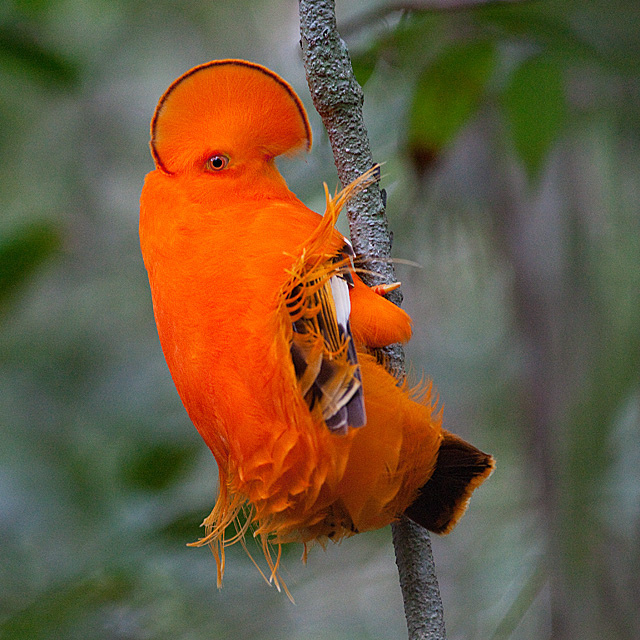 Guianan Cock-of-the-rockRupicola rupicola
-
 Screaming PihaLipaugus vociferans
-
 Bare-throated BellbirdProcnias nudicollis
-
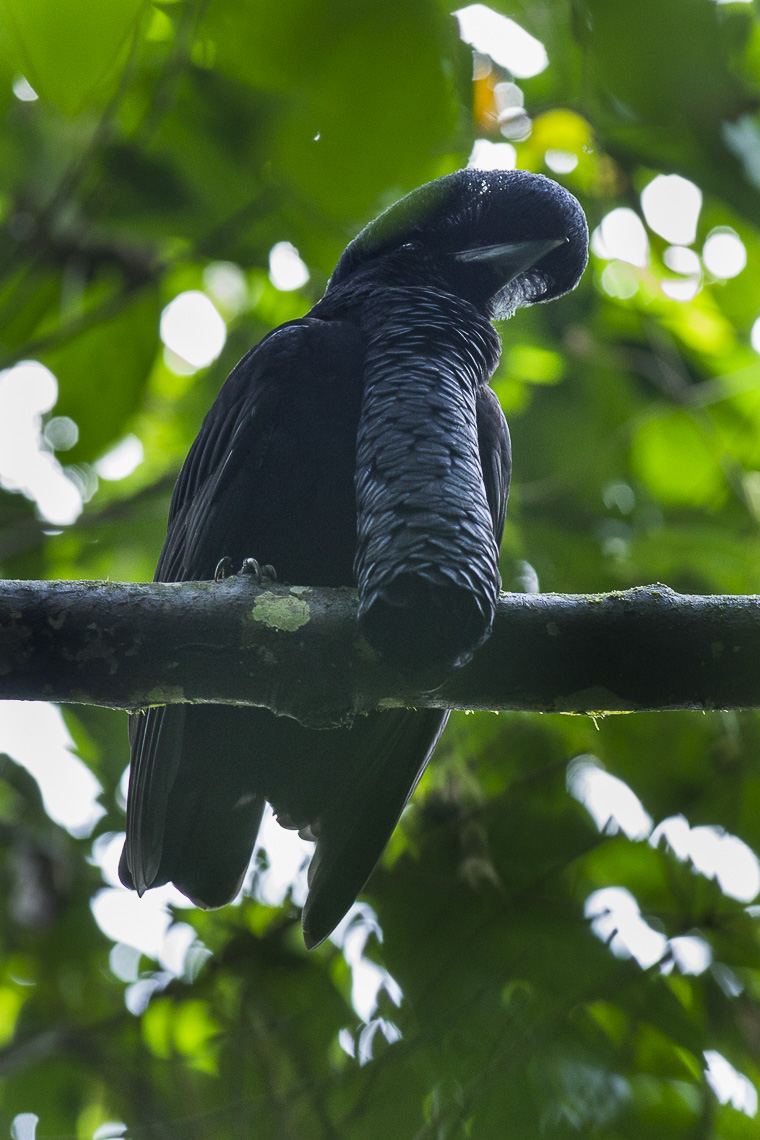 Long-wattled UmbrellabirdCephalopterus penduliger
-
 Three-wattled BellbirdProcnias tricarunculatus
-
 Amazonian UmbrellabirdCephalopterus ornatus
Compare
Questions and answers
What is the scientific name of the Capuchinbird?
The scientific name of the Capuchinbird is Perissocephalus tricolor. Written with its author, the full name is Perissocephalus tricolor (P. L. S. Müller, 1776).
Which family does the Capuchinbird belong to?
Perissocephalus tricolor belongs to the family Cotingidae, in the order Passeriformes and the class Aves.
Where is the Capuchinbird found?
Checklists and occurrence records place Perissocephalus tricolor in 6 countries: Brazil, Guyana, Suriname, French Guiana, Colombia and Venezuela.
What is the conservation status of the Capuchinbird?
The IUCN Red List category recorded for Perissocephalus tricolor is Least Concern (LC).
What other names does the Capuchinbird have?
Perissocephalus tricolor is also known in English as Calfbird.
Where do capuchin birds live?
Capuchinbirds occur in northeastern South America, almost entirely north of the Amazon River and east of the Rio Negro. Their recorded distribution includes Colombia, Venezuela, Brazil and the Guianas. They inhabit humid forests at elevations reaching 1,400 metres, although most occur below 600 metres.[6][7][8][9]
What is the main diet of birds?
Capuchinbirds feed mainly on fruits and insects.[10]
Sources
Passages the profile rests on
- The capuchinbird has a large, thick-set body and a relatively heavy bill. Source passage: “The capuchinbird is a large thick-set suboscine passerine with a relatively heavy bill.” — English Wikipedia
- Adult capuchinbirds have predominantly rich brown plumage, with orange tones on the belly and undertail coverts. Source passage: “Its plumage is overall rich brown, approaching orange on the belly and undertail coverts” — English Wikipedia
- The capuchinbird has black flight feathers and a short black tail. Source passage: “the remiges and short tail are black.” — English Wikipedia
- The capuchinbird has a bare head covered in dull blue skin. Source passage: “The most distinctive feature is its bare, almost vulture-like head covered in dull blue skin.” — English Wikipedia
- Juvenile capuchinbirds resemble adults but have some downy feathers on their heads. Source passage: “Juveniles resemble adults, with the exception of some downy feathers on the head.” — English Wikipedia
- The capuchinbird inhabits humid forests at elevations reaching 1,400 metres. Source passage: “found in humid forests (up to 1,400 metres (4,600 ft)” — English Wikipedia
- Most capuchinbirds occur in forests below 600 metres in elevation. Source passage: “but mostly below 600 m” — English Wikipedia
- The capuchinbird occurs in northeastern South America, almost entirely north of the Amazon River and east of the Rio Negro. Source passage: “in north-eastern South America, almost entirely north of the Amazon River and east of Rio Negro” — English Wikipedia
- The capuchinbird's recorded distribution includes Colombia, Venezuela, Brazil and the Guianas. Source passage: “(Colombia, Venezuela, Brazil and The Guianas).” — English Wikipedia
- Capuchinbirds feed mainly on fruits and insects. Source passage: “Capuchinbirds eat mainly fruits and insects.” — English Wikipedia
- Capuchinbirds gather in leks and produce unusual vocalizations described as singing. Source passage: “They gather in leks where they "sing".” — English Wikipedia
- The capuchinbird's song has been compared to the distant sound of a chainsaw. Source passage: “although some have compared it to the distant sound of a chainsaw” — English Wikipedia
- The capuchinbird's vocalization has also been compared to the sound of a young cow mooing. Source passage: “or (as indicated by its alternative name "calfbird") a young cow mooing.” — English Wikipedia
- The capuchinbird builds a small and rather scanty nest. Source passage: “The nest is small and rather scanty” — English Wikipedia
- Capuchinbird nests are normally located close to the lek. Source passage: “and is normally found in close proximity to the lek.” — English Wikipedia
- The capuchinbird has a very wide geographical distribution. Source passage: “The capuchinbird has a very wide distribution” — English Wikipedia
- Although uncommon, the capuchinbird has an estimated large total population. Source passage: “although it is an uncommon bird, its total population is estimated to be large.” — English Wikipedia
- The capuchinbird population may be declining slightly because of deforestation. Source passage: “The population may be in slight decline because of deforestation” — English Wikipedia
- The capuchinbird is classified as a species of least concern by the International Union for Conservation of Nature. Source passage: “the International Union for Conservation of Nature has rated its conservation status as being of "least concern".” — English Wikipedia
Data
- Catalogue of Life, 2026-10-16 XR cc by
- Global Biodiversity Information Facility CC BY 4.0
- Wikidata CC0
- GeoNames CC BY 4.0
- Wikimedia Commons per image; credit shown with each image
- Within the Catalogue of Life, this name comes from The Integrated Taxonomic Information System cc0
References
- Gill, Frank, & and Minturn Wright. (2006). Birds of the World: Recommended English Names.
This species in other databases
Page built on 29 November 2026. See how the catalog is made and all sources and licences.
Cite this page
ScientificNames.org. (2026). Perissocephalus tricolor (Capuchinbird). Retrieved November 29, 2026, from https://scientificnames.org/species/perissocephalus-tricolor
“Perissocephalus tricolor (Capuchinbird).” ScientificNames.org, 2026, scientificnames.org/species/perissocephalus-tricolor. Accessed 29 Nov. 2026.
ScientificNames.org. “Perissocephalus tricolor (Capuchinbird).” Accessed November 29, 2026. https://scientificnames.org/species/perissocephalus-tricolor.
@misc{scientificnames_perissocephalus_tricolor_capuchinbird,
  author = {{ScientificNames.org}},
  title = {Perissocephalus tricolor (Capuchinbird)},
  year = {2026},
  url = {https://scientificnames.org/species/perissocephalus-tricolor},
  note = {Accessed 2026-11-29}
}