Comparison
Chaunacops roseus vs Furry Coffinfish
Chaunacops roseus (Chaunacops roseus) and Furry Coffinfish (Chaunax endeavouri) both belong to the family Chaunacidae (sea toad) and part ways below it.
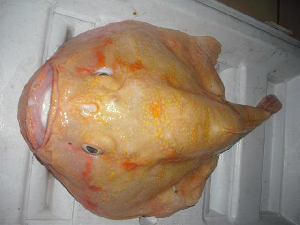

Side by side
| Chaunacops roseus | Furry Coffinfish | |
|---|---|---|
| Scientific name | Chaunacops roseus (Barbour, 1941) | Chaunax endeavouri Whitley, 1929 |
| English name | Not recorded | Furry Coffinfish |
| Group | Fishes | Fishes |
| Class | Teleostei Teleost | Teleostei Teleost |
| Order | Lophiiformes Anglerfish | Lophiiformes Anglerfish |
| Family | Chaunacidae Sea Toad | Chaunacidae Sea Toad |
| Genus | Chaunacops | Chaunax |
| Named in | 1941 | 1929 |
| Red List category | Least Concern | Least Concern |
| Environment | marine | marine |
| Countries on record | 1 country | 1 country |
| GBIF occurrence records | 4 records | 321 records |
Rows where the two agree are shown in grey.
Where each is found
Only Chaunacops roseus (1)
Only Furry Coffinfish (1)
From Catalogue of Life checklists and GBIF occurrence records. A country missing from a list means no record is held, which is not proof of absence.
Checked facts
| Chaunacops roseus | Furry Coffinfish | |
|---|---|---|
| Appearance |
|
|
| Habitat |
|
|
| Diet | No checked fact yet |
|
| Behaviour | No checked fact yet |
|
| Reproduction | No checked fact yet |
|
| Distribution |
|
|
| Conservation | No checked fact yet |
|
| Uses | No checked fact yet |
|
| Name origin | No checked fact yet |
|
| Other | No checked fact yet |
|
In brief
Chaunacops roseus
Chaunacops roseus occurs in the central and western Atlantic, with a documented range from Newfoundland to the northern Caribbean. It is distinguished by a rounded body, a large globular head, and an angling lure formed by a dense cluster of short, mop-like threads. Full profile
Furry Coffinfish
Chaunax endeavouri inhabits muddy ocean bottoms on the Australian continental shelf and upper deep-ocean slope, in temperate waters of the southwestern Pacific off Australia's east coast. It is distinguished by its rounded body, large globose head and short lure with a dense, mop-like cluster of thread-like cirri. Full profile
Compare something else
Page built on 29 November 2026 from the data on the two species pages, where every source is listed.
Cite this page
ScientificNames.org. (2026). Chaunacops roseus vs Furry Coffinfish. Retrieved November 29, 2026, from https://scientificnames.org/compare/chaunacops-roseus-vs-furry-coffinfish
“Chaunacops roseus vs Furry Coffinfish.” ScientificNames.org, 2026, scientificnames.org/compare/chaunacops-roseus-vs-furry-coffinfish. Accessed 29 Nov. 2026.
ScientificNames.org. “Chaunacops roseus vs Furry Coffinfish.” Accessed November 29, 2026. https://scientificnames.org/compare/chaunacops-roseus-vs-furry-coffinfish.
@misc{scientificnames_chaunacops_roseus_vs_furry_coffinfish,
  author = {{ScientificNames.org}},
  title = {Chaunacops roseus vs Furry Coffinfish},
  year = {2026},
  url = {https://scientificnames.org/compare/chaunacops-roseus-vs-furry-coffinfish},
  note = {Accessed 2026-11-29}
}