Species · Fishes
Furry Coffinfish Chaunax endeavouri
The scientific name of the Furry Coffinfish is Chaunax endeavouri. It is a species of fish in the family Chaunacidae (sea toad), order Lophiiformes. The name dates from 1929.
- Scientific name
- Chaunax endeavouri Whitley, 1929
- Common name
- Furry Coffinfish
- Genus
- Chaunax
- Family
- Chaunacidae (Sea Toad)
- Order
- Lophiiformes
- Class
- Teleostei
- Red List category
- LC Least Concern
- Environment
- marine
- Recorded in
- 1 country
- Name status
- accepted in the Catalogue of Life
Overview
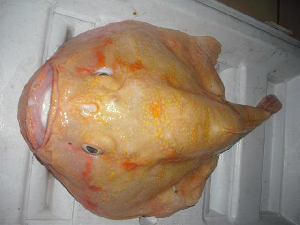
Chaunax endeavouri inhabits muddy ocean bottoms on the Australian continental shelf and upper deep-ocean slope, in temperate waters of the southwestern Pacific off Australia's east coast. It is distinguished by its rounded body, large globose head and short lure with a dense, mop-like cluster of thread-like cirri.
Written 26 November 2026 from the sources listed below. Each statement was checked against the passage it cites; statements that could not be supported were removed.
Appearance
The Furry Coffinfish has a rounded, ventrally compressed body covered in loose skin. Its large, globose head has prominent open lateral-line canals, and its large mouth is oblique to nearly vertical, with relatively small, sharp, slender teeth.[1][2][3]
Its short lure is positioned behind the snout in a depression. The esca consists of numerous short, thread-like cirri arranged in a dense mop-like cluster.[4][5]
Its skin is densely covered with small to minute spine-like scales resembling shark placoid scales. Its body coloration is generally pink, reddish, orange or rose-colored, and some individuals have pale, diffuse yellow or olive-green spots.[6][7][8]
Its anal fin usually has seven rays, with six or seven rays recorded. Its soft dorsal fin has 10 to 12 rays, and its narrow, paddle-like pectoral fins have 10 to 15 soft rays.[9][10][11]
Habitat
The Furry Coffinfish is benthic and inhabits muddy ocean bottoms on the Australian continental shelf and upper deep-ocean slope. It is endemic to temperate waters of the southwestern Pacific off Australia's east coast.[12][13][14]
Its type locality is east of Flinders Island in Bass Strait. The type specimen was collected at a depth of 130 to 180 metres.[15][16]
Diet
Adult Furry Coffinfish are ambush predators that use their lures to attract small invertebrate crustaceans. Their diet includes small crustaceans, including the deep-sea shrimp Acanthomysis microps.[17][18]
Behaviour
The Furry Coffinfish uses inflatable gills to fill its body with water as a defensive mechanism. Filling its gill chambers with water increases its body volume by 30%.[19][20]
When its gill chambers are completely filled with water, it stops inhaling and exhaling for 26 to 245 seconds. Its numerous lateral-line canals help it detect movement in low-visibility surroundings.[21][22]
Reproduction and life cycle
The Furry Coffinfish lays its eggs in buoyant, ribbon-like mucous rafts. These rafts disperse numerous small eggs over large geographic distances.[23][24]
After hatching, the larvae swim to the surface and feed on plankton. They return to deeper waters as they mature.[25][26]
The larvae are translucent and round, unlike the benthic, dorsoventrally compressed adults.[27]
Conservation
The Australian Fisheries Management Authority assessed the species as being at high risk from oceanic trawlers. Its susceptibility to trawlers is associated with its benthic lifestyle and relatively low productivity.[28][29]
Despite trawling risks, the species is described as non-threatened because of its wide distribution. It was assessed for the IUCN Red List on 12 August 2019.[30][31]
Uses
The Furry Coffinfish is caught as bycatch by deep-sea trawlers.[32]
Similar species
The Furry Coffinfish belongs to the Chaunax fimbriatus species group.[33]
Classification of the Furry Coffinfish
| Kingdom | Animalia |
|---|---|
| Phylum | Chordata |
| Subphylum | Vertebrata |
| Infraphylum | Gnathostomata |
| Parvphylum | Osteichthyes |
| Gigaclass | Actinopterygii |
| Superclass | Actinopteri |
| Class | Teleostei (Teleost) |
| Order | Lophiiformes (Anglerfish) |
| Suborder | Chaunacoidei |
| Family | Chaunacidae (Sea Toad) |
| Genus | Chaunax |
| Species | Chaunax endeavouri Whitley, 1929 |
Where the Furry Coffinfish is found
Checklists and occurrence records place Chaunax endeavouri in 1 country. GBIF holds 321 georeferenced records of it.
Countries
Regions and cities with the most records
A number beside a place is its count of GBIF occurrence records. A place without a number comes from a checklist alone. Records show where a species has been observed or collected, which can include escapes and vagrants.
Common names
English
- Furry Coffinfish
- Coffinfish
- Furry Angler
- Furry Anglerfish
- Sea Toad
Names in 1 other language
- Czech
- žaboškleb Endeavourův
Related species
-
 Pink FrogmouthChaunax pictus
-
 Suttkus Sea ToadChaunax suttkusi
-
 Redeye GaperChaunax stigmaeus
-
 Abe's FrogmouthChaunax abei
-
 Sea ToadChaunax fimbriatus
- Sea-toadChaunax breviradius
- Chaunax flammeus
- Naked-belly FrogmouthChaunax nudiventer
Compare
Questions and answers
What is the scientific name of the Furry Coffinfish?
The scientific name of the Furry Coffinfish is Chaunax endeavouri. Written with its author, the full name is Chaunax endeavouri Whitley, 1929.
Which family does the Furry Coffinfish belong to?
Chaunax endeavouri belongs to the family Chaunacidae, in the order Lophiiformes and the class Teleostei.
Where is the Furry Coffinfish found?
Checklists and occurrence records place Chaunax endeavouri in 1 country: Australia.
What is the conservation status of the Furry Coffinfish?
The IUCN Red List category recorded for Chaunax endeavouri is Least Concern (LC).
What other names does the Furry Coffinfish have?
Chaunax endeavouri is also known in English as Coffinfish, Furry Angler, Furry Anglerfish and Sea Toad.
Sources
Passages the profile rests on
- The species has a rounded, ventrally compressed body covered in loose skin. Source passage: “The furry coffinfish has a rounded body and ventrally compressed with loose skin” — English Wikipedia
- Its head is large and globose, with prominent open lateral-line canals. Source passage: “Head very large and globose with especially prominent open lateral-line canals” — English Wikipedia
- Its mouth is large and oblique to nearly vertical, with relatively small, sharp, slender teeth. Source passage: “the mouth is large, oblique to nearly vertical, with relatively small, sharp slender teeth.” — English Wikipedia
- Its lure is short and positioned behind the snout in a depression. Source passage: “Lure is short, located just behind snout within a depression that it rests in” — English Wikipedia
- Its esca consists of numerous short, thread-like cirri arranged in a dense mop-like cluster. Source passage: “the esca is mop-like, a dense cluster of numerous, short, thread-like cirri.” — English Wikipedia
- Its skin is densely covered with small to minute spine-like scales resembling shark placoid scales. Source passage: “The skin is densely covered with small to minute spine-like scales that are somewhat similar both in shape and feel to placoid scales of sharks.” — English Wikipedia
- Its body coloration is generally pink, reddish, orange, or rose-colored. Source passage: “The color of C. endeavouri is generally pink, reddish, orange, or rose-colored” — English Wikipedia
- Some individuals have pale, diffuse yellow or olive-green spots. Source passage: “some with pale diffuse spots of yellow or olive green.” — English Wikipedia
- Its anal fin usually has seven rays, with six or seven rays recorded. Source passage: “Anal-fin rays 6 or 7 (usually 7)” — English Wikipedia
- Its soft dorsal fin has 10 to 12 rays. Source passage: “Soft dorsal fin with 10 to 12 rays” — English Wikipedia
- Its narrow, paddle-like pectoral fins have 10 to 15 soft rays. Source passage: “pectoral fins narrow and paddle-like, with 10 to 15 soft rays” — English Wikipedia
- The species is benthic and inhabits muddy ocean bottoms. Source passage: “The furry coffinfish is a benthic fish, it is found on muddy bottom of the ocean” — English Wikipedia
- It inhabits the Australian continental shelf and upper deep-ocean slope. Source passage: “Australian continental shelf and upper slope in the deep ocean” — English Wikipedia
- The species is endemic to temperate waters of the southwestern Pacific off Australia's east coast. Source passage: “The furry coffinfish is endemic to the temperate waters of the southwestern Pacific, off east coast of Australia.” — English Wikipedia
- Its type locality is east of Flinders Island in Bass Strait. Source passage: “with its type locality given as east of Flinders Island in the Bass Strait” — English Wikipedia
- The type specimen was collected at a depth of 130 to 180 metres. Source passage: “at a depths of 70 to 100 fathoms (130 to 180 m).” — English Wikipedia
- Adult individuals are ambush predators that use their lures to attract small invertebrate crustaceans. Source passage: “The furry coffinfish adults are ambush predators that use small lures above their snouts to attract small, invertebrate crustaceans to their mouths.” — English Wikipedia
- The species feeds on small crustaceans, including the deep-sea shrimp Acanthomysis microps. Source passage: “small crustaceans, like Acanthomysis microps, a deep sea shrimp.” — English Wikipedia
- The species uses inflatable gills to fill its body with water as a defensive mechanism. Source passage: “C. endeavouri has inflatable gills that it uses to fill its body with water, acting as a defense mechanism much like the pufferfish.” — English Wikipedia
- Filling its gill chambers with water increases its body volume by 30%. Source passage: “The body of the C. endeavouri will increase in volume by 30% with full gill chambers” — English Wikipedia
- When its gill chambers are completely filled with water, it stops inhaling and exhaling for 26 to 245 seconds. Source passage: “When the gill chambers are completely filled with water, there is no inhalation or exhalation for 26 to 245 seconds.” — English Wikipedia
- Its numerous lateral-line canals help it detect movement in low-visibility surroundings. Source passage: “The furry coffinfish has a very large number of lateral line canals allowing it to detect movement in their surroundings as they often live in low-visibility areas.” — English Wikipedia
- The species lays its eggs in buoyant, ribbon-like mucous rafts. Source passage: “The furry coffinfish lays eggs in buoyant mucous ribbon-like "rafts".” — English Wikipedia
- Its buoyant egg rafts disperse numerous small eggs over large geographic distances. Source passage: “These buoyant rafts are an excellent device for broadcasting a large number of small eggs over great geographic distances” — English Wikipedia
- After hatching, the larvae swim to the surface and feed on plankton. Source passage: “After hatching, the larvae swim to the surface and feed on plankton.” — English Wikipedia
- The larvae return to deeper waters as they mature. Source passage: “As they mature, they return to the depths below.” — English Wikipedia
- The larvae are translucent and round, unlike the benthic, dorsoventrally compressed adults. Source passage: “The larvae are translucent, round and found in the pelagic zone, unlike the benthic, dorsoventrally compressed adults.” — English Wikipedia
- The species was assessed as being at high risk from oceanic trawlers by the Australian Fisheries Management Authority. Source passage: “The furry coffinfish was categorized as "High Risk" from oceanic trawlers in an Ecological Risk Assessment by the Australian Fisheries Management Authority” — English Wikipedia
- Its susceptibility to trawlers is associated with its benthic lifestyle and relatively low productivity. Source passage: “due to their high susceptibility to trawlers (Being benthic) and relatively low productivity.” — English Wikipedia
- Despite trawling risks, the species is described as non-threatened because of its wide distribution. Source passage: “However, they are non-threatened due to their wide area of distribution.” — English Wikipedia
- The species was assessed on 12 August 2019 for the IUCN Red List. Source passage: “Date assessed. 12 August 2019” — iucnredlist.org
- The species is caught as bycatch by deep-sea trawlers. Source passage: “Furry coffinfishes, like other species in Chaunax, have been bycatch for deep sea trawlers.” — English Wikipedia
- The species belongs to the Chaunax fimbriatus species group. Source passage: “Within the genus Chaunax this species is placed in the Chaunax fimbriatus species group.” — English Wikipedia
- The genus name Chaunax derives from a Greek term meaning to gape. Source passage: “which means "one who gapes", from chanos meaning "to gape"” — English Wikipedia
- The genus name alludes to the large, wide mouths of these fishes. Source passage: “an allusion to the large, wide mouths of these fishes.” — English Wikipedia
- The specific name endeavouri commemorates the Australian fisheries survey vessel F. I. S. Endeavour. Source passage: “The specific name endeavouri commemorates the F. I. S. Endeavour, an Australian fisheries survey vessel” — English Wikipedia
Data
- Catalogue of Life, 2026-10-16 XR cc by
- Global Biodiversity Information Facility CC BY 4.0
- Wikidata CC0
- GeoNames CC BY 4.0
- Wikimedia Commons per image; credit shown with each image
- iNaturalist per image; credit shown with each image
- Within the Catalogue of Life, this name comes from World Register of Marine Species cc by
References
- Whitley, G. P. (1929). Additions to the check-list of the fishes of New South Wales. No. 2. Australian Zoologist, v. 5 (pt 4): 353–357. where the name was published
This species in other databases
- Catalogue of Life TQSD
- Wikidata Q2487841
- iNaturalist 529764
- WoRMS urn:lsid:marinespecies.org:taxname:272550
- ITIS 690382
Page built on 28 November 2026. See how the catalog is made and all sources and licences.
Cite this page
ScientificNames.org. (2026). Chaunax endeavouri (Furry Coffinfish). Retrieved November 28, 2026, from https://scientificnames.org/species/chaunax-endeavouri
“Chaunax endeavouri (Furry Coffinfish).” ScientificNames.org, 2026, scientificnames.org/species/chaunax-endeavouri. Accessed 28 Nov. 2026.
ScientificNames.org. “Chaunax endeavouri (Furry Coffinfish).” Accessed November 28, 2026. https://scientificnames.org/species/chaunax-endeavouri.
@misc{scientificnames_chaunax_endeavouri_furry_coffinfish,
  author = {{ScientificNames.org}},
  title = {Chaunax endeavouri (Furry Coffinfish)},
  year = {2026},
  url = {https://scientificnames.org/species/chaunax-endeavouri},
  note = {Accessed 2026-11-28}
}