Comparison

Redeye Gaper vs Furry Coffinfish

Redeye Gaper (Chaunax stigmaeus) and Furry Coffinfish (Chaunax endeavouri) both belong to the genus Chaunax and part ways below it.

Redeye Gaper

Redeye Gaper

Chaunax stigmaeus

Derivate work by Citron from : Dr. Steve Ross, UNC-W. NOAA Office of Ocean Exploration., Public domain, via Wikimedia Commons
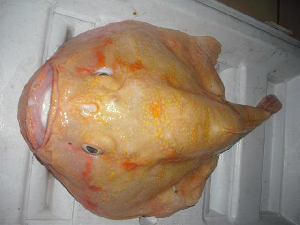
Furry Coffinfish

Furry Coffinfish

Chaunax endeavouri

Chin Choi Serge, CC BY 3.0, via Wikimedia Commons

Side by side

Redeye GaperFurry Coffinfish
Scientific nameChaunax stigmaeus Fowler, 1946Chaunax endeavouri Whitley, 1929
English nameRedeye GaperFurry Coffinfish
GroupFishesFishes
ClassTeleostei TeleostTeleostei Teleost
OrderLophiiformes AnglerfishLophiiformes Anglerfish
FamilyChaunacidae Sea ToadChaunacidae Sea Toad
GenusChaunaxChaunax
Named in19461929
Red List categoryData DeficientLeast Concern
Environmentmarinemarine
Countries on record1 country1 country
GBIF occurrence records83 records321 records

Rows where the two agree are shown in grey.

Where each is found

Only Redeye Gaper (1)

Only Furry Coffinfish (1)

From Catalogue of Life checklists and GBIF occurrence records. A country missing from a list means no record is held, which is not proof of absence.

Checked facts

Redeye GaperFurry Coffinfish
Appearance
  • The redeye gaper has a rounded, slightly compressed body and a very large head. English Wikipedia
  • Its head is globular and cuboid, and its tail is small and rounded. biogeodb.stri.si.edu
  • Its eyes are positioned high on the sides of its head and covered by transparent skin. biogeodb.stri.si.edu
  • It has a large mouth with a protruding lower jaw and teeth arranged in bands. English Wikipedia
  • Its teeth are small, slender, and sharp. biogeodb.stri.si.edu
  • Its skin is soft, loose, pliable, and covered with minute spinules that produce a velvety texture. English Wikipedia
  • Its lateral line system has prominent open canals. English Wikipedia
  • Its lure consists of a cluster of filaments of varying thickness, with a dark front and brilliant white rear. English Wikipedia
  • Its angling apparatus has two dark rings, although these are faint or absent in some individuals. English Wikipedia
  • Its upper body is olive green with large irregular blotches surrounded by smaller circular spots. English Wikipedia
  • Its nape often has a kidney-shaped or figure-eight-shaped blotch. English Wikipedia
  • Its underside is rose-colored with large, diffuse lighter patches. English Wikipedia
  • Its red coloration extends up the sides of the head in front of the eyes and surrounds the jaws. English Wikipedia
  • Its iris is deep rose red. English Wikipedia
  • Its dorsal, pectoral, and caudal fins have red membranes and small dark olive markings. biogeodb.stri.si.edu
  • The species has a rounded, ventrally compressed body covered in loose skin. English Wikipedia
  • Its head is large and globose, with prominent open lateral-line canals. English Wikipedia
  • Its mouth is large and oblique to nearly vertical, with relatively small, sharp, slender teeth. English Wikipedia
  • Its lure is short and positioned behind the snout in a depression. English Wikipedia
  • Its esca consists of numerous short, thread-like cirri arranged in a dense mop-like cluster. English Wikipedia
  • Its skin is densely covered with small to minute spine-like scales resembling shark placoid scales. English Wikipedia
  • Its body coloration is generally pink, reddish, orange, or rose-colored. English Wikipedia
  • Some individuals have pale, diffuse yellow or olive-green spots. English Wikipedia
  • Its anal fin usually has seven rays, with six or seven rays recorded. English Wikipedia
  • Its soft dorsal fin has 10 to 12 rays. English Wikipedia
  • Its narrow, paddle-like pectoral fins have 10 to 15 soft rays. English Wikipedia
  • The larvae are translucent and round, unlike the benthic, dorsoventrally compressed adults. English Wikipedia
SizeNo checked fact yet
Habitat
Diet
  • Adult individuals are ambush predators that use their lures to attract small invertebrate crustaceans. English Wikipedia
  • The species feeds on small crustaceans, including the deep-sea shrimp Acanthomysis microps. English Wikipedia
Behaviour
  • The redeye gaper is sedentary and uses ambush predation. English Wikipedia
  • It spends most of its time resting on the seabed using its pectoral and pelvic fins for support. English Wikipedia
  • It moves primarily to capture prey or avoid predators. English Wikipedia
  • It attracts prey using its movable lure. English Wikipedia
  • When threatened, it raises itself on its pelvic fins and rapidly takes in water to enlarge its body. English Wikipedia
  • The species can survive temperature and pressure changes associated with being brought to the surface. English Wikipedia
  • The species uses inflatable gills to fill its body with water as a defensive mechanism. English Wikipedia
  • When its gill chambers are completely filled with water, it stops inhaling and exhaling for 26 to 245 seconds. English Wikipedia
  • Filling its gill chambers with water increases its body volume by 30%. English Wikipedia
  • Its numerous lateral-line canals help it detect movement in low-visibility surroundings. English Wikipedia
ReproductionNo checked fact yet
Distribution
  • The species is endemic to temperate waters of the southwestern Pacific off Australia's east coast. English Wikipedia
  • Its type locality is east of Flinders Island in Bass Strait. English Wikipedia
ConservationNo checked fact yet
  • The species was assessed as being at high risk from oceanic trawlers by the Australian Fisheries Management Authority. English Wikipedia
  • Its susceptibility to trawlers is associated with its benthic lifestyle and relatively low productivity. English Wikipedia
  • Despite trawling risks, the species is described as non-threatened because of its wide distribution. English Wikipedia
UsesNo checked fact yet
Similar speciesNo checked fact yet
Name origin
  • The genus name Chaunax derives from a Greek term meaning to gape. English Wikipedia
  • The genus name alludes to the large, wide mouths of these fishes. English Wikipedia
  • The specific name endeavouri commemorates the Australian fisheries survey vessel F. I. S. Endeavour. English Wikipedia
Other
  • The original type specimen was caught in a trawl off Atlantic City on March 1, 1946. English Wikipedia
  • The original type specimen was donated to the Academy of Natural Sciences by Carroll B. Atkinson. English Wikipedia
  • Individuals of this species have sacs beneath their skin that can be filled with water to inflate their bodies. fisheries.noaa.gov

In brief

Redeye Gaper

Chaunax stigmaeus inhabits the outer continental shelf and upper continental slope at depths of 90–730 m. It is distinguished by its olive green, spotted upper body, rose-colored underside, and deep rose red iris. Full profile

Furry Coffinfish

Chaunax endeavouri inhabits muddy ocean bottoms on the Australian continental shelf and upper deep-ocean slope, in temperate waters of the southwestern Pacific off Australia's east coast. It is distinguished by its rounded body, large globose head and short lure with a dense, mop-like cluster of thread-like cirri. Full profile

Compare something else

Page built on 29 November 2026 from the data on the two species pages, where every source is listed.

Cite this page

ScientificNames.org. (2026). Redeye Gaper vs Furry Coffinfish. Retrieved November 29, 2026, from https://scientificnames.org/compare/redeye-gaper-vs-furry-coffinfish