Comparison

Cheetah vs Snow Leopard

Cheetah (Acinonyx jubatus) and Snow Leopard (Panthera uncia) both belong to the family Felidae (cats) and part ways below it. Both are recorded in 1 country.

Cheetah

Cheetah

Acinonyx jubatus

James Temple, CC BY 2.0, via Wikimedia Commons

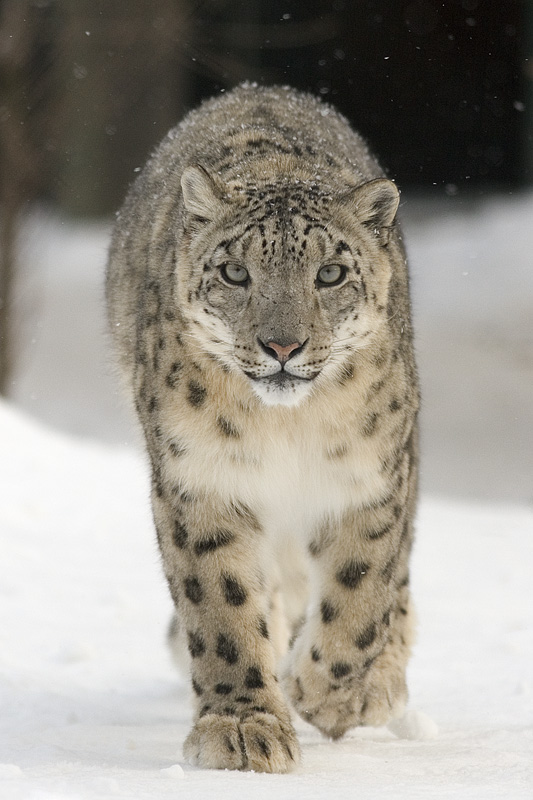
Snow Leopard

Snow Leopard

Panthera uncia

Bernard Landgraf, CC BY-SA 3.0, via Wikimedia Commons

How they differ

The cheetah has a slim body, long limbs, a tawny-to-pale coat with solid black spots, and black tear-like markings extending from the eyes toward the mouth. The snow leopard has a stocky body, short legs, thick whitish-to-grey fur, black spots and larger rosettes, and a thick bushy tail. The cheetah is a pursuit predator capable of running at 93–104 km/h, whereas the snow leopard is solitary and mostly active around dawn and twilight. The cheetah and the snow leopard are both classified as Vulnerable on the IUCN Red List.

CheetahSnow Leopard
Body and coatThe cheetah has a slim body, long limbs, and a tawny, creamy white, or pale buff coat with evenly distributed solid black spots.The snow leopard has a stocky body, short legs, and thick whitish-to-grey fur with black spots and larger rosettes.
TailThe cheetah has a 60–80 cm tail ending in a bushy white tuft, with four to six dark rings or stripes on its final third.The snow leopard has a thick tail that it uses for balance in rocky terrain and can wrap around its face while sleeping.
ActivityThe cheetah is primarily active during daylight, with activity peaks around dawn and dusk.The snow leopard is mostly active around dawn and twilight.
Social behaviourThe cheetah forms three main social group types: females with cubs, male coalitions, and solitary males.The snow leopard is solitary.
PredationThe cheetah typically approaches prey to within 30–200 m before pursuing it at high speed.The snow leopard actively hunts its prey and commonly rests near cliffs and ridges that provide vantage points.
PreyThe cheetah primarily consumes small- to medium-sized prey, particularly ungulates weighing less than 40 kg.The snow leopard's preferred prey generally weighs between 36 and 76 kg.
LivestockLivestock has been documented as potential prey for the cheetah.The snow leopard preys on domestic livestock, which accounts for between 0% and 33% of its dietary repertoire in the studied populations.
PopulationThe global cheetah population was estimated at 6,517 mature individuals in 2021.The global population of mature snow leopards is estimated at fewer than 10,000 individuals.

Written from the checked facts listed further down. Statements that the sources did not support were removed.

Side by side

CheetahSnow Leopard
Scientific nameAcinonyx jubatus (Schreber, 1775)Panthera uncia (Schreber, 1775)
English nameCheetahSnow Leopard
GroupMammalsMammals
ClassMammalia MammalMammalia Mammal
OrderCarnivora CarnivoresCarnivora Carnivores
FamilyFelidae CatsFelidae Cats
GenusAcinonyx CheetahPanthera Roaring Cats
Named in17751775
Red List categoryVulnerableVulnerable
Countries on record24 countries10 countries
GBIF occurrence records9,349 records399 records

Rows where the two agree are shown in grey.

Where each is found

Both recorded in 1 country

Only Cheetah (23)

Only Snow Leopard (9)

From Catalogue of Life checklists and GBIF occurrence records. A country missing from a list means no record is held, which is not proof of absence.

Checked facts

CheetahSnow Leopard
Appearance
  • The cheetah has a slim body, a small streamlined head, a short snout, a deep chest, long limbs, and a long tail. English Wikipedia
  • Its coat is generally tawny, creamy white, or pale buff, with evenly distributed solid black spots. English Wikipedia
  • The underside of its body, chin, throat, and lower legs are white and unmarked. English Wikipedia
  • Its coat typically contains approximately 2,000 black spots, each measuring 3–5 cm across. English Wikipedia
  • Individual cheetahs have distinctive spot patterns that can be used to identify them. English Wikipedia
  • Black tear-like markings extend from the corners of the eyes down the nose toward the mouth. English Wikipedia
  • Its tail measures 60–80 cm and ends in a bushy white tuft. English Wikipedia
  • The final third of its tail bears four to six dark rings or stripes. English Wikipedia
  • Its claws are partly retractile and lack protective sheaths. English Wikipedia
  • King cheetahs have large blotchy spots and three broad dark stripes running from the neck to the tail. English Wikipedia
  • The snow leopard has thick whitish-to-grey fur with black spots on its head and neck and larger rosettes on its back, flanks and bushy tail. English Wikipedia
  • The snow leopard has a short muzzle, domed forehead and large nasal cavities. English Wikipedia
  • The snow leopard has small, rounded ears, broad paws and a thick tail. English Wikipedia
  • The snow leopard has thick fur with individual hairs measuring 5–12 cm long. English Wikipedia
  • The snow leopard has a whitish underbelly. English Wikipedia
  • The snow leopard has long canine teeth measuring 28.6 mm. English Wikipedia
  • The snow leopard has short legs and a stocky body. English Wikipedia
Size
Habitat
  • Cheetahs inhabit savannahs, arid mountain ranges, and hilly desert terrain. English Wikipedia
  • Grasslands and deserts are among the habitats favored by cheetahs. animaldiversity.org
  • Cheetahs occur in protected natural habitats, communal and rural lands, game farms, agricultural croplands, and settlements. pmc.ncbi.nlm.nih.gov
  • Cheetahs are terrestrial animals that occasionally climb trees. animaldiversity.org
  • The snow leopard inhabits alpine and subalpine zones, particularly at elevations of 3,000–4,500 m. English Wikipedia
  • The snow leopard prefers rocky, broken terrain. English Wikipedia
  • During summer, the snow leopard commonly occupies alpine meadows and rocky regions above the tree line at elevations of 2,700–6,000 m. English Wikipedia
  • During winter, the snow leopard descends to elevations of approximately 1,200–2,000 m. English Wikipedia
  • The snow leopard can move through snow up to 85 cm deep. English Wikipedia
  • Snow leopards occupy alpine habitats at elevations ranging from 900 to 4,500 m. pmc.ncbi.nlm.nih.gov
Diet
  • Cheetahs primarily consume small- to medium-sized prey, particularly ungulates weighing less than 40 kg. English Wikipedia
  • Impala, springbok, and Thomson's gazelles are among the cheetah's preferred prey. English Wikipedia
  • Grant's gazelle contributed the largest proportion of the diet in a study of cheetahs in southeastern Kenya. pmc.ncbi.nlm.nih.gov
  • Thomson's gazelle was the most abundant medium-sized ungulate prey in the southeastern Kenya study areas. pmc.ncbi.nlm.nih.gov
  • Yellow baboons, vervet monkeys, and rock hyraxes were recorded in the diet of cheetahs in southeastern Kenya. pmc.ncbi.nlm.nih.gov
  • Livestock has been documented as potential prey for cheetahs. pmc.ncbi.nlm.nih.gov
  • Cheetahs can consume a wide range of prey species and primarily hunt wild ungulates weighing 23–56 kg. pmc.ncbi.nlm.nih.gov
  • The snow leopard is a carnivore that actively hunts its prey. English Wikipedia
  • The snow leopard's preferred wild prey includes Himalayan blue sheep, Himalayan tahr, argali, markhor and wild goats. English Wikipedia
  • The snow leopard also hunts smaller mammals, including Himalayan marmots, pikas and voles. English Wikipedia
  • The snow leopard also preys on domestic livestock. English Wikipedia
  • The snow leopard consumes grass and twigs in addition to animal prey. English Wikipedia
  • The snow leopard's preferred prey generally weighs between 36 and 76 kg. English Wikipedia
  • In the Himalayas, the snow leopard commonly hunts Himalayan blue sheep, Siberian ibex, white-bellied musk deer and wild boar. English Wikipedia
  • The snow leopard's preferred prey species have an average weight of approximately 55 ± 5 kg. pmc.ncbi.nlm.nih.gov
  • The snow leopard's diet can include pikas, hares and game birds such as chukar partridges and snowcocks. pmc.ncbi.nlm.nih.gov
  • An individual snow leopard requires approximately 1.5 kg of meat per day. pmc.ncbi.nlm.nih.gov
  • Across its range, the snow leopard predominantly consumes larger-bodied wild hoofed mammals, with prey selection varying according to availability. dsc.duq.edu
  • Livestock accounts for between 0% and 33% of the snow leopard's dietary repertoire in the studied populations. dsc.duq.edu
Behaviour
  • Cheetahs are pursuit predators capable of running at speeds of 93–104 km/h. English Wikipedia
  • Cheetahs are primarily active during daylight, with activity peaks around dawn and dusk. English Wikipedia
  • Cheetahs form three main social group types: females with cubs, male coalitions, and solitary males. English Wikipedia
  • Female cheetahs generally lead nomadic lives while searching for prey across large home ranges. English Wikipedia
  • Male cheetahs are generally more sedentary and establish smaller territories where prey and females are plentiful. English Wikipedia
  • Cheetahs typically approach prey to within 30–200 m before pursuing it at high speed. English Wikipedia
  • Cheetahs kill their prey with a throat bite after bringing it down during pursuit. English Wikipedia
  • Male cheetahs provide no parental care and associate with females only for mating. animaldiversity.org
  • The snow leopard is solitary and is mostly active around dawn and twilight. English Wikipedia
  • The snow leopard commonly rests near cliffs and ridges that provide vantage points and shade. English Wikipedia
  • The snow leopard uses its long, flexible tail to maintain balance in rocky terrain. English Wikipedia
  • The snow leopard can wrap its thick, fur-covered tail around its face for protection while sleeping. English Wikipedia
ReproductionNo checked fact yet
Distribution
  • The present distribution of cheetahs consists mainly of fragmented populations in northwestern, eastern, and southern Africa and central Iran. English Wikipedia
  • The snow leopard is native to the mountain ranges of Asia, extending from the eastern Hindu Kush and Himalayas to southern Siberia, Mongolia and western China. English Wikipedia
Conservation
  • The cheetah is classified as Vulnerable on the IUCN Red List. English Wikipedia
  • The global cheetah population was estimated at 6,517 mature individuals in 2021. English Wikipedia
  • Habitat loss, human conflict, poaching, and disease susceptibility threaten cheetah populations. English Wikipedia
  • More than 80% of Kenya's cheetah population occurs mainly on community and private lands outside protected areas. pmc.ncbi.nlm.nih.gov
  • Cheetahs have unusually low genetic variability compared with other felids. English Wikipedia
  • Low genetic variability has been associated with poor captive breeding, sperm defects, juvenile mortality, and increased disease susceptibility. English Wikipedia
  • The snow leopard is classified as Vulnerable on the IUCN Red List in document 1. English Wikipedia
  • The global population of mature snow leopards is estimated at fewer than 10,000 individuals. English Wikipedia
  • Poaching and habitat destruction are major threats to the snow leopard. English Wikipedia
  • The snow leopard is listed in Appendix I of CITES. English Wikipedia
  • Snow leopards are threatened by habitat loss, reduced prey availability, retaliatory killings and climate change. dsc.duq.edu
  • Reduced availability of wild prey can increase livestock predation and retaliatory killings of snow leopards. pmc.ncbi.nlm.nih.gov
  • Conservation of the snow leopard depends partly on maintaining populations of its preferred wild prey. pmc.ncbi.nlm.nih.gov
Uses
  • Cheetahs were historically tamed in ancient Egypt and trained to hunt ungulates in the Arabian Peninsula and India. English Wikipedia
  • Cheetahs have been kept in zoos since the early nineteenth century. English Wikipedia
  • The snow leopard is widely used in heraldry and as an emblem in Central Asia and parts of North India. English Wikipedia
Similar species
  • The cougar and jaguarundi are the cheetah's closest living relatives. English Wikipedia
  • Leopards can be distinguished from cheetahs by their rosette-shaped markings and absence of tear streaks. English Wikipedia
  • Servals resemble cheetahs, but their spots merge into stripes along the back. English Wikipedia
No checked fact yet

In brief

Cheetah

The Cheetah (Acinonyx jubatus) is a mammal in the family Felidae, order Carnivora, and class Mammalia. It occurs mainly in fragmented populations in northwestern, eastern, and southern Africa and central Iran. It is distinguished by its slim body, solid black spots, distinctive tear-like facial markings, and ability to run at speeds of 93–104 km/h. Full profile

Snow Leopard

The Snow Leopard inhabits alpine and subalpine zones in the mountain ranges of Asia. It has thick whitish-to-grey fur with black spots and rosettes, broad paws, short legs and a thick, bushy tail. Full profile

Compare something else

Page built on 24 November 2026 from the data on the two species pages, where every source is listed.

Cite this page

ScientificNames.org. (2026). Cheetah vs Snow Leopard. Retrieved November 24, 2026, from https://scientificnames.org/compare/cheetah-vs-snow-leopard