Species · Mammals
Snow Leopard Panthera uncia
The scientific name of the Snow Leopard is Panthera uncia. It is a species of mammal in the family Felidae (cats), order Carnivora. The name dates from 1775.
- Scientific name
- Panthera uncia (Schreber, 1775)
- Common name
- Snow Leopard
- Genus
- Panthera
- Family
- Felidae (Cats)
- Order
- Carnivora
- Class
- Mammalia
- Red List category
- VU Vulnerable
- Recorded in
- 10 countries
- Name status
- accepted in the Catalogue of Life
Overview
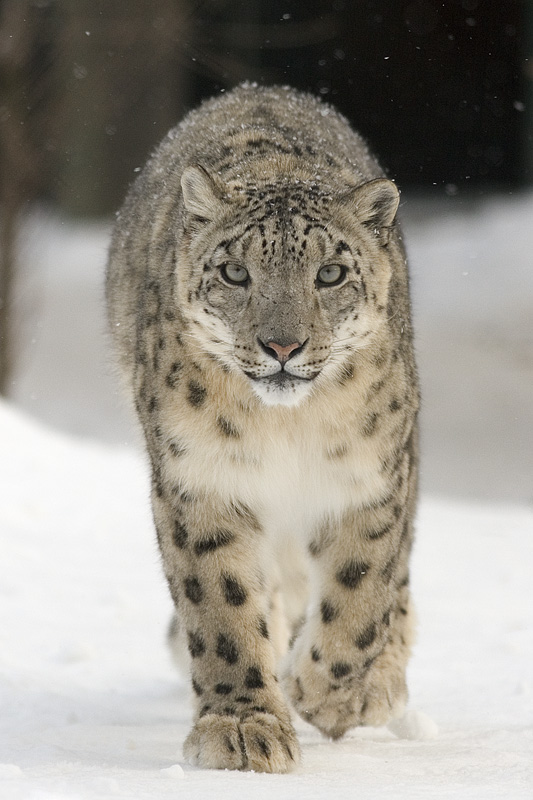
The Snow Leopard inhabits alpine and subalpine zones in the mountain ranges of Asia. It has thick whitish-to-grey fur with black spots and rosettes, broad paws, short legs and a thick, bushy tail.
Written 24 November 2026 from the sources listed below. Each statement was checked against the passage it cites; statements that could not be supported were removed.
Appearance
The Snow Leopard has thick whitish-to-grey fur with black spots on its head and neck and larger rosettes on its back, flanks and bushy tail. Its underbelly is whitish.[1][2]
It has a short muzzle, domed forehead, large nasal cavities and small, rounded ears. Its paws are broad, its legs are short and its body is stocky.[3][4][5]
Its thick fur has individual hairs measuring 5–12 cm long. Its long canine teeth measure 28.6 mm.[6][7]
The Snow Leopard reaches a shoulder height of approximately 56 cm and measures 75–150 cm from head to body. Its tail measures 80–105 cm long.[8][9][10]
Male Snow Leopards average 45–55 kg, while females average 35–40 kg. Some males weigh up to 75 kg, while some females weigh less than 25 kg.[11][12]
Habitat
The Snow Leopard inhabits alpine and subalpine zones, particularly at elevations of 3,000–4,500 m. It prefers rocky, broken terrain.[13][14]
During summer, it commonly occupies alpine meadows and rocky regions above the tree line at elevations of 2,700–6,000 m. During winter, it descends to elevations of approximately 1,200–2,000 m.[15][16]
Snow Leopards occupy alpine habitats at elevations ranging from 900 to 4,500 m. They can move through snow up to 85 cm deep.[17][18]
Diet
The Snow Leopard is a carnivore that actively hunts its prey. Across its range, it predominantly consumes larger-bodied wild hoofed mammals, with prey selection varying according to availability.[19][20]
Its preferred wild prey includes Himalayan blue sheep, Himalayan tahr, argali, markhor and wild goats. In the Himalayas, it commonly hunts Himalayan blue sheep, Siberian ibex, white-bellied musk deer and wild boar.[21][22]
It also hunts smaller mammals, including Himalayan marmots, pikas, voles and hares, as well as game birds such as chukar partridges and snowcocks. It also preys on domestic livestock.[23][24][25]
The Snow Leopard consumes grass and twigs in addition to animal prey. An individual requires approximately 1.5 kg of meat per day.[26][27]
Its preferred prey generally weighs between 36 and 76 kg. Preferred prey species have an average weight of approximately 55 ± 5 kg.[28][29]
Livestock accounts for between 0% and 33% of the dietary repertoire in the studied populations.[30]
Behaviour
The Snow Leopard is solitary and is mostly active around dawn and twilight. It commonly rests near cliffs and ridges that provide vantage points and shade.[31][32]
It uses its long, flexible tail to maintain balance in rocky terrain and can wrap its thick, fur-covered tail around its face for protection while sleeping.[33][34]
Conservation
The Snow Leopard is classified as Vulnerable on the IUCN Red List in document 1. The global population of mature Snow Leopards is estimated at fewer than 10,000 individuals.[35][36]
Poaching and habitat destruction are major threats to the Snow Leopard. Other threats include habitat loss, reduced prey availability, retaliatory killings and climate change.[37][38]
Reduced availability of wild prey can increase livestock predation and retaliatory killings of Snow Leopards. Conservation depends partly on maintaining populations of their preferred wild prey.[39][40]
The Snow Leopard is listed in Appendix I of CITES.[41]
Uses
The Snow Leopard is widely used in heraldry and as an emblem in Central Asia and parts of North India.[42]
Classification of the Snow Leopard
| Kingdom | Animalia |
|---|---|
| Phylum | Chordata |
| Subphylum | Vertebrata |
| Infraphylum | Gnathostomata |
| Parvphylum | Osteichthyes |
| Megaclass | Tetrapoda |
| Class | Mammalia (Mammal) |
| Subclass | Theria |
| Infraclass | Eutheria |
| Order | Carnivora (Carnivores) |
| Suborder | Feliformia (Cat-like Carnivores) |
| Family | Felidae (Cats) |
| Subfamily | Pantherinae |
| Genus | Panthera (Roaring Cats) |
| Species | Panthera uncia (Schreber, 1775) |
Where the Snow Leopard is found
Checklists and occurrence records place Panthera uncia in 10 countries across Asia. GBIF holds 399 georeferenced records of it.
Countries
- Afghanistan 3
- China 96
- India 177
- Kazakhstan 5
- Kyrgyzstan 20
- Mongolia 55
- Nepal 17
- Pakistan 10
- Tajikistan 5
- Uzbekistan 11
Regions and cities with the most records
- Qinghai, China 55
- Hovd, Mongolia 40
- Himachal Pradesh, India 16
- Issyk-Kul, Kyrgyzstan 9
- Yushu, China 8
- Chhattisgarh, India 7
- Anantnag, India 5
- Chuy Region, Kyrgyzstan 4
- Gorno-Badakhshan, Tajikistan 3
- Qashqadaryo, Uzbekistan 3
- Sikkim, India 3
- Tibet, China 3
- Övörhangay, Mongolia 3
5 more countries have a few records outside this range
These countries hold a few records of Panthera uncia but lie outside the range the checklists give for it. Such records are often zoo or garden specimens, museum material or vagrants, so the species is not counted as occurring there.
Range as the checklists state it
Europe & Northern Asia (excluding China)
Southern Asia
A number beside a place is its count of GBIF occurrence records. A place without a number comes from a checklist alone. Records show where a species has been observed or collected, which can include escapes and vagrants.
Common names
English
- Snow Leopard
- Ounce
Names in 99 other languages
- Afrikaans
- Sneeuluiperd, Sneeupanter
- Albanian
- Leopardi i dëborës
- Arabic
- فهد ثلجي, نمر الثلوج, نمر ثلجي, نَمِرُ الثُّلُوجِ
- Armenian
- Ձյունահովազ
- Azerbaijani
- Qar bəbiri, İrbis
- Basque
- Elur-lehoinabar, Elur-pantera
- Belarusian
- Снежны барс
- Bengali
- তুষার চিতা
- Breton
- Loupard an erc'h, Oñs
- Bulgarian
- Барс, Снежен барс
- Burmese
- နှင်းကျားသစ်
- Catalan
- Lleopard de les neus, Pantera de les neus
- Chinese
- Xue bào, 艾葉豹, 草豹, 荷葉豹, 雪豹
- Croatian
- Sniježni leopard, Snježni leopard
- Czech
- Irbis horský, Levhart sněžný, sněžný levhart
- Danish
- Sneleopard
- Dutch
- Sneeuwluipaard, Sneeuwpanter
- Esperanto
- Neĝleopardo
- Estonian
- Lumeleopard
- Finnish
- Lumileopardi
- French
- Léopard des neiges, Once, Panthère des neiges, panthère de neige
- Galician
- Leopardo das neves, Onza
- German
- Schneeleopard
- Greek
- Λεοπάρδαλη του χιονιού
- Hebrew
- נמר השלג
- Hindi
- Baral he, हिम तेंदुआ, हिम तेन्दुआ
- Hungarian
- hópárduc, irbisz
- Icelandic
- Snjóhlébarði
- Irish
- Liopard sneachta
- Italian
- Leopardo delle nevi
- Japanese
- ユキヒョウ
- Kannada
- ಹಿಮ ಚಿರತೆ
- Kazakh
- Irbis, Қар барысы
- Korean
- 눈표범, 설표, 회색표범
- Latvian
- Sniega leopards
- Luxembourgish
- Schnéileopard
- Macedonian
- Снежен леопард
- Malay
- Harimau bintang salji
- Malayalam
- ഹിമപ്പുലി
- Marathi
- हिमबिबट्या
- Mongolian
- Irvis, Ирвэс
- Nepali
- Hiun chituwa
- Norwegian Bokmål
- Snøleopard
- Occitan
- Onça, Pantèra de las nèus
- Persian
- پلنگ برفی
- Polish
- Irbis śnieżny, Pantera śnieżna
- Portuguese
- Leopardo-das-neves
- Punjabi
- ਬਰਫ਼ੀਲਾ ਤੇਂਦੂਆ
- Romanian
- Leopardul zăpezilor
- Russian
- Snezhniy bars, Снежный барс, Снежный леопард
- Scottish Gaelic
- Leopard-sneachda
- Serbian
- Снежни леопард - Snežni leopard, снежни леопард
- Slovak
- Leopard snežný
- Slovenian
- Snežni leopard
- Spanish
- Leopardo de las nieves, Pantera de la Nieves, pantera de las nieves
- Swahili
- Chui-theluji
- Swedish
- snöleopard
- Tamil
- பனிச்சிறுத்தை
- Telugu
- మంచు చిరుత
- Thai
- เสือดาวหิมะ
- Turkish
- Kar parsı, kar leoparı
- Ukrainian
- Ірбіс, Барс сніговий, Сніговий барс
- Urdu
- Barfani chita, برفانی چیتا
- Uzbek
- Ilvirs
- Vietnamese
- Báo tuyết
- Welsh
- Llewpard Eira
- amh
- አመዳይ ነብር
- asm
- বৰফৰ বাঘ
- azb
- ایربیس
- bak
- Барыс
- bod
- Sah, གསའ་གཟིག
- ckb
- پڵینگی بەفری
- cor
- Lewpard an ergh
- dty
- हिउँ चितुवा
- fil
- Leopardong niyebe
- frr
- Snäleopard
- grn
- Jaguaretetĩ
- ido
- Unco
- inh
- ЦӀокълом
- jav
- Macan tutul salju
- kab
- Aɣilas n wedfel
- kas
- چھۆت سٕہہ
- kir
- Илбирс
- kur
- Parsa berfîn
- lez
- Перленг
- ltg
- Snīga leopards
- nan
- Seh-pà
- nav
- Náshdóíłgaii łikizhígíí
- ory
- ହିମ କଲରାପତ୍ରିଆ ବାଘ
- oss
- Фыранк
- sah
- Баарыс
- sco
- snaw leopard
- tat
- Ирбис
- tgk
- Babri barfi, Паланги барфӣ
- tyv
- Ирбиш
- uig
- يىلپىز
- xmf
- ირბისი
- yid
- שניי לעמפערט
- zza
- Leoparê vewre
Synonyms
9 other scientific names have been used for this species and are now treated as synonyms of Panthera uncia.
- Felis irbis Ehrenberg, 1830
- Felis uncia Schreber, 1775
- Felis uncioides Horsfield, 1855
- Panthera uncia schneideri (Zukowsky, 1950)
- Panthera uncia uncia (Schreber, 1775)
- Panthera uncia uncioides Horsfield, 1855
- Panthera unica Schreber, 1775
- Uncia uncia Pocock, 1916
- Uncia uncia (Schreber, 1775)
Subspecies and varieties
- Panthera unica pyrenaica subspecies
Related species
-
 TigerPanthera tigris
-
 LionPanthera leo
-
 JaguarPanthera onca
-
 LeopardPanthera pardus
-
 Cave LionPanthera spelaea
-
 European JaguarPanthera gombaszoegensis
-
 Longdan TigerPanthera zdanskyi
- CatFelis catus
Compare
Questions and answers
What is the scientific name of the Snow Leopard?
The scientific name of the Snow Leopard is Panthera uncia. Written with its author, the full name is Panthera uncia (Schreber, 1775).
Which family does the Snow Leopard belong to?
Panthera uncia belongs to the family Felidae, in the order Carnivora and the class Mammalia.
Where is the Snow Leopard found?
Checklists and occurrence records place Panthera uncia in 10 countries, including India, China, Mongolia, Kyrgyzstan, Nepal and Uzbekistan.
What is the conservation status of the Snow Leopard?
The IUCN Red List category recorded for Panthera uncia is Vulnerable (VU).
What other names does the Snow Leopard have?
Panthera uncia is also known in English as Ounce.
What is the snow leopard's diet?
The Snow Leopard predominantly consumes larger-bodied wild hoofed mammals, including Himalayan blue sheep, Himalayan tahr, argali, markhor and wild goats. It also hunts smaller mammals, game birds and domestic livestock, and consumes grass and twigs.[19][21][23][24][26][25][20]
Sources
Passages the profile rests on
- The snow leopard has thick whitish-to-grey fur with black spots on its head and neck and larger rosettes on its back, flanks and bushy tail. Source passage: “It has a thick whitish to grey fur with black spots on the head and neck, with larger rosettes on the back, flanks and bushy tail.” — English Wikipedia
- The snow leopard has a whitish underbelly. Source passage: “and its underbelly is whitish.” — English Wikipedia
- The snow leopard has a short muzzle, domed forehead and large nasal cavities. Source passage: “Its muzzle is short, its forehead domed, and its nasal cavities are large.” — English Wikipedia
- The snow leopard has small, rounded ears, broad paws and a thick tail. Source passage: “Its small rounded ears, broad paws, and thick tails are adaptations for living in cold, mountainous environments.” — English Wikipedia
- The snow leopard has short legs and a stocky body. Source passage: “They are stocky, short-legged, and slightly smaller than other cats of the genus Panthera” — English Wikipedia
- The snow leopard has thick fur with individual hairs measuring 5–12 cm long. Source passage: “The fur is thick with hairs measuring 5 to 12 cm (2.0 to 4.7 in) in length” — English Wikipedia
- The snow leopard has long canine teeth measuring 28.6 mm. Source passage: “Its canine teeth are 28.6 mm (1.13 in) long” — English Wikipedia
- The snow leopard reaches a shoulder height of approximately 56 cm. Source passage: “reaching a shoulder height of 56 cm (22 in)” — English Wikipedia
- The snow leopard measures 75–150 cm from head to body. Source passage: “ranging in head to body size from 75 to 150 cm (30 to 59 in).” — English Wikipedia
- The snow leopard's tail measures 80–105 cm long. Source passage: “Its tail is 80 to 105 cm (31 to 41 in) long.” — English Wikipedia
- Male snow leopards average 45–55 kg, while females average 35–40 kg. Source passage: “Males average 45 to 55 kg (99 to 121 lb), and females 35 to 40 kg (77 to 88 lb)” — English Wikipedia
- Some male snow leopards weigh up to 75 kg, while some females weigh less than 25 kg. Source passage: “but large males reaching 75 kg (165 lb) and small females under 25 kg (55 lb) have also been recorded.” — English Wikipedia
- The snow leopard inhabits alpine and subalpine zones, particularly at elevations of 3,000–4,500 m. Source passage: “It inhabits alpine and subalpine zones at elevations of 3,000–4,500 m (9,800–14,800 ft)” — English Wikipedia
- The snow leopard prefers rocky, broken terrain. Source passage: “It prefers rocky, broken terrain” — English Wikipedia
- During summer, the snow leopard commonly occupies alpine meadows and rocky regions above the tree line at elevations of 2,700–6,000 m. Source passage: “In summer, it usually lives above the tree line on alpine meadows and in rocky regions at elevations of 2,700 to 6,000 m” — English Wikipedia
- During winter, the snow leopard descends to elevations of approximately 1,200–2,000 m. Source passage: “In winter, it descends to elevations around 1,200 to 2,000 m” — English Wikipedia
- The snow leopard can move through snow up to 85 cm deep. Source passage: “and can move in 85 cm (33 in) deep snow” — English Wikipedia
- Snow leopards occupy alpine habitats at elevations ranging from 900 to 4,500 m. Source passage: “Snow leopards are elusive predators whose key habitats are alpine regions within altitudes of 900–4500 m” — pmc.ncbi.nlm.nih.gov
- The snow leopard is a carnivore that actively hunts its prey. Source passage: “The snow leopard is a carnivore and actively hunts its prey.” — English Wikipedia
- Across its range, the snow leopard predominantly consumes larger-bodied wild hoofed mammals, with prey selection varying according to availability. Source passage: “Across their range, snow leopards predominately consumed larger-bodied wild hoof stock species, though these varied based on availability.” — dsc.duq.edu
- The snow leopard's preferred wild prey includes Himalayan blue sheep, Himalayan tahr, argali, markhor and wild goats. Source passage: “Its preferred wild prey species are Himalayan blue sheep (Pseudois nayaur), Himalayan tahr (Hemitragus jemlahicus), argali (Ovis ammon), markhor (Capra falconeri) and wild goat (C. aegagrus).” — English Wikipedia
- In the Himalayas, the snow leopard commonly hunts Himalayan blue sheep, Siberian ibex, white-bellied musk deer and wild boar. Source passage: “In the Himalayas, it preys mostly on Himalayan blue sheep, Siberian ibex (C. sibirica), white-bellied musk deer (Moschus leucogaster) and wild boar (Sus scrofa).” — English Wikipedia
- The snow leopard also hunts smaller mammals, including Himalayan marmots, pikas and voles. Source passage: “but also hunts smaller mammals such as Himalayan marmot (Marmota himalayana), pika and vole species.” — English Wikipedia
- The snow leopard also preys on domestic livestock. Source passage: “It also preys on domestic livestock.” — English Wikipedia
- The snow leopard's diet can include pikas, hares and game birds such as chukar partridges and snowcocks. Source passage: “their diet can also include pikas, hares, and game birds (chukar partridge Alectoris chukar and snowcock Tetraogallus sp.)” — pmc.ncbi.nlm.nih.gov
- The snow leopard consumes grass and twigs in addition to animal prey. Source passage: “It also eats grass and twigs.” — English Wikipedia
- An individual snow leopard requires approximately 1.5 kg of meat per day. Source passage: “A single snow leopard requires 1.5 kg of meat per day” — pmc.ncbi.nlm.nih.gov
- The snow leopard's preferred prey generally weighs between 36 and 76 kg. Source passage: “It prefers prey ranging in weight from 36 to 76 kg (79 to 168 lb)” — English Wikipedia
- The snow leopard's preferred prey species have an average weight of approximately 55 ± 5 kg. Source passage: “The significantly preferred prey species of snow leopard weighed 55±5 kg” — pmc.ncbi.nlm.nih.gov
- Livestock accounts for between 0% and 33% of the snow leopard's dietary repertoire in the studied populations. Source passage: “Livestock constituted anywhere from 0% to 33% of dietary repertoire” — dsc.duq.edu
- The snow leopard is solitary and is mostly active around dawn and twilight. Source passage: “It is a solitary animal and is mostly active at dawn and twilight.” — English Wikipedia
- The snow leopard commonly rests near cliffs and ridges that provide vantage points and shade. Source passage: “They mostly rest near cliffs and ridges that provide vantage points and shade.” — English Wikipedia
- The snow leopard uses its long, flexible tail to maintain balance in rocky terrain. Source passage: “Its long and flexible tail helps the cat to balance in rocky terrain.” — English Wikipedia
- The snow leopard can wrap its thick, fur-covered tail around its face for protection while sleeping. Source passage: “which allows the cat to use it like a blanket to protect its face when asleep.” — English Wikipedia
- The snow leopard is classified as Vulnerable on the IUCN Red List in document 1. Source passage: “The snow leopard is listed as Vulnerable on the IUCN Red List” — English Wikipedia
- The global population of mature snow leopards is estimated at fewer than 10,000 individuals. Source passage: “the global population is estimated to number fewer than 10,000 mature individuals” — English Wikipedia
- Poaching and habitat destruction are major threats to the snow leopard. Source passage: “It is mainly threatened by poaching and habitat destruction.” — English Wikipedia
- Snow leopards are threatened by habitat loss, reduced prey availability, retaliatory killings and climate change. Source passage: “Snow leopards are threatened by habitat loss, decreased prey availability, retaliatory killings, and large-scale negative impacts associated with climate change.” — dsc.duq.edu
- Reduced availability of wild prey can increase livestock predation and retaliatory killings of snow leopards. Source passage: “increased use of domestic livestock by snow leopards, elevating conflict and retaliatory killing by pastoralists” — pmc.ncbi.nlm.nih.gov
- Conservation of the snow leopard depends partly on maintaining populations of its preferred wild prey. Source passage: “Conservation of key prey species is crucial for the survival of any large predator” — pmc.ncbi.nlm.nih.gov
- The snow leopard is listed in Appendix I of CITES. Source passage: “It is listed in CITES Appendix I” — English Wikipedia
- The snow leopard is widely used in heraldry and as an emblem in Central Asia and parts of North India. Source passage: “It is widely used in heraldry and as an emblem in Central Asia and parts of North India.” — English Wikipedia
Data
- Catalogue of Life, 2026-10-16 XR cc by
- Global Biodiversity Information Facility CC BY 4.0
- Wikidata CC0
- GeoNames CC BY 4.0
- Wikimedia Commons per image; credit shown with each image
- Within the Catalogue of Life, this name comes from The Integrated Taxonomic Information System cc0
References
- Sunquist, M. E. and F. C. Sunquist / Don E. Wilson and Russell A. Mittermeier, eds. (2009). Family Felidae (Cats). Handbook of the Mammals of the World. Vol. 1: Carnivores.
- Kitchener, A. C., C. Breitenmoser-Würsten, E. Eizirik, A. Gentry, L. Werdelin, A. Wilting, et al. (2017). A revised taxonomy of the Felidae. The final report of the Cat Classification Task Force of the IUCN/SSC Cat Specialist Group. Cat News Special Issue, Vol. 11.
This species in other databases
Page built on 24 November 2026. See how the catalog is made and all sources and licences.
Cite this page
ScientificNames.org. (2026). Panthera uncia (Snow Leopard). Retrieved November 24, 2026, from https://scientificnames.org/species/panthera-uncia
“Panthera uncia (Snow Leopard).” ScientificNames.org, 2026, scientificnames.org/species/panthera-uncia. Accessed 24 Nov. 2026.
ScientificNames.org. “Panthera uncia (Snow Leopard).” Accessed November 24, 2026. https://scientificnames.org/species/panthera-uncia.
@misc{scientificnames_panthera_uncia_snow_leopard,
  author = {{ScientificNames.org}},
  title = {Panthera uncia (Snow Leopard)},
  year = {2026},
  url = {https://scientificnames.org/species/panthera-uncia},
  note = {Accessed 2026-11-24}
}