Comparison

Chinese Pangolin vs Indian Pangolin

Chinese Pangolin (Manis pentadactyla) and Indian Pangolin (Manis crassicaudata) both belong to the genus Manis (asian pangolins) and part ways below it. Both are recorded in 4 countries.

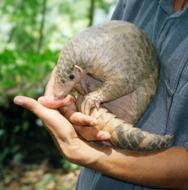
Chinese Pangolin

Chinese Pangolin

Manis pentadactyla

U.S. Fish and Wildlife Service Headquarters, CC BY 2.0, via Wikimedia Commons

Indian Pangolin

Indian Pangolin

Manis crassicaudata

S megan at English Wikipedia, Public domain, via Wikimedia Commons

Side by side

Chinese PangolinIndian Pangolin
Scientific nameManis pentadactyla Linnaeus, 1758Manis crassicaudata É. Geoffroy Saint-Hilaire, 1803
English nameChinese PangolinIndian Pangolin
GroupMammalsMammals
ClassMammalia MammalMammalia Mammal
OrderPholidota PangolinsPholidota Pangolins
FamilyManidae PangolinsManidae Pangolins
GenusManis Asian PangolinsManis Asian Pangolins
Named in17581803
Red List categoryCritically EndangeredEndangered
Countries on record11 countries5 countries
GBIF occurrence records1,223 records134 records

Rows where the two agree are shown in grey.

Where each is found

Both recorded in 4 countries

Only Chinese Pangolin (7)

Only Indian Pangolin (1)

From Catalogue of Life checklists and GBIF occurrence records. A country missing from a list means no record is held, which is not proof of absence.

Checked facts

Chinese PangolinIndian Pangolin
Appearance
  • The Indian pangolin has large overlapping scales covering its upper face and body, except for its belly and the insides of its legs. English Wikipedia
  • Its protective scales are rigid and composed of keratin. English Wikipedia
  • Its head is cone-shaped, with small dark eyes and a long muzzle. English Wikipedia
  • Its limbs are powerful and terminate in digits equipped with sharp claws. English Wikipedia
  • The Indian pangolin has no teeth. English Wikipedia
  • Its scales account for approximately one-quarter to one-third of its total body mass. animaldiversity.org
Size
Habitat
  • The species inhabits primary and secondary tropical forests. English Wikipedia
  • Its habitats include bamboo forests, limestone forests, broadleaf forests and coniferous forests. English Wikipedia
  • The species also inhabits agricultural fields and grasslands. English Wikipedia
  • In Chandragiri Municipality, Nepal, its foraging burrows were recorded in forests with 50–75% canopy closure. pmc.ncbi.nlm.nih.gov
  • In the Chandragiri study area, foraging burrows occurred at elevations of 1,500–1,700 metres. pmc.ncbi.nlm.nih.gov
  • The probability of detecting foraging burrows increased with slope gradient. pmc.ncbi.nlm.nih.gov
  • Foraging burrow occurrence was associated with shorter distances to agricultural lands and ant nests or termite mounds. pmc.ncbi.nlm.nih.gov
  • The species inhabits grasslands and secondary forests. English Wikipedia
  • It has been recorded in Sri Lankan rainforests and at elevations extending from plains to middle hill levels. English Wikipedia
  • It prefers soft, semi-sandy soils suitable for digging burrows. English Wikipedia
  • The species occurs in subtropical thorn forests and the Salt Range. animaldiversity.org
  • It can inhabit tropical forests, open land, grasslands, and areas close to villages. animaldiversity.org
  • In Buner District, active burrows were associated with north- and east-facing slopes, loamy soils, rocky substrates, moderate canopy cover, and dense understory vegetation. pmc.ncbi.nlm.nih.gov
  • In Buner District, resting burrows were frequently associated with Lantana camara and Punica granatum. pmc.ncbi.nlm.nih.gov
  • In Buner District, feeding burrows were commonly associated with Dalbergia sissoo and Acacia modesta. pmc.ncbi.nlm.nih.gov
Diet
  • The Chinese pangolin feeds mainly on insects, particularly termites and ants. English Wikipedia
  • It extracts insects from nests and mounds using its long, sticky tongue. English Wikipedia
  • Its natural diet includes bee larvae, flies, worms, earthworms and crickets in addition to ants and termites. English Wikipedia
  • A study in Chandragiri Municipality identified Aphaenogaster symthiesii, Camponotus species, Monomorium species and Pheidole species as dominant ant prey. pmc.ncbi.nlm.nih.gov
  • No termites were detected in the ten scats analyzed in the Chandragiri study. pmc.ncbi.nlm.nih.gov
  • The species has been reported to feed on more than 70 ant species and four termite species. pmc.ncbi.nlm.nih.gov
  • Odontotermes formosanus is identified as its dominant termite prey species. pmc.ncbi.nlm.nih.gov
  • The Indian pangolin feeds principally on ants and termites. English Wikipedia
  • It also consumes beetles and cockroaches. English Wikipedia
  • It consumes eggs, larvae, and adults of its insect prey, with eggs being its preferred food stage. English Wikipedia
  • In the Potohar region of Punjab, Camponotus confuci and Camponotus compressus constituted the majority of its recorded diet. English Wikipedia
  • The species uses a long, sticky tongue to capture ants and termites. English Wikipedia
  • The Indian pangolin uses its sense of smell to locate ant nests and termite mounds. English Wikipedia
Behaviour
Reproduction
  • Female Chinese pangolins give birth to one offspring at a time. English Wikipedia
  • The species reproduces during April and May as the weather warms. English Wikipedia
  • Newborn pangolins have soft scales that harden after two days. English Wikipedia
  • Newborn pangolins can walk on their first day of life. English Wikipedia
  • Mother pangolins carry their young on their backs or tails. English Wikipedia
  • When threatened, a mother immediately folds her offspring against her belly using her tail. English Wikipedia
  • Male Chinese pangolins have been observed allowing females and their offspring to share their burrows. English Wikipedia
Distribution
  • The species occurs in southern Nepal, northeast India, Bhutan, Bangladesh, Myanmar, northern Indochina and southern China. English Wikipedia
  • Its documented range includes Taiwan and the Chinese island of Hainan. English Wikipedia
No checked fact yet
Conservation
  • The Chinese pangolin has been classified as Critically Endangered on the IUCN Red List since 2014. English Wikipedia
  • Its wild population is estimated to have declined by more than 80% over three pangolin generations, equivalent to 21 years. English Wikipedia
  • Illegal hunting and habitat loss are identified as causes of population decline in Nepal. pmc.ncbi.nlm.nih.gov
  • The species is listed in Appendix I of CITES. pmc.ncbi.nlm.nih.gov
  • Nepal protects the Chinese pangolin under the National Parks and Wildlife Conservation Act of 1973. pmc.ncbi.nlm.nih.gov
  • China raised the protection status of all pangolin species, including the Chinese pangolin, to the highest level in 2020. English Wikipedia
Uses
  • Chinese pangolin meat is consumed by some people in China. English Wikipedia
  • Chinese pangolin scales are used as an ingredient in traditional Chinese medicine. English Wikipedia
  • Its skins are used to manufacture leather products, including boots and shoes. English Wikipedia

In brief

Chinese Pangolin

Manis pentadactyla occurs in southern Nepal, northeast India, Bhutan, Bangladesh, Myanmar, northern Indochina and southern China, as well as Taiwan and the Chinese island of Hainan. It has 18 rows of overlapping scales accompanied by hair and feeds mainly on ants and termites. Full profile

Indian Pangolin

Manis crassicaudata has a body covered in rigid, overlapping keratin scales and feeds principally on ants and termites. Full profile

Compare something else

Page built on 29 November 2026 from the data on the two species pages, where every source is listed.

Cite this page

ScientificNames.org. (2026). Chinese Pangolin vs Indian Pangolin. Retrieved November 29, 2026, from https://scientificnames.org/compare/chinese-pangolin-vs-indian-pangolin