Species · Mammals
Indian Pangolin Manis crassicaudata
The scientific name of the Indian Pangolin is Manis crassicaudata. It is a species of mammal in the family Manidae (pangolins), order Pholidota. The name dates from 1803.
- Scientific name
- Manis crassicaudata É. Geoffroy Saint-Hilaire, 1803
- Common name
- Indian Pangolin
- Genus
- Manis
- Family
- Manidae (Pangolins)
- Order
- Pholidota
- Class
- Mammalia
- Red List category
- EN Endangered
- Recorded in
- 5 countries
- Name status
- accepted in the Catalogue of Life
Overview
Manis crassicaudata has a body covered in rigid, overlapping keratin scales and feeds principally on ants and termites.
Written 26 November 2026 from the sources listed below. Each statement was checked against the passage it cites; statements that could not be supported were removed.
Appearance
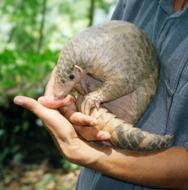
The Indian Pangolin has large overlapping scales covering its upper face and body, except for its belly and the insides of its legs. These protective scales are rigid, composed of keratin, and account for approximately one-quarter to one-third of its total body mass.[1][2][3]
Its head is cone-shaped, with small dark eyes and a long muzzle. Its limbs are powerful and terminate in digits equipped with sharp claws, and it has no teeth.[4][5][6]
Adults typically weigh between 10 and 16 kg, while the highest recorded adult weight is 20 kg. Fully grown individuals have a reported total body length ranging from 45 to 147 cm.[7][8][9]
Its tongue extends an average of 25 cm beyond its mouth and measures 42.5 cm in total length.[10]
Habitat
The Indian Pangolin inhabits grasslands, secondary forests, subtropical thorn forests, tropical forests, and open land. It also occurs in areas close to villages and in the Salt Range.[11][12][13]
It has been recorded in Sri Lankan rainforests at elevations extending from plains to middle hill levels. It prefers soft, semi-sandy soils suitable for digging burrows.[14][15]
In Buner District, active burrows were associated with north- and east-facing slopes, loamy soils, rocky substrates, moderate canopy cover, and dense understory vegetation. Resting burrows were frequently associated with Lantana camara and Punica granatum, while feeding burrows were commonly associated with Dalbergia sissoo and Acacia modesta.[16][17][18]
Diet
The Indian Pangolin feeds principally on ants and termites. It also consumes beetles and cockroaches, including the eggs, larvae, and adults of its insect prey, with eggs being its preferred food stage.[19][20][21]
In the Potohar region of Punjab, Camponotus confuci and Camponotus compressus constituted the majority of its recorded diet.[22]
The species uses its sense of smell to locate ant nests and termite mounds. It captures ants and termites using a long, sticky tongue.[23][24]
Behaviour
The Indian Pangolin is solitary, shy, slow-moving, and nocturnal. Its activity is concentrated between approximately 17:00 and 05:00, and it rests in deep burrows during daylight hours.[25][26][27]
The species constructs separate feeding and living burrows. Living burrows are wider, deeper, and more circular than feeding burrows.[28][29]
When threatened by predators, the Indian Pangolin curls into an armored ball. It can produce hissing noises when stressed or attacked and may release unpleasant-smelling secretions from its anal glands to deter predators.[30][31][32]
Reproduction and life cycle
The mating period is believed to occur between July and October. The gestation period generally lasts 65–70 days, and females usually give birth to one offspring, although twins have been reported.[33][34][35]
Newborn individuals weigh approximately 235–400 g and measure approximately 30 cm at birth. The mother carries her offspring on her tail.[36][37][38]
Young individuals are generally weaned after approximately six months. Sexual maturity is believed to occur between one and two years of age.[39][40]
Conservation
The Indian Pangolin is listed as Endangered on the IUCN Red List. It has been included in CITES Appendix I since January 2017.[41][42]
Poaching and illegal international trade are identified as threats to the species. Habitat loss through deforestation is an additional threat.[43][44]
Uses
Its skins are used to manufacture leather products, including boots and shoes.[45]
Classification of the Indian Pangolin
| Kingdom | Animalia |
|---|---|
| Phylum | Chordata |
| Subphylum | Vertebrata |
| Infraphylum | Gnathostomata |
| Parvphylum | Osteichthyes |
| Megaclass | Tetrapoda |
| Class | Mammalia (Mammal) |
| Subclass | Theria |
| Infraclass | Eutheria |
| Order | Pholidota (Pangolins) |
| Family | Manidae (Pangolins) |
| Subfamily | Maninae (Asian Pangolins) |
| Genus | Manis (Asian Pangolins) |
| Species | Manis crassicaudata É. Geoffroy Saint-Hilaire, 1803 |
Where the Indian Pangolin is found
Checklists and occurrence records place Manis crassicaudata in 5 countries across Asia. GBIF holds 134 georeferenced records of it.
Countries
Regions and cities with the most records
- Madhya Pradesh, India 8
- Bhimdatta, Nepal 7
- Tamil Nadu, India 7
- Bharatpur, Nepal 4
- Karnataka, India 4
- Uttarakhand, India 4
- Valparai, India 4
- Dambulla, Sri Lanka 3
Range as the checklists state it
Southern Asia
A number beside a place is its count of GBIF occurrence records. A place without a number comes from a checklist alone. Records show where a species has been observed or collected, which can include escapes and vagrants.
Common names
English
- Indian Pangolin
- Thick-tailed Pangolin
Names in 2 other languages
- French
- Grand pangolin de l'Inde, Pangolin à grosse queue
- Spanish
- Pangolín Indio
Synonyms
2 other scientific names have been used for this species and are now treated as synonyms of Manis crassicaudata.
- Manis crassicaudata Gray, 1827
- Pholidotus indicus Gray, 1865
Related species
-
 Sunda PangolinManis javanica
-
 Chinese PangolinManis pentadactyla
-
 Philippine PangolinManis culionensis
- Cryptic PangolinManis mysteria
- Indo-Burmese PangolinManis indoburmanica
-
 Ground PangolinSmutsia temminckii
-
 Giant PangolinSmutsia gigantea
-
 Long-tailed PangolinPhataginus tetradactyla
Compare
Questions and answers
What is the scientific name of the Indian Pangolin?
The scientific name of the Indian Pangolin is Manis crassicaudata. Written with its author, the full name is Manis crassicaudata É. Geoffroy Saint-Hilaire, 1803.
Which family does the Indian Pangolin belong to?
Manis crassicaudata belongs to the family Manidae, in the order Pholidota and the class Mammalia.
Where is the Indian Pangolin found?
Checklists and occurrence records place Manis crassicaudata in 5 countries: India, Sri Lanka, China, Nepal and Pakistan.
What is the conservation status of the Indian Pangolin?
The IUCN Red List category recorded for Manis crassicaudata is Endangered (EN).
What other names does the Indian Pangolin have?
Manis crassicaudata is also known in English as Thick-tailed Pangolin.
What is the habitat of the Indian pangolin?
The Indian Pangolin inhabits grasslands, secondary forests, subtropical thorn forests, tropical forests, and open land. It also occurs in areas close to villages, the Salt Range, and Sri Lankan rainforests. It prefers soft, semi-sandy soils suitable for digging burrows.[11][14][15][12][13]
What do Indian pangolins eat?
Indian Pangolins feed principally on ants and termites. They also consume beetles and cockroaches, including eggs, larvae, and adults of their insect prey. Eggs are their preferred food stage.[19][20][21]
Sources
Passages the profile rests on
- The Indian pangolin has large overlapping scales covering its upper face and body, except for its belly and the insides of its legs. Source passage: “its massive, scaled armour which covers its upper face and its whole body with the exception of the belly and the inside of the legs.” — English Wikipedia
- Its protective scales are rigid and composed of keratin. Source passage: “These protective scales are rigid and made of keratin.” — English Wikipedia
- Its scales account for approximately one-quarter to one-third of its total body mass. Source passage: “These scales are composed of keratin and make up 1/4 to 1/3 of the body mass of Indian pangolins.” — animaldiversity.org
- Its head is cone-shaped, with small dark eyes and a long muzzle. Source passage: “The pangolin possesses a cone-shaped head with small, dark eyes, and a long muzzle” — English Wikipedia
- Its limbs are powerful and terminate in digits equipped with sharp claws. Source passage: “It has powerful limbs, tipped with sharp, clawed digits.” — English Wikipedia
- The Indian pangolin has no teeth. Source passage: “The pangolin has no teeth” — English Wikipedia
- Adults typically weigh between 10 and 16 kg. Source passage: “weighs 10–16 kg (22–35 lb).” — English Wikipedia
- Fully grown individuals have a reported total body length ranging from 45 to 147 cm. Source passage: “The total body length of fully grown Indian pangolins ranges from 45 to 147 cm.” — animaldiversity.org
- The highest recorded adult weight reported in the document is 20 kg. Source passage: “with the highest recorded weight at 20 kg.” — animaldiversity.org
- Its tongue extends an average of 25 cm beyond its mouth and measures 42.5 cm in total length. Source passage: “Their tongues extend an average of 25 cm from their mouths and measure 42.5 cm in total length” — animaldiversity.org
- The species inhabits grasslands and secondary forests. Source passage: “It inhabits grasslands and secondary forests” — English Wikipedia
- The species occurs in subtropical thorn forests and the Salt Range. Source passage: “They reside in subtropical thorn forests as well as the Salt Range.” — animaldiversity.org
- It can inhabit tropical forests, open land, grasslands, and areas close to villages. Source passage: “Indian pangolins have also been shown to survive in various types of tropical forests, open land, grasslands, and in close proximity to villages.” — animaldiversity.org
- It has been recorded in Sri Lankan rainforests and at elevations extending from plains to middle hill levels. Source passage: “including Sri Lankan rainforest and plains to middle hill levels.” — English Wikipedia
- It prefers soft, semi-sandy soils suitable for digging burrows. Source passage: “It prefers soft and semi-sandy soil conditions suitable for digging burrows.” — English Wikipedia
- In Buner District, active burrows were associated with north- and east-facing slopes, loamy soils, rocky substrates, moderate canopy cover, and dense understory vegetation. Source passage: “was associated with north- and east-facing slopes, loamy soils, rocky substrates, moderate canopy cover (41%–70%), and dense understory vegetation.” — pmc.ncbi.nlm.nih.gov
- In Buner District, resting burrows were frequently associated with Lantana camara and Punica granatum. Source passage: “resting burrows were frequently linked to Lantana camara and Punica granatum” — pmc.ncbi.nlm.nih.gov
- In Buner District, feeding burrows were commonly associated with Dalbergia sissoo and Acacia modesta. Source passage: “feeding burrows were commonly associated with Dalbergia sissoo , Acacia modesta” — pmc.ncbi.nlm.nih.gov
- The Indian pangolin feeds principally on ants and termites. Source passage: “principally subsists on ants and termites” — English Wikipedia
- It also consumes beetles and cockroaches. Source passage: “but also forages for beetles and cockroaches.” — English Wikipedia
- It consumes eggs, larvae, and adults of its insect prey, with eggs being its preferred food stage. Source passage: “It feeds on the eggs, larvae, and adults of its prey, but eggs are the preferred choice.” — English Wikipedia
- In the Potohar region of Punjab, Camponotus confuci and Camponotus compressus constituted the majority of its recorded diet. Source passage: “the majority of its diet was found to consist of two types of ants, Camponotus confuci and Camponotus compressus.” — English Wikipedia
- The species uses a long, sticky tongue to capture ants and termites. Source passage: “which it catches with a specially adapted long, sticky tongue.” — English Wikipedia
- The Indian pangolin uses its sense of smell to locate ant nests and termite mounds. Source passage: “uses its well-developed sense of smell to locate ant nests or termite mounds and other food sources.” — English Wikipedia
- The Indian pangolin is solitary, shy, slow-moving, and nocturnal. Source passage: “The Indian pangolin is a solitary, shy, slow-moving, nocturnal mammal.” — English Wikipedia
- Its activity is concentrated between approximately 17:00 and 05:00. Source passage: “mostly active intermittently between 17:00 and 05:00 hr.” — English Wikipedia
- It rests in deep burrows during daylight hours. Source passage: “It is nocturnal and rests in deep burrows during the day.” — English Wikipedia
- The species constructs separate feeding and living burrows. Source passage: “Pangolin burrows fall into one of two categories: feeding and living burrows.” — English Wikipedia
- Living burrows are wider, deeper, and more circular than feeding burrows. Source passage: “Living burrows are wider, deeper, and more circular” — English Wikipedia
- It defends itself against predators by curling into an armored ball. Source passage: “It can also curl itself into a ball as self-defence against predators such as the tiger.” — English Wikipedia
- The Indian pangolin can produce hissing noises when stressed or attacked. Source passage: “They also give off hissing noises when stressed or attacked.” — animaldiversity.org
- It may release unpleasant-smelling secretions from its anal glands to deter predators. Source passage: “They may also produce bad-smelling secretions from their anal glands to scare off predators.” — animaldiversity.org
- The gestation period generally lasts 65–70 days. Source passage: “The gestation period lasts 65–70 days” — English Wikipedia
- Females usually give birth to one offspring, although twins have been reported. Source passage: “Usually, a single young is born, but twins have been reported in this species.” — English Wikipedia
- The mating period is believed to occur between July and October. Source passage: “it is believed that their mating period is between July and October.” — animaldiversity.org
- Newborn individuals weigh approximately 235–400 g. Source passage: “The young weigh 235–400 g at birth” — English Wikipedia
- The young measure approximately 30 cm at birth. Source passage: “and measure roughly 30 cm.” — English Wikipedia
- The mother carries her offspring on her tail. Source passage: “The mother pangolin carries her young on her tail.” — English Wikipedia
- Young individuals are generally weaned after approximately six months. Source passage: “This lasts on average 6 months, after which the offspring are weaned and begin to eat ants and termites.” — animaldiversity.org
- Sexual maturity is believed to occur between one and two years of age. Source passage: “They are believed to reach sexual maturity after 1 to 2 years.” — animaldiversity.org
- The Indian pangolin is listed as Endangered on the IUCN Red List. Source passage: “The Indian pangolin is currently listed as Endangered on the IUCN Red List of Threatened Species” — pmc.ncbi.nlm.nih.gov
- The species has been included in CITES Appendix I since January 2017. Source passage: “The Indian pangolin is listed on CITES Appendix I since January 2017” — English Wikipedia
- Poaching and illegal international trade are identified as threats to the species. Source passage: “Major threats identified through field observations and community surveys included poaching, illegal trade, habitat degradation, marble mining, and unregulated infrastructure development” — pmc.ncbi.nlm.nih.gov
- Habitat loss through deforestation is an additional threat to the species. Source passage: “Other threats include habitat loss, e.g. through deforestation.” — English Wikipedia
- Its skins are used to manufacture leather products, including boots and shoes. Source passage: “The skins are used to manufacture leather goods, including boots and shoes.” — English Wikipedia
Data
- Catalogue of Life, 2026-10-16 XR cc by
- Global Biodiversity Information Facility CC BY 4.0
- Wikidata CC0
- GeoNames CC BY 4.0
- Wikimedia Commons per image; credit shown with each image
- Within the Catalogue of Life, this name comes from The Integrated Taxonomic Information System cc0
References
- Cat. Mamm. Mus. H. N. Paris p.213 where the name was published
- Wilson, Don E., and F. Russell Cole. (2000). Common Names of Mammals of the World.
- Wilson, Don E., and DeeAnn M. Reeder, eds. (2005). Mammal Species of the World: A Taxonomic and Geographic Reference, 3rd Ed., Vols. 1 & 2.
- Wilson, D. E., and R. A. Mittermeier, eds. (2011). Handbook of the Mammals of the World, Vol. 2: Hoofed Mammals.
- Burgin, Connor J., Don E. Wilson, Russell A. Mittermeier, Anthony B. Rylands, et al. (2020). Illustrated Checklist of the Mammals of the World. Vol. 2. Eulipotyphla to Carnivora.
This species in other databases
Page built on 26 November 2026. See how the catalog is made and all sources and licences.
Cite this page
ScientificNames.org. (2026). Manis crassicaudata (Indian Pangolin). Retrieved November 26, 2026, from https://scientificnames.org/species/manis-crassicaudata
“Manis crassicaudata (Indian Pangolin).” ScientificNames.org, 2026, scientificnames.org/species/manis-crassicaudata. Accessed 26 Nov. 2026.
ScientificNames.org. “Manis crassicaudata (Indian Pangolin).” Accessed November 26, 2026. https://scientificnames.org/species/manis-crassicaudata.
@misc{scientificnames_manis_crassicaudata_indian_pangolin,
  author = {{ScientificNames.org}},
  title = {Manis crassicaudata (Indian Pangolin)},
  year = {2026},
  url = {https://scientificnames.org/species/manis-crassicaudata},
  note = {Accessed 2026-11-26}
}