Comparison
Chirodectes maculatus vs Australian Box Jellyfish
Chirodectes maculatus (Chirodectes maculatus) and Australian Box Jellyfish (Chironex fleckeri) both belong to the family Chirodropidae and part ways below it.


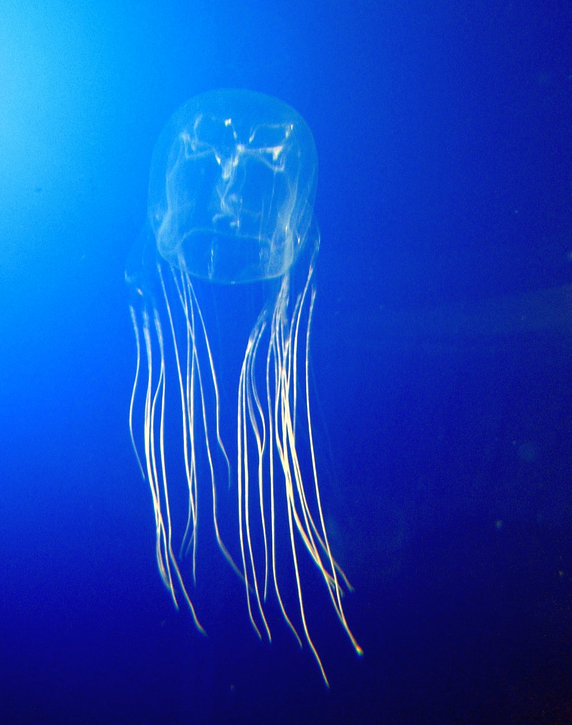
Australian Box Jellyfish
Chironex fleckeri
Avispa marina.jpg: Guido Gautsch, Toyota, Japan derivative work: Mithril (talk), CC BY-SA 2.0, via Wikimedia Commons

Side by side
| Chirodectes maculatus | Australian Box Jellyfish | |
|---|---|---|
| Scientific name | Chirodectes maculatus (Cornelius, Fenner & Hore, 2005) | Chironex fleckeri Southcott, 1956 |
| English name | Not recorded | Australian Box Jellyfish |
| Group | Other invertebrates | Other invertebrates |
| Class | Cubozoa Box Jellyfish | Cubozoa Box Jellyfish |
| Order | Chirodropida | Chirodropida |
| Family | Chirodropidae | Chirodropidae |
| Genus | Chirodectes | Chironex Lethal Sea Wasps |
| Named in | 2005 | 1956 |
| Environment | marine | marine |
| Countries on record | Not recorded | 1 country |
| GBIF occurrence records | Not recorded | 199 records |
Rows where the two agree are shown in grey.
Where each is found
Only Australian Box Jellyfish (1)
From Catalogue of Life checklists and GBIF occurrence records. A country missing from a list means no record is held, which is not proof of absence.
Checked facts
| Chirodectes maculatus | Australian Box Jellyfish | |
|---|---|---|
| Appearance | No checked fact yet |
|
| Size |
|
|
| Habitat |
|
|
| Diet | No checked fact yet |
|
| Behaviour |
|
|
| Reproduction | No checked fact yet |
|
| Distribution |
| No checked fact yet |
| Conservation | No checked fact yet |
|
| Uses | No checked fact yet |
|
| Other |
|
|
In brief
Chirodectes maculatus
Chirodectes maculatus is a species in the genus Chirodectes. The first scientifically studied specimen was collected near the outer edge of the Great Barrier Reef, approximately 43 km off northeastern Queensland, within 5 metres of the sea surface. The examined specimen neither stung nor adhered to a volunteer's hand or forearm. Full profile
Australian Box Jellyfish
Chironex fleckeri inhabits shallow, murky saline waters near Australia. Full profile
Compare something else
Page built on 28 November 2026 from the data on the two species pages, where every source is listed.
Cite this page
ScientificNames.org. (2026). Chirodectes maculatus vs Australian Box Jellyfish. Retrieved November 28, 2026, from https://scientificnames.org/compare/chirodectes-maculatus-vs-australian-box-jellyfish
“Chirodectes maculatus vs Australian Box Jellyfish.” ScientificNames.org, 2026, scientificnames.org/compare/chirodectes-maculatus-vs-australian-box-jellyfish. Accessed 28 Nov. 2026.
ScientificNames.org. “Chirodectes maculatus vs Australian Box Jellyfish.” Accessed November 28, 2026. https://scientificnames.org/compare/chirodectes-maculatus-vs-australian-box-jellyfish.
@misc{scientificnames_chirodectes_maculatus_vs_australian_box_jellyfish,
  author = {{ScientificNames.org}},
  title = {Chirodectes maculatus vs Australian Box Jellyfish},
  year = {2026},
  url = {https://scientificnames.org/compare/chirodectes-maculatus-vs-australian-box-jellyfish},
  note = {Accessed 2026-11-28}
}