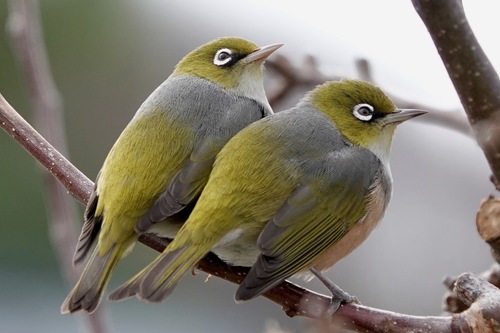
| Appearance | - The species has an orange-yellow head, a pale eye-ring, yellow-green back, wings and tail, and golden-orange undersides. English Wikipedia
- Both sexes have similar plumage, but males have longer wings than females. English Wikipedia
- Juveniles have duller plumage than adults, with brownish facial and neck patches and brown-yellow breast streaks. English Wikipedia
- Juveniles have dusky bills and dull legs. English Wikipedia
- The species has large eyes and an outermost primary wing feather that is not reduced. English Wikipedia
- The species has orange-colored bills and legs. English Wikipedia
| |
|---|
| Size | | |
|---|
| Habitat | - The species inhabits native forests, particularly limestone forests. English Wikipedia
- The golden white-eye also occurs in open shrubland and suburban areas. English Wikipedia
- On Saipan, the species is absent from the marshes around Lake Susupe and grassy savannas. English Wikipedia
| - The silvereye occurs in vegetated habitats other than open grasslands within its distribution range. English Wikipedia
- Its habitats include forests, scrub, horticultural blocks and urban gardens. English Wikipedia
|
|---|
| Diet | | - The silvereye feeds on small insects and spiders, as well as fruit and nectar. English Wikipedia
- Its diet includes berries in addition to insects, spiders, fruit and nectar. English Wikipedia
- In New Zealand, the silvereye consumes fruit from kahikatea and rimu trees. English Wikipedia
- Silvereyes consume insects that are harmful to garden and orchard produce, including aphids, scale insects and diamondback moths. English Wikipedia
|
|---|
| Behaviour | - The golden white-eye is active during daylight hours. English Wikipedia
- The species generally forages in pairs or small family groups. English Wikipedia
- The golden white-eye is territorial and its pairs sing throughout the day in response to neighboring pairs. English Wikipedia
- Groups of golden white-eyes can become aggressive when encountering one another. English Wikipedia
- The species aggressively chases bridled white-eyes away from food and perches. English Wikipedia
- The golden white-eye is socially dominant over bridled white-eyes and rufous fantails. English Wikipedia
- The species produces a long, raspy warbling song. English Wikipedia
- The species also produces short rasping calls and whistles when flying or in flocks. English Wikipedia
| - Silvereyes gather into flocks in late summer. English Wikipedia
- Many Australian silvereyes migrate northwards along the coast and mountain ranges. English Wikipedia
- Migrating silvereyes forage during the day and undertake long-distance flights at night. English Wikipedia
- Most of the Tasmanian population crosses Bass Strait and disperses into Victoria, New South Wales and south-eastern Queensland. English Wikipedia
- Northernmost populations of silvereyes in Australia remain resident throughout the year. English Wikipedia
- In western Australia, silvereyes have been recorded moving between the mainland and offshore islands. English Wikipedia
|
|---|
| Reproduction | - The golden white-eye is monogamous. English Wikipedia
- Breeding occurs throughout the year on Saipan, with a peak period from March to July. English Wikipedia
- The species builds simple, undecorated cup nests from casuarina needles, grasses and vines. English Wikipedia
- Nests are typically positioned approximately 2.9 m above the ground. English Wikipedia
- The species typically lays two eggs per clutch. English Wikipedia
- The eggs measure approximately 20.3 by 15.1 mm. English Wikipedia
- The eggs are pale bluish-green with red or brown spots concentrated around their wider ends. English Wikipedia
- Both parents share incubation duties, taking turns in approximately 25-minute shifts. English Wikipedia
- Golden white-eye eggs hatch approximately two weeks after being laid. English Wikipedia
- Chicks fledge approximately 10–14 days after hatching. English Wikipedia
- The chicks' diet consists almost entirely of insects and caterpillars. English Wikipedia
| - Silvereyes breed during spring and early summer, mainly between September and December. English Wikipedia
- Silvereyes construct small cup-shaped nests from grass, moss, hair, spiderweb and thistledown. English Wikipedia
- Silvereyes suspend their nests from branch forks in the outer portions of small trees or shrubs. English Wikipedia
- A silvereye clutch contains two to four pale blue eggs. English Wikipedia
- Silvereyes may raise two or three broods during one breeding season. English Wikipedia
- Silvereye eggs hatch after approximately 11 days of incubation. English Wikipedia
- Silvereye nestlings fledge approximately 10 days after hatching. English Wikipedia
- Juvenile silvereyes become independent at approximately three weeks of age. English Wikipedia
|
|---|
| Distribution | - The golden white-eye is endemic to the Northern Mariana Islands in the western Pacific Ocean. English Wikipedia
- The species currently occurs on Saipan and Aguijan. English Wikipedia
- Fossil remains indicate that the species formerly occurred on Tinian and Rota. English Wikipedia
- The species occurs on Saipan, which covers 115 km², and uninhabited Aguiguan, which covers 7 km². datazone.birdlife.org
| - The silvereye is native to Australia, New Zealand and several south-west Pacific island groups. English Wikipedia
- The silvereye is common to abundant in the relatively fertile south-western and south-eastern regions of Australia. English Wikipedia
- Its Australian distribution includes Tasmania and the Bass Strait islands. English Wikipedia
- The silvereye occurs along the well-watered coastal region of tropical Queensland, including Cape York Peninsula. English Wikipedia
- The species was first recorded in New Zealand in 1832 and arrived in greater numbers in 1856. English Wikipedia
|
|---|
| Conservation | - The golden white-eye is classified as Endangered. English Wikipedia
- The brown tree snake is the species' primary conservation threat. English Wikipedia
- The golden white-eye population is expected to decline rapidly if the brown tree snake becomes established on Saipan. English Wikipedia
- Twenty-four golden white-eyes were transferred from Saipan to Sarigan in 2011 to establish a breeding population. English Wikipedia
| |
|---|
| Uses | No checked fact yet | - Silvereyes provide a beneficial service in gardens and orchards by consuming insects that damage produce. English Wikipedia
- Silvereyes can be regarded as agricultural and horticultural pests because they consume fruit crops and pass through bird netting. English Wikipedia
- Silvereyes are attracted to apples, citrus, feijoas, figs, grapes, pears and persimmons. English Wikipedia
|
|---|