Species · Birds
Golden White-eye Cleptornis marchei
The scientific name of the Golden White-eye is Cleptornis marchei. It is a species of bird in the family Zosteropidae (white-eye), order Passeriformes. The name dates from 1889.
- Scientific name
- Cleptornis marchei (Oustalet, 1889)
- Common name
- Golden White-eye
- Genus
- Cleptornis
- Family
- Zosteropidae (White-eye)
- Order
- Passeriformes
- Class
- Aves
- Red List category
- EN Endangered
- Recorded in
- 1 country
- Name status
- accepted in the Catalogue of Life

Overview
The species is endemic to the Northern Mariana Islands and currently occurs on Saipan and Aguijan. It has an orange-yellow head, a pale eye-ring, yellow-green upperparts and golden-orange undersides.
Written 26 November 2026 from the sources listed below. Each statement was checked against the passage it cites; statements that could not be supported were removed.
Conservation
The Golden White-eye is classified as Endangered. Its primary conservation threat is the brown tree snake, and its population is expected to decline rapidly if the snake becomes established on Saipan.[1][2][3]
In 2011, twenty-four Golden White-eyes were transferred from Saipan to Sarigan to establish a breeding population.[4]
Appearance
The Golden White-eye has an orange-yellow head, a pale eye-ring, yellow-green back, wings and tail, and golden-orange undersides. Its bill and legs are orange-colored.[5][6]
Both sexes have similar plumage, but males have longer wings than females. The species has large eyes and an outermost primary wing feather that is not reduced.[7][8]
Juveniles have duller plumage than adults, with brownish facial and neck patches and brown-yellow breast streaks. Their bills are dusky and their legs are dull.[9][10]
The Golden White-eye measures approximately 14 cm in length and weighs approximately 20 g.[11][12]
Habitat
The Golden White-eye inhabits native forests, particularly limestone forests. It also occurs in open shrubland and suburban areas.[13][14]
On Saipan, the species is absent from the marshes around Lake Susupe and grassy savannas.[15]
The species currently occurs on Saipan, which covers 115 km², and uninhabited Aguiguan, which covers 7 km².[16][17]
Fossil remains indicate that the Golden White-eye formerly occurred on Tinian and Rota.[18]
Diet
The Golden White-eye feeds on fruit, berries, insects and nectar. It obtains insects by gleaning them from tree bark and leaves or catching them in the air.[19][20][21]
The species also obtains insects from dead leaves and branches. It forages in both the forest canopy and understory, with Cynometra ramifolia as its most frequently used foraging tree.[22][23][24]
The Golden White-eye is a pollinator of some trees.[25]
Behaviour
The Golden White-eye is active during daylight hours and generally forages in pairs or small family groups. It is territorial, and pairs sing throughout the day in response to neighboring pairs.[26][27][28]
Groups can become aggressive when encountering one another. The species aggressively chases bridled white-eyes away from food and perches and is socially dominant over bridled white-eyes and rufous fantails.[29][30][31]
The Golden White-eye produces a long, raspy warbling song. It also produces short rasping calls and whistles when flying or in flocks.[32][33]
Similar species
The Golden White-eye is socially dominant over bridled white-eyes and rufous fantails. It aggressively chases bridled white-eyes away from food and perches.[30][31]
Reproduction and life cycle
The Golden White-eye is monogamous. Breeding occurs throughout the year on Saipan, with a peak period from March to July.[34][35]
The species builds simple, undecorated cup nests from casuarina needles, grasses and vines. Nests are typically positioned approximately 2.9 m above the ground.[36][37]
The species typically lays two eggs per clutch. The eggs measure approximately 20.3 by 15.1 mm and are pale bluish-green with red or brown spots concentrated around their wider ends.[38][39][40]
Both parents share incubation duties, taking turns in approximately 25-minute shifts. The eggs hatch approximately two weeks after being laid.[41][42]
Chicks fledge approximately 10–14 days after hatching. Their diet consists almost entirely of insects and caterpillars.[43][44]
Classification of the Golden White-eye
| Kingdom | Animalia |
|---|---|
| Phylum | Chordata |
| Subphylum | Vertebrata |
| Infraphylum | Gnathostomata |
| Parvphylum | Osteichthyes |
| Megaclass | Tetrapoda |
| Class | Aves (Bird) |
| Order | Passeriformes (Passerine) |
| Family | Zosteropidae (White-eye) |
| Genus | Cleptornis (Golden Honeyeaters) |
| Species | Cleptornis marchei (Oustalet, 1889) |
Where the Golden White-eye is found
Checklists and occurrence records place Cleptornis marchei in 1 country across Oceania. GBIF holds 1,012 georeferenced records of it.
Countries
Regions and cities with the most records
- Saipan, Northern Mariana Islands 896
- Saipan, Northern Mariana Islands 863
- Tinian, Northern Mariana Islands 7
- Northern Islands, Northern Mariana Islands 5
1 more country has a few records outside this range
These countries hold a few records of Cleptornis marchei but lie outside the range the checklists give for it. Such records are often zoo or garden specimens, museum material or vagrants, so the species is not counted as occurring there.
Range as the checklists state it
Oceania
A number beside a place is its count of GBIF occurrence records. A place without a number comes from a checklist alone. Records show where a species has been observed or collected, which can include escapes and vagrants.
Common names
English
- Golden White-eye
- Golden Honeyeater
Names in 31 other languages
- Arabic
- أبيض العين الذهبي
- Bengali
- ক্লেপটরনিস মার্চেই
- Catalan
- Zosterop daurat, zostèrops daurat
- Chinese
- 金绣眼鸟, 金色繡眼
- Croatian
- zlatna bjelooka
- Czech
- kruhoočko zlaté
- Danish
- Gylden Brillefugl
- Dutch
- Gouden Brilvogel
- Esperanto
- ora zosteropo
- Finnish
- kultarilli, saipaninmesikko
- French
- Zostérops doré
- German
- Goldbrillenvogel, Goldhonigfresser
- Hungarian
- aranyos pápaszemesmadár
- Italian
- Occhialino dorato
- Japanese
- オウゴンミツスイ
- Lithuanian
- auksinis baltavokis
- Malayalam
- ഗോൾഡൻ വൈറ്റ്-ഐ
- Norwegian
- gyllenbrillefugl
- Persian
- چشمسفید طلایی
- Polish
- złotoszlarnik
- Portuguese
- olho-branco-dourado
- Russian
- Золотистая тахоу, Золотой медосос
- Serbian
- Zlatna belooka
- Slovak
- okánik pôvabný
- Spanish
- Anteojitos dorado
- Swedish
- gyllenglasögonfågel
- Turkish
- Altın Rengi Gözlükçü
- Ukrainian
- окулярник золотий
- cha
- Canario
- nav
- Nákʼeehgaii łitsxooígíí
- pnb
- دورنگی چٹی اکھ
Synonyms
One other scientific name has been used for this species and is now treated as a synonym of Cleptornis marchei.
- Ptilotis marchei Oustalet, J-FÉ, 1889
Related species
-
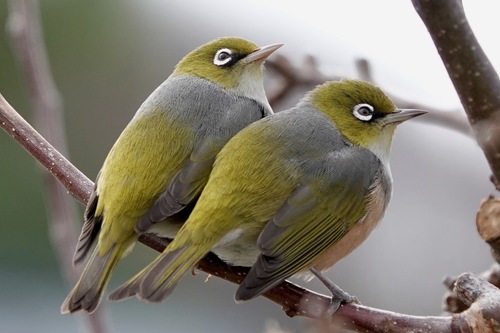 SilvereyeZosterops lateralis
-
 Warbling White-eyeZosterops japonicus
-
 Indian White-eyeZosterops palpebrosus
-
 White-chested White-eyeZosterops albogularis
-
 Bonin White-eyeApalopteron familiare
-
 Bridled White-eyeZosterops conspicillatus
-
 Green-backed White-eyeZosterops xanthochroa
-
 Mauritius Grey White-eyeZosterops mauritianus
Compare
Questions and answers
What is the scientific name of the Golden White-eye?
The scientific name of the Golden White-eye is Cleptornis marchei. Written with its author, the full name is Cleptornis marchei (Oustalet, 1889).
Which family does the Golden White-eye belong to?
Cleptornis marchei belongs to the family Zosteropidae, in the order Passeriformes and the class Aves.
Where is the Golden White-eye found?
Checklists and occurrence records place Cleptornis marchei in 1 country: Northern Mariana Islands.
What is the conservation status of the Golden White-eye?
The IUCN Red List category recorded for Cleptornis marchei is Endangered (EN).
What other names does the Golden White-eye have?
Cleptornis marchei is also known in English as Golden Honeyeater.
Sources
Passages the profile rests on
- The golden white-eye is classified as Endangered. Source passage: “The species is nonetheless evaluated as Endangered by the IUCN” — English Wikipedia
- The brown tree snake is the species' primary conservation threat. Source passage: “The primary threat to this species is the brown tree snake” — English Wikipedia
- The golden white-eye population is expected to decline rapidly if the brown tree snake becomes established on Saipan. Source passage: “the population is expected to undergo a rapid decline if the brown tree snake becomes established on Saipan.” — English Wikipedia
- Twenty-four golden white-eyes were transferred from Saipan to Sarigan in 2011 to establish a breeding population. Source passage: “24 birds were translocated from Saipan to the island of Sarigan, a predator-free island reserve, in 2011 in the hope of establishing a breeding population.” — English Wikipedia
- The species has an orange-yellow head, a pale eye-ring, yellow-green back, wings and tail, and golden-orange undersides. Source passage: “an orange-yellow head coupled with a pale eye-ring; a yellow-green back, wings, and tail; and golden orange undersides.” — English Wikipedia
- The species has orange-colored bills and legs. Source passage: “The bill and legs are also orange.” — English Wikipedia
- Both sexes have similar plumage, but males have longer wings than females. Source passage: “The plumage of both sexes is similar; the males can be told from the females only when examined in the hand, since the males have longer wings than the females.” — English Wikipedia
- The species has large eyes and an outermost primary wing feather that is not reduced. Source passage: “The golden white-eye differs from the other white-eyes in having large eyes and an outermost primary wing feather that is not reduced” — English Wikipedia
- Juveniles have duller plumage than adults, with brownish facial and neck patches and brown-yellow breast streaks. Source passage: “The juveniles have similar plumage, though duller than the adults', with brownish patches on the face and neck and brown-yellow streaks on the breast.” — English Wikipedia
- Juveniles have dusky bills and dull legs. Source passage: “Juveniles also have dusky bills and dull legs.” — English Wikipedia
- The golden white-eye measures approximately 14 cm in length. Source passage: “It is a large white-eye, 14 cm (5.5 in) long” — English Wikipedia
- The species weighs approximately 20 g. Source passage: “weighing around 20 g (0.7 oz).” — English Wikipedia
- The species inhabits native forests, particularly limestone forests. Source passage: “It is common in native forests, particularly limestone forests” — English Wikipedia
- The golden white-eye also occurs in open shrubland and suburban areas. Source passage: “but also occurs in open shrubland and suburban areas.” — English Wikipedia
- On Saipan, the species is absent from the marshes around Lake Susupe and grassy savannas. Source passage: “On Saipan, the only habitats it is absent from are the marshes around Lake Susupe and grassy savannas.” — English Wikipedia
- The species currently occurs on Saipan and Aguijan. Source passage: “where it currently occurs on the islands of Saipan and Aguijan.” — English Wikipedia
- The species occurs on Saipan, which covers 115 km², and uninhabited Aguiguan, which covers 7 km². Source passage: “occurring on Saipan (115 km2) and on the uninhabited Aguiguan (7 km2)” — datazone.birdlife.org
- Fossil remains indicate that the species formerly occurred on Tinian and Rota. Source passage: “Fossil bones of this species have been found on the nearby islands of Tinian and Rota” — English Wikipedia
- The golden white-eye feeds on fruit, berries and insects. Source passage: “The golden white-eye is a generalist, feeding on fruit, berries, and insects.” — English Wikipedia
- Nectar is also part of the species' diet. Source passage: “Nectar forms part of the diet” — English Wikipedia
- The species obtains insects by gleaning them from tree bark and leaves or catching them in the air. Source passage: “Insects may be either gleaned from the bark of trees and from leaves, or caught in the air.” — English Wikipedia
- Cynometra ramifolia is the species' most frequently used foraging tree. Source passage: “The common forest tree Cynometra ramifolia is the most favoured tree” — English Wikipedia
- The golden white-eye forages in both the forest canopy and understory. Source passage: “the golden white-eye feeding in both the canopy and understory of the forest” — English Wikipedia
- The species obtains insects from dead leaves and branches. Source passage: “feeding in dead leaves and branches” — English Wikipedia
- The species is a pollinator of some trees. Source passage: “the golden white-eye is a pollinator of some trees” — English Wikipedia
- The golden white-eye is active during daylight hours. Source passage: “Like other white-eyes, the golden white-eye is diurnal.” — English Wikipedia
- The species generally forages in pairs or small family groups. Source passage: “the golden white-eye occurs in pairs or small family groups consisting of a breeding pair and fledged young.” — English Wikipedia
- The golden white-eye is territorial and its pairs sing throughout the day in response to neighboring pairs. Source passage: “The golden white-eye is also territorial, and pairs will sing throughout the day in response to neighbouring pairs.” — English Wikipedia
- Groups of golden white-eyes can become aggressive when encountering one another. Source passage: “Groups can become aggressive when they encounter one another.” — English Wikipedia
- The species aggressively chases bridled white-eyes away from food and perches. Source passage: “chasing it away from food and perches” — English Wikipedia
- The golden white-eye is socially dominant over bridled white-eyes and rufous fantails. Source passage: “The golden white-eye is socially dominant over the bridled white-eyes and rufous fantails” — English Wikipedia
- The species produces a long, raspy warbling song. Source passage: “The song is a long raspy warble” — English Wikipedia
- The species also produces short rasping calls and whistles when flying or in flocks. Source passage: “The species also makes rasping shorter calls and whistles when in flocks and in flight.” — English Wikipedia
- The golden white-eye is monogamous. Source passage: “The species is monogamous.” — English Wikipedia
- Breeding occurs throughout the year on Saipan, with a peak period from March to July. Source passage: “Breeding occurs throughout the year on Saipan, where the species' nesting behaviour has been studied. The peak breeding period seems to be from March to July.” — English Wikipedia
- The species builds simple, undecorated cup nests from casuarina needles, grasses and vines. Source passage: “The nests are simple undecorated cups of casuarina needles, grasses, and vines.” — English Wikipedia
- Nests are typically positioned approximately 2.9 m above the ground. Source passage: “These are placed around 2.9 m (between 1.5 and 6.5 m) off the ground” — English Wikipedia
- The species typically lays two eggs per clutch. Source passage: “The typical clutch size is two eggs” — English Wikipedia
- The eggs measure approximately 20.3 by 15.1 mm. Source passage: “20.3 × 15.1 mm in size” — English Wikipedia
- The eggs are pale bluish-green with red or brown spots concentrated around their wider ends. Source passage: “which are pale blueish green with red or brown splotches that are concentrated around the wider end.” — English Wikipedia
- Both parents share incubation duties, taking turns in approximately 25-minute shifts. Source passage: “with each parent incubating for stints of around 25 minutes before being relieved.” — English Wikipedia
- Golden white-eye eggs hatch approximately two weeks after being laid. Source passage: “From laying it takes about two weeks for the eggs to hatch.” — English Wikipedia
- Chicks fledge approximately 10–14 days after hatching. Source passage: “Chicks fledge around 10–14 days after hatching.” — English Wikipedia
- The chicks' diet consists almost entirely of insects and caterpillars. Source passage: “The diet of the chicks is almost exclusively composed of insects and caterpillars.” — English Wikipedia
Data
- Catalogue of Life, 2026-10-16 XR cc by
- Global Biodiversity Information Facility CC BY 4.0
- Wikidata CC0
- GeoNames CC BY 4.0
- Wikimedia Commons per image; credit shown with each image
- Within the Catalogue of Life, this name comes from The Integrated Taxonomic Information System cc0
References
- Banks, R. C., R. W. McDiarmid, and A. L. Gardner. (1987). Checklist of Vertebrates of the United States, the U.S. Territories, and Canada. Resource Publication, No. 166.
- Banks, R. C., R. W. McDiarmid, A. L. Gardner, and W. C. Starnes. (2003). Checklist of Vertebrates of the United States, the U.S. Territories, and Canada.
- Gill, Frank, & and Minturn Wright. (2006). Birds of the World: Recommended English Names.
This species in other databases
Page built on 29 November 2026. See how the catalog is made and all sources and licences.
Cite this page
ScientificNames.org. (2026). Cleptornis marchei (Golden White-eye). Retrieved November 29, 2026, from https://scientificnames.org/species/cleptornis-marchei
“Cleptornis marchei (Golden White-eye).” ScientificNames.org, 2026, scientificnames.org/species/cleptornis-marchei. Accessed 29 Nov. 2026.
ScientificNames.org. “Cleptornis marchei (Golden White-eye).” Accessed November 29, 2026. https://scientificnames.org/species/cleptornis-marchei.
@misc{scientificnames_cleptornis_marchei_golden_white_eye,
  author = {{ScientificNames.org}},
  title = {Cleptornis marchei (Golden White-eye)},
  year = {2026},
  url = {https://scientificnames.org/species/cleptornis-marchei},
  note = {Accessed 2026-11-29}
}