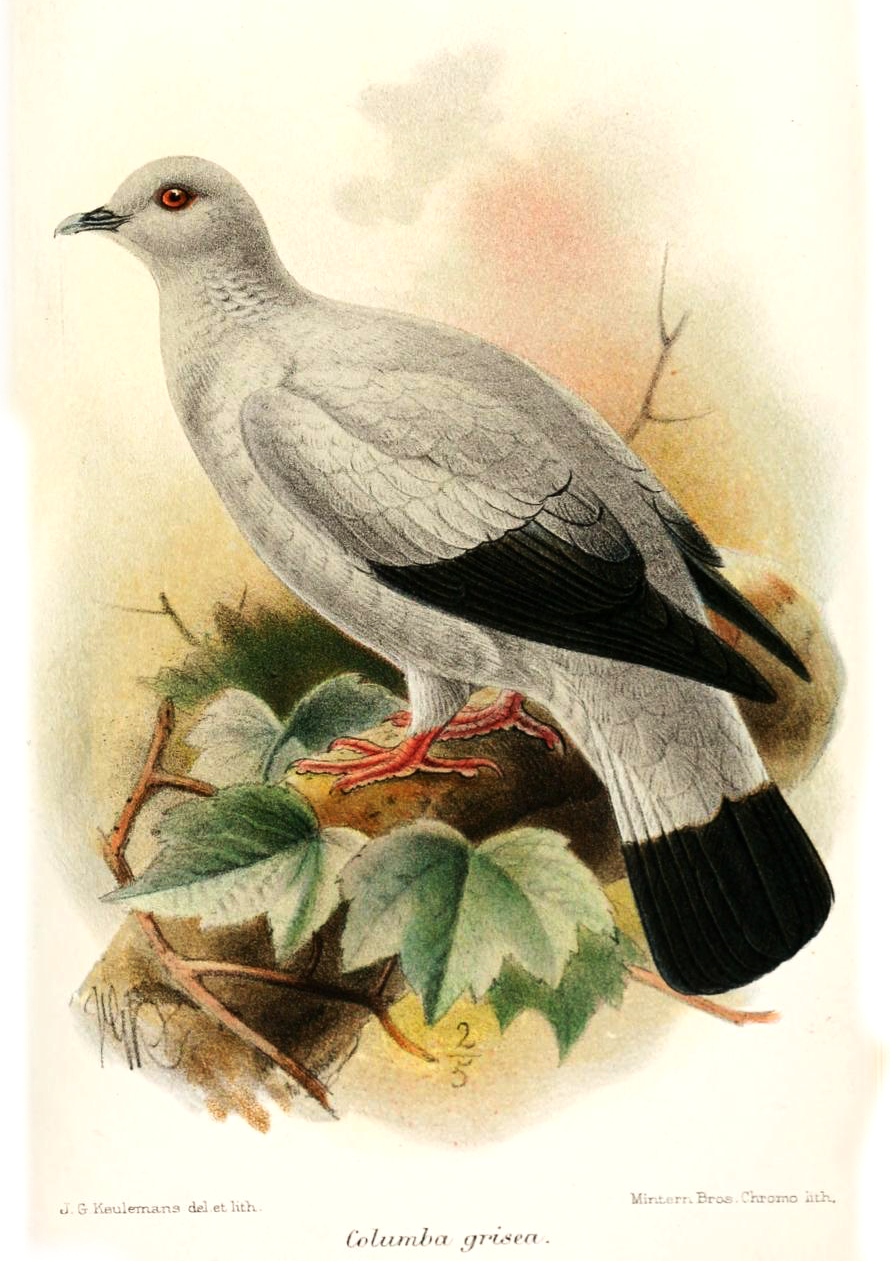
| Appearance | - The species has pale silvery-grey plumage with black flight feathers and black tips on its tail feathers. English Wikipedia
- The feathers on the back of the neck may have a slight greenish sheen. English Wikipedia
- Its forehead slopes rather than having a rounded profile. English Wikipedia
- Its eyes and surrounding wattles are conspicuously dark red or purplish. English Wikipedia
- Its bill is dusky purple with a pale apple-green tip and a darker base. English Wikipedia
- Its feet are bluish-grey and have varying amounts of red mottling. English Wikipedia
- Juveniles have apparently sandier-coloured feather fringes on their upperparts and breast. English Wikipedia
| - The stock dove has blue-toned grey plumage with two short dark wingbars and a broad dark grey bar at the tip of its tail. English Wikipedia
- The stock dove has a lightly pinkish-purple breast and an iridescent green-to-purple patch on each side of its neck. English Wikipedia
- The stock dove has dark eyes and a pink bill with a yellow tip. English Wikipedia
- Juvenile stock doves resemble adults but lack the iridescent neck patch. English Wikipedia
- The male and female stock dove have indistinguishable plumage, although males are slightly larger. English Wikipedia
- The stock dove has a dark grey underwing and a dark trailing edge on its grey wings. English Wikipedia
|
|---|
| Size | | |
|---|
| Habitat | - The species inhabits mangrove forests and other woodland on low-lying offshore islands and adjacent coastal regions. English Wikipedia
- Its recorded habitat occurs below 100 metres above sea level. English Wikipedia
| - The stock dove typically inhabits open wooded areas rather than densely wooded habitats. English Wikipedia
- The stock dove also inhabits coastal areas where cliffs provide nesting sites. English Wikipedia
- Stock doves commonly nest in cavities in old trees. English Wikipedia
- Stock doves have also been recorded nesting in rabbit burrows, ruins, poplar hedges, cliff cracks, ivy and lime-tree growth. English Wikipedia
- Stock doves also use nest boxes. English Wikipedia
|
|---|
| Diet | - The species is believed to move around in search of seasonal fruit. English Wikipedia
| - The stock dove's diet consists mainly of plant material, particularly young shoots and seedlings. English Wikipedia
- The stock dove also eats grain, insects and snails. English Wikipedia
- In some areas, acorns and pine seeds make up most of the stock dove's diet. English Wikipedia
- The stock dove consumes berries including bay and hawthorn, as well as figs, cereal grains, beans and peas. English Wikipedia
- The stock dove obtains small invertebrates while foraging on the ground. English Wikipedia
- During autumn migration in October, stock doves supplement their food intake with shoots and leaves at locations rich in acorns. English Wikipedia
- A molecular dietary study detected plants from the family Pinaceae in stock dove samples. pmc.ncbi.nlm.nih.gov
- Animal DNA was detected very rarely in the faecal samples of the studied columbiform birds, including stock doves. pmc.ncbi.nlm.nih.gov
- Plants from the class Spermatopsida dominated the diets of the studied columbiform birds, including stock doves. pmc.ncbi.nlm.nih.gov
|
|---|
| Behaviour | - The species has often been recorded associating with much larger flocks of Pied Imperial Pigeons. English Wikipedia
- Individuals observed in 2011 at Tanahbala in the Batu Islands were associating with Pied and Green Imperial Pigeons. English Wikipedia
| - The stock dove is sociable and gregarious. English Wikipedia
- Stock doves often associate with wood pigeons and occasionally associate with rock doves. English Wikipedia
- Stock doves generally form flocks containing a few to a few tens of individuals. English Wikipedia
- The stock dove flies quickly and regularly, occasionally making sharp flicks with its wings. English Wikipedia
- During courtship displays, stock doves walk along horizontal branches with swollen necks, lowered wings and fanned tails. English Wikipedia
- During spring circling flights, the stock dove produces a sharp wing sound resembling a whip crack. English Wikipedia
- The stock dove has a distinctive short, deep, grunting call. English Wikipedia
|
|---|
| Reproduction | - The species breeds in nesting colonies of Pied Imperial Pigeons. English Wikipedia
- Its breeding period probably extends over several months beginning around March or April. English Wikipedia
- The species builds a flimsy stick nest in trees. English Wikipedia
- The species lays a single white egg with a chalky rather than glossy shell. English Wikipedia
| - The stock dove generally lays two eggs per clutch. English Wikipedia
- Stock dove nests containing as many as six eggs have been recorded and are thought to result from other females laying eggs in existing nests. English Wikipedia
- Stock doves generally prefer to nest close together. English Wikipedia
- Stock doves seldom use nesting material. English Wikipedia
|
|---|
| Conservation | - BirdLife International classifies the species as Critically Endangered under category D1. English Wikipedia
- The estimated population is fewer than 50 mature individuals. English Wikipedia
- The population estimate is based on a lack of confirmed sightings. English Wikipedia
- Deforestation, particularly the removal of mangrove forests, adversely affects the species. English Wikipedia
- The introduction of alien predators such as feral cats threatens breeding on offshore islets. English Wikipedia
| - The stock dove is not considered threatened in Europe. English Wikipedia
- The stock dove is listed in Schedule 2 of the Birds Directive and Annex III of the Berne Convention. English Wikipedia
- The stock dove population in Europe is increasing. datazone.birdlife.org
- The estimated number of mature stock doves is between 1,700,000 and 2,860,000 individuals. datazone.birdlife.org
- The stock dove population in France experienced a sharp decline reported as 57% in 1976. English Wikipedia
|
|---|
| Similar species | - The Silvery Pigeon is difficult to distinguish from the Pied Imperial Pigeon at a distance. English Wikipedia
- The species is slightly smaller than the Pied Imperial Pigeon. English Wikipedia
- Its unusual colour pattern probably represents convergent evolution towards the Pied Imperial Pigeon. English Wikipedia
| No checked fact yet |
|---|
| Name origin | No checked fact yet | - The English name stock dove derives from the Old English word stocc, referring to a stump, post, stake, tree trunk or log. English Wikipedia
- The name stock dove refers approximately to a dove that lives in hollow trees. English Wikipedia
|
|---|