Species · Birds
Silvery Pigeon Columba argentina
The scientific name of the Silvery Pigeon is Columba argentina. It is a species of bird in the family Columbidae (doves), order Columbiformes. The name dates from 1855.
- Scientific name
- Columba argentina Bonaparte, 1855
- Common name
- Silvery Pigeon
- Genus
- Columba
- Family
- Columbidae (Doves)
- Order
- Columbiformes
- Class
- Aves
- Red List category
- CR Critically Endangered
- Recorded in
- 1 country
- Name status
- accepted in the Catalogue of Life
Overview
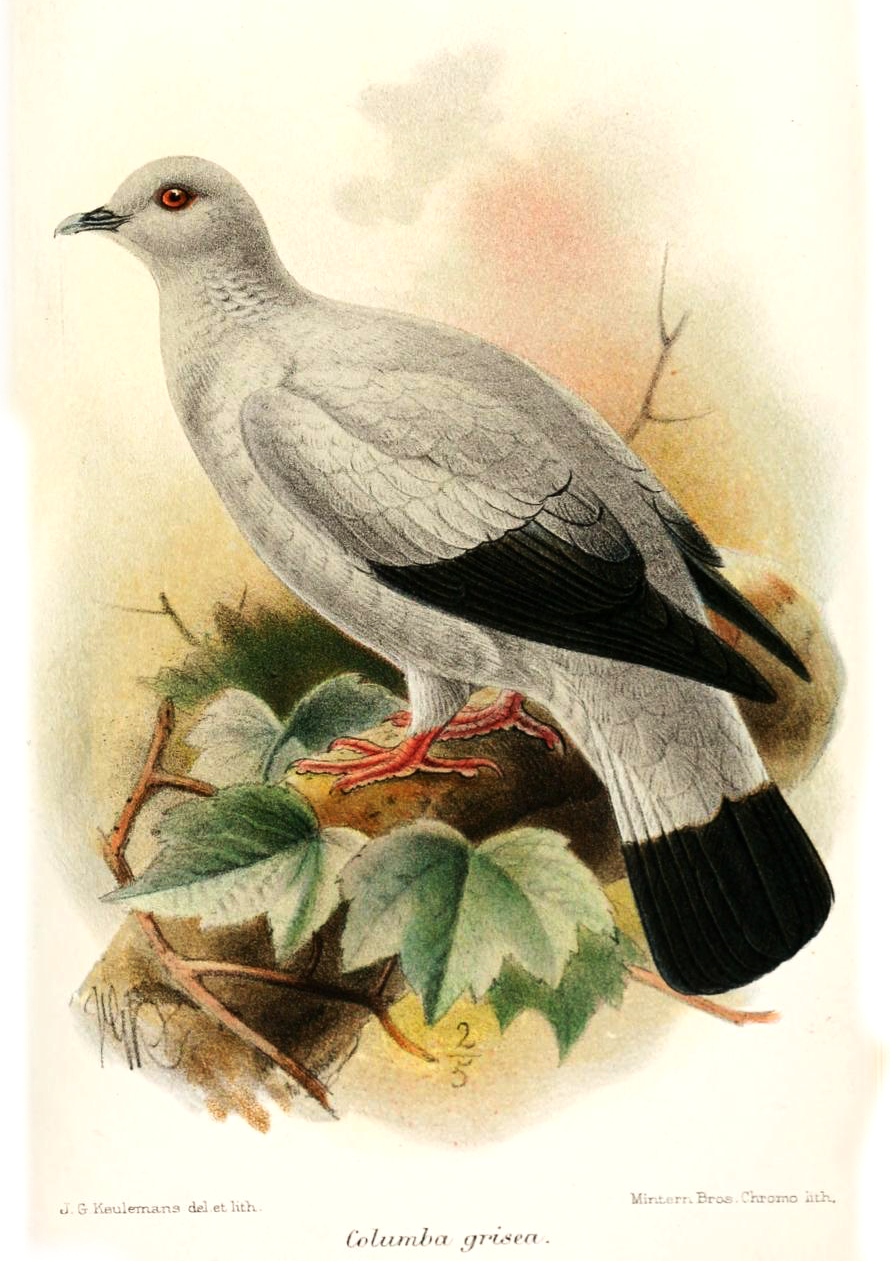
Columba argentina inhabits mangrove forests and other woodland on low-lying offshore islands and adjacent coastal regions, below 100 metres above sea level. It is distinguished by pale silvery-grey plumage, black flight feathers and tail tips, and conspicuously dark red or purplish eyes and surrounding wattles.
Written 26 November 2026 from the sources listed below. Each statement was checked against the passage it cites; statements that could not be supported were removed.
Similar species
The Silvery Pigeon is difficult to distinguish from the Pied Imperial Pigeon at a distance. It is slightly smaller than the Pied Imperial Pigeon.[1][2]
Its unusual colour pattern probably represents convergent evolution towards the Pied Imperial Pigeon.[3]
Appearance
The Silvery Pigeon has pale silvery-grey plumage, black flight feathers and black tips on its tail feathers. The feathers on the back of its neck may have a slight greenish sheen.[4][5]
Its forehead slopes rather than having a rounded profile. Its eyes and surrounding wattles are conspicuously dark red or purplish.[6][7]
Its bill is dusky purple, with a pale apple-green tip and a darker base. Its feet are bluish-grey, with varying amounts of red mottling.[8][9]
Juveniles apparently have sandier-coloured feather fringes on their upperparts and breast.[10]
The species has a total body length of approximately 36 cm and an estimated average weight of approximately 350 grams. Females are marginally larger than males on average.[11][12][13]
Habitat
The Silvery Pigeon inhabits mangrove forests and other woodland on low-lying offshore islands and adjacent coastal regions. Its recorded habitat occurs below 100 metres above sea level.[14][15]
Diet
The Silvery Pigeon is believed to move around in search of seasonal fruit.[16]
Behaviour
The Silvery Pigeon has often been recorded associating with much larger flocks of Pied Imperial Pigeons. Individuals observed at Tanahbala in the Batu Islands in 2011 were associating with Pied and Green Imperial Pigeons.[17][18]
Reproduction and life cycle
The Silvery Pigeon breeds in nesting colonies of Pied Imperial Pigeons. Its breeding period probably extends over several months, beginning around March or April.[19][20]
It builds a flimsy stick nest in trees and lays a single white egg with a chalky rather than glossy shell.[21][22]
Conservation
BirdLife International classifies the Silvery Pigeon as Critically Endangered under category D1. Its estimated population is fewer than 50 mature individuals, based on a lack of confirmed sightings.[23][24][25]
Deforestation, particularly the removal of mangrove forests, adversely affects the species. The introduction of alien predators such as feral cats threatens breeding on offshore islets.[26][27]
Classification of the Silvery Pigeon
| Kingdom | Animalia |
|---|---|
| Phylum | Chordata |
| Subphylum | Vertebrata |
| Infraphylum | Gnathostomata |
| Parvphylum | Osteichthyes |
| Megaclass | Tetrapoda |
| Class | Aves (Bird) |
| Order | Columbiformes (Doves) |
| Family | Columbidae (Doves) |
| Subfamily | Columbinae |
| Genus | Columba (Pigeons) |
| Species | Columba argentina Bonaparte, 1855 |
Where the Silvery Pigeon is found
Checklists and occurrence records place Columba argentina in 1 country across Asia. GBIF holds 25 georeferenced records of it.
Countries
Regions and cities with the most records
Range as the checklists state it
Southern Asia
A number beside a place is its count of GBIF occurrence records. A place without a number comes from a checklist alone. Records show where a species has been observed or collected, which can include escapes and vagrants.
Common names
English
- Silvery Pigeon
- Grey Wood-pigeon
- Silvery Wood Pigeon
- Silvery Wood-Pigeon
Names in 29 other languages
- Arabic
- حمام الغابات الفضي
- Catalan
- colom argentat
- Chinese
- 銀林鴿, 銀鴿, 银鸽
- Croatian
- srebrnasti golub
- Czech
- holub stříbrný
- Danish
- Sølvdue
- Dutch
- Zilverduif
- Esperanto
- arĝenta kolombo
- Estonian
- hõbetuvi
- Finnish
- hopeakyyhky
- French
- Pigeon argenté
- German
- Silbertaube
- Hungarian
- ezüstgalamb
- Indonesian
- Merpati-hutan perak
- Italian
- Colombaccio argentato
- Japanese
- ギンモリバト
- Lithuanian
- sidabrinis karvelis
- Persian
- کبوتر نقرهای
- Polish
- gołąb srebrzysty
- Portuguese
- pomba-prateada, pombo-prateado
- Russian
- Серебристый вяхирь, Серебристый голубь
- Serbian
- Srebrni šumski golub
- Slovak
- holub striebristý
- Spanish
- Paloma plateada
- Swedish
- silverduva
- Turkish
- Gümüş Güvercin
- Ukrainian
- голуб сріблястий
- Welsh
- ysguthan arian
- pnb
- چاندی کبوتر
Synonyms
3 other scientific names have been used for this species and are now treated as synonyms of Columba argentina.
- Columba phasma Richmond, CW, 1903
- Myristicivora argentea Bonaparte, CLJL, 1855
- Myristicivora grisea Bonaparte, CLJL, 1855
Related species
-
 Rock DoveColumba livia
-
 Common Wood PigeonColumba palumbus
-
 Stock DoveColumba oenas
-
 Speckled PigeonColumba guinea
-
 White-headed PigeonColumba leucomela
-
 Snow PigeonColumba leuconota
-
 Andaman Wood PigeonColumba palumboides
-
 Hill PigeonColumba rupestris
Compare
Questions and answers
What is the scientific name of the Silvery Pigeon?
The scientific name of the Silvery Pigeon is Columba argentina. Written with its author, the full name is Columba argentina Bonaparte, 1855.
Which family does the Silvery Pigeon belong to?
Columba argentina belongs to the family Columbidae, in the order Columbiformes and the class Aves.
Where is the Silvery Pigeon found?
Checklists and occurrence records place Columba argentina in 1 country: Indonesia.
What is the conservation status of the Silvery Pigeon?
The IUCN Red List category recorded for Columba argentina is Critically Endangered (CR).
What other names does the Silvery Pigeon have?
Columba argentina is also known in English as Grey Wood-pigeon, Silvery Wood Pigeon and Silvery Wood-Pigeon.
Sources
Passages the profile rests on
- The Silvery Pigeon is difficult to distinguish from the Pied Imperial Pigeon at a distance. Source passage: “The silvery pigeon is indistinguishable from the pied imperial pigeon at a distance” — English Wikipedia
- The species is slightly smaller than the Pied Imperial Pigeon. Source passage: “The birds are slightly smaller than the PIP” — English Wikipedia
- Its unusual colour pattern probably represents convergent evolution towards the Pied Imperial Pigeon. Source passage: “The colour pattern, unusual for a Columba pigeon, probably represents convergent evolution towards the PIP” — English Wikipedia
- The species has pale silvery-grey plumage with black flight feathers and black tips on its tail feathers. Source passage: “The plumage is always a pale silvery grey, with black remiges and ends of the tail feathers” — English Wikipedia
- The feathers on the back of the neck may have a slight greenish sheen. Source passage: “there may be a slight greenish sheen on the feathers of the backsides of the neck.” — English Wikipedia
- Its forehead slopes rather than having a rounded profile. Source passage: “with a sloping forehead (rounded in the PIP)” — English Wikipedia
- Its eyes and surrounding wattles are conspicuously dark red or purplish. Source passage: “conspicuous dark red or purplish eye-wattles (none in the PIP) and eyes” — English Wikipedia
- Its bill is dusky purple with a pale apple-green tip and a darker base. Source passage: “being dusky purple with a pale apple-green tip.” — English Wikipedia
- Its feet are bluish-grey and have varying amounts of red mottling. Source passage: “The feet are bluish-grey, mottled with varying amounts of red.” — English Wikipedia
- Juveniles have apparently sandier-coloured feather fringes on their upperparts and breast. Source passage: “juvenile birds are apparently more sandy-coloured on the upperpart feather fringes and breast.” — English Wikipedia
- The species has a total body length of approximately 36 cm. Source passage: “with a total length of around 36 cm” — English Wikipedia
- Its average weight is estimated at approximately 350 grams. Source passage: “comparison with related species gives an estimate of 350 grams on average.” — English Wikipedia
- Females are marginally larger than males on average. Source passage: “females being marginally larger and darker than males on average” — English Wikipedia
- The species inhabits mangrove forests and other woodland on low-lying offshore islands and adjacent coastal regions. Source passage: “known from mangrove forests and other woodland in the low-lying offshore islands and adjacent coastal regions” — English Wikipedia
- Its recorded habitat occurs below 100 metres above sea level. Source passage: “at an altitude below 100 m ASL.” — English Wikipedia
- The species is believed to move around in search of seasonal fruit. Source passage: “It is believed to wander around following fruit in season” — English Wikipedia
- The species has often been recorded associating with much larger flocks of Pied Imperial Pigeons. Source passage: “was often found in association with much larger flocks of the pied imperial pigeon.” — English Wikipedia
- Individuals observed in 2011 at Tanahbala in the Batu Islands were associating with Pied and Green Imperial Pigeons. Source passage: “In 2011 individuals observed for the first time at Tanahbala in the Batu Islands were also associating with Pied and Green Imperial Pigeons.” — English Wikipedia
- The species breeds in nesting colonies of Pied Imperial Pigeons. Source passage: “It also breeds in these birds' nesting colonies” — English Wikipedia
- Its breeding period probably extends over several months beginning around March or April. Source passage: “probably over a period of several months from March/April on.” — English Wikipedia
- The species builds a flimsy stick nest in trees. Source passage: “it builds a flimsy stick nest in trees” — English Wikipedia
- The species lays a single white egg with a chalky rather than glossy shell. Source passage: “lays a single white egg, which has a chalky, not glossy shell” — English Wikipedia
- BirdLife International classifies the species as Critically Endangered under category D1. Source passage: “This species has been classified as Critically Endangered (D1) by BirdLife International” — English Wikipedia
- The estimated population is fewer than 50 mature individuals. Source passage: “translating into an estimated population of less than fifty mature individuals.” — English Wikipedia
- The population estimate is based on a lack of confirmed sightings. Source passage: “This is based on a lack of confirmed sightings” — English Wikipedia
- Deforestation, particularly the removal of mangrove forests, adversely affects the species. Source passage: “deforestation, especially the removal of mangrove forests, certainly adversely affects this bird” — English Wikipedia
- The introduction of alien predators such as feral cats threatens breeding on offshore islets. Source passage: “introduction of alien predators (like cats that become feral) will jeopardize breeding on offshore islets” — English Wikipedia
Data
- Catalogue of Life, 2026-10-16 XR cc by
- Global Biodiversity Information Facility CC BY 4.0
- Wikidata CC0
- GeoNames CC BY 4.0
- Wikimedia Commons per image; credit shown with each image
- Within the Catalogue of Life, this name comes from The Integrated Taxonomic Information System cc0
References
- Gill, Frank, & and Minturn Wright. (2006). Birds of the World: Recommended English Names.
This species in other databases
Page built on 27 November 2026. See how the catalog is made and all sources and licences.
Cite this page
ScientificNames.org. (2026). Columba argentina (Silvery Pigeon). Retrieved November 27, 2026, from https://scientificnames.org/species/columba-argentina
“Columba argentina (Silvery Pigeon).” ScientificNames.org, 2026, scientificnames.org/species/columba-argentina. Accessed 27 Nov. 2026.
ScientificNames.org. “Columba argentina (Silvery Pigeon).” Accessed November 27, 2026. https://scientificnames.org/species/columba-argentina.
@misc{scientificnames_columba_argentina_silvery_pigeon,
  author = {{ScientificNames.org}},
  title = {Columba argentina (Silvery Pigeon)},
  year = {2026},
  url = {https://scientificnames.org/species/columba-argentina},
  note = {Accessed 2026-11-27}
}