Comparison
Common Earthworm vs Red Wiggler
Common Earthworm (Lumbricus terrestris) and Red Wiggler (Eisenia fetida) both belong to the family Lumbricidae (earthworms) and part ways below it. Both are recorded in 30 countries.

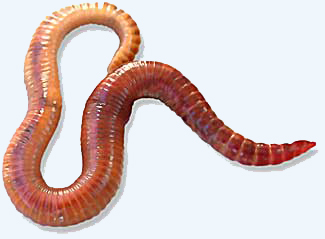
Common Earthworm
Lumbricus terrestris
Donald Hobern from Copenhagen, Denmark, CC BY 2.0, via Wikimedia Commons


How they differ
The Nightcrawler (Lumbricus terrestris) primarily consumes dead leaves and mineral soil, while the red worm (Eisenia fetida) consumes decaying organic matter, including cardboard.
| Common Earthworm | Red Wiggler | |
|---|---|---|
| Setae | The Nightcrawler has small hair-like projections called setae that provide leverage against surrounding soil. | The red worm has groups of bristles called setae on each body segment. |
| Movement | The Nightcrawler has recorded surface movement on moist, flat terrain at approximately 20 metres per hour. | The red worm moves by using segmental bristles to grip surfaces while contracting and stretching its muscles. |
| Summer behaviour | The Nightcrawler retreats to the deepest parts of its burrows during summer conditions that inhibit activity. | The red worm may move deeper than 15 centimeters during summer to find cooler areas. |
| Diet | The Nightcrawler primarily consumes dead leaves on the soil surface and mineral soil from the A horizon. | The red worm consumes decaying organic matter and can consume most organic materials that are not high in salts or ammonia. |
| Reproduction | The Nightcrawler is a simultaneous hermaphrodite that reproduces sexually through mutual sperm exchange. | The red worm can produce approximately three cocoons per week under ideal conditions, with each cocoon containing between one and nine fertilized eggs. |
| Cocoon development | Nightcrawler young emerge from their cocoons after several weeks and begin feeding in the soil. | Red worm individuals hatch from their cocoons in approximately three weeks at 25°C. |
Written from the checked facts listed further down. Statements that the sources did not support were removed.
Side by side
| Common Earthworm | Red Wiggler | |
|---|---|---|
| Scientific name | Lumbricus terrestris Linnaeus, 1758 | Eisenia fetida (Savigny in Cuvier, 1826) |
| English name | Common Earthworm | Red Wiggler |
| Group | Other invertebrates | Other invertebrates |
| Class | Clitellata | Clitellata |
| Order | Crassiclitellata | Crassiclitellata |
| Family | Lumbricidae Earthworms | Lumbricidae Earthworms |
| Genus | Lumbricus | Eisenia Rosy Worm |
| Named in | 1758 | 1826 |
| Environment | terrestrial | freshwater, terrestrial |
| Countries on record | 39 countries | 44 countries |
| GBIF occurrence records | 16,547 records | 3,018 records |
Rows where the two agree are shown in grey.
Where each is found
Both recorded in 30 countries
- Aland Islands
- Austria
- Belarus
- Belgium
- Bulgaria
- Canada
- Denmark
- Estonia
- Finland
- France
- Germany
- Hungary
- Ireland
- Isle of Man
- Italy
- Jersey
- Latvia
- Moldova
- Norway
- Poland
- Portugal
- Romania
- Russia
- Spain
- Sweden
- Switzerland
- The Netherlands
- Ukraine
- United Kingdom
- United States
Only Common Earthworm (9)
Only Red Wiggler (14)
- Azerbaijan
- Bermuda
- China
- Georgia
- Greece
- India
- Japan
- Kazakhstan
- Mexico
- Pakistan
- South Korea
- Tajikistan
- Turkey
- Uzbekistan
From Catalogue of Life checklists and GBIF occurrence records. A country missing from a list means no record is held, which is not proof of absence.
Checked facts
| Common Earthworm | Red Wiggler | |
|---|---|---|
| Appearance |
|
|
| Habitat |
|
|
| Diet |
|
|
| Behaviour |
|
|
| Reproduction |
|
|
| Conservation |
| No checked fact yet |
| Uses | No checked fact yet |
|
| Similar species | No checked fact yet |
|
| Other |
| No checked fact yet |
In brief
Common Earthworm
The common earthworm is an invertebrate in the family Lumbricidae, order Crassiclitellata, and class Clitellata. It inhabits garden and agricultural soils in temperate regions. Full profile
Red Wiggler
The red wiggler inhabits moist, decaying organic material, including compost, manure, and rotting vegetation. It has a reddish-brown body with small rings, a yellowish tail, and groups of bristles on each body segment. Full profile
Compare something else
Page built on 24 November 2026 from the data on the two species pages, where every source is listed.
Cite this page
ScientificNames.org. (2026). Common Earthworm vs Red Wiggler. Retrieved November 24, 2026, from https://scientificnames.org/compare/common-earthworm-vs-red-wiggler
“Common Earthworm vs Red Wiggler.” ScientificNames.org, 2026, scientificnames.org/compare/common-earthworm-vs-red-wiggler. Accessed 24 Nov. 2026.
ScientificNames.org. “Common Earthworm vs Red Wiggler.” Accessed November 24, 2026. https://scientificnames.org/compare/common-earthworm-vs-red-wiggler.
@misc{scientificnames_common_earthworm_vs_red_wiggler,
  author = {{ScientificNames.org}},
  title = {Common Earthworm vs Red Wiggler},
  year = {2026},
  url = {https://scientificnames.org/compare/common-earthworm-vs-red-wiggler},
  note = {Accessed 2026-11-24}
}