Comparison
Common Krait vs Tiger Snake
Common Krait (Bungarus caeruleus) and Tiger Snake (Notechis scutatus) both belong to the family Elapidae (cobras) and part ways below it.


How they differ
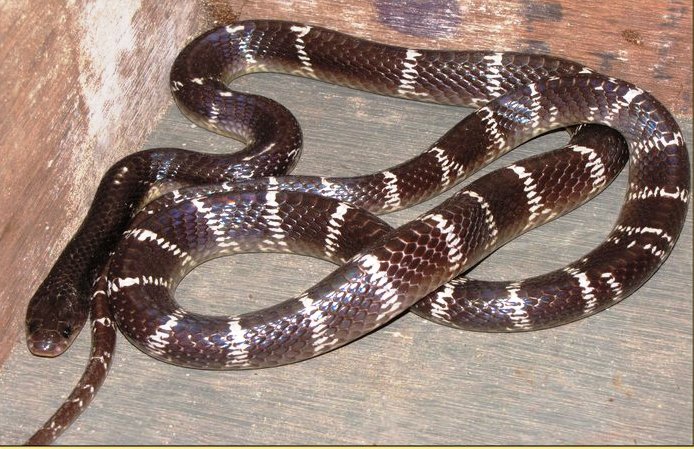
The common krait has a generally black or bluish-black body with narrow white crossbands, while the tiger snake has highly variable body colours and may have contrasting, indistinct or absent body bands. The common krait is nocturnal and remains inactive during daylight hours, while the tiger snake is predominantly active during daylight hours but also forages on warm evenings. The common krait primarily feeds on other snakes, while the tiger snake consumes fish, frogs, tadpoles, lizards, birds, mammals and carrion. The common krait occurs in India, Pakistan, Bangladesh, Sri Lanka and Nepal, while the tiger snake occurs in southeastern and southwestern Australia, including Tasmania and islands in Bass Strait.
| Common Krait | Tiger Snake | |
|---|---|---|
| Appearance | The common krait generally has a black or bluish-black body with approximately 40 thin white crossbars and highly polished scales arranged in 15–17 rows. | The tiger snake has highly variable body colours, 17–21 rows of midbody scales and populations that may consist almost entirely of individuals without body bands. |
| Head | The common krait has a flat head and relatively small eyes with rounded pupils. | The common tiger snake has a flat, blunt head that is slightly distinct from its robust body. |
| Behaviour | The common krait generally avoids confrontation, is non-aggressive and rarely bites unless provoked. | The tiger snake may bite when threatened by an aggressor. |
| Threat response | When threatened, the common krait may coil tightly with its head tucked underneath. | When threatened, the tiger snake flattens its body and raises its head above the ground. |
| Habitat | The common krait inhabits scrub jungles, grasslands, agricultural fields, semi-desert environments and rocky terrain. | The tiger snake inhabits marshes, riparian environments, temperate habitats, open forests, open heaths, tussock grasslands and woodlands. |
| Shelter | The common krait takes refuge in termite mounds, rat burrows and locations beneath debris. | The tiger snake shelters in fallen timber, dense matted vegetation and abandoned animal burrows. |
| Aquatic behaviour | The common krait is particularly associated with habitats near streams, canals and ponds. | The tiger snake can remain underwater for at least nine minutes. |
| Conservation | The common krait is reported to have a stable population despite localized habitat fragmentation and persecution. | Tiger snakes are protected species in most Australian states. |
Written from the checked facts listed further down. Statements that the sources did not support were removed.
Side by side
| Common Krait | Tiger Snake | |
|---|---|---|
| Scientific name | Bungarus caeruleus (Schneider, 1801) | Notechis scutatus (Peters, 1861) |
| English name | Common Krait | Tiger Snake |
| Group | Reptiles | Reptiles |
| Class | Reptilia Reptile | Reptilia Reptile |
| Order | Squamata Snakes | Squamata Snakes |
| Family | Elapidae Cobras | Elapidae Cobras |
| Genus | Bungarus Deathpickers | Notechis Tiger Snakes |
| Named in | 1801 | 1861 |
| Red List category | Least Concern | Least Concern |
| Countries on record | 8 countries | 1 country |
| GBIF occurrence records | 1,003 records | 13,914 records |
Rows where the two agree are shown in grey.
Where each is found
Only Common Krait (8)
Only Tiger Snake (1)
From Catalogue of Life checklists and GBIF occurrence records. A country missing from a list means no record is held, which is not proof of absence.
Checked facts
| Common Krait | Tiger Snake | |
|---|---|---|
| Appearance |
|
|
| Size |
| No checked fact yet |
| Habitat |
|
|
| Diet |
|
|
| Behaviour |
|
|
| Reproduction |
|
|
| Distribution |
|
|
| Conservation |
|
|
| Similar species | No checked fact yet |
|
| Other |
|
|
In brief
Common Krait
The Common Krait (Bungarus caeruleus) is a highly venomous snake in the family Elapidae, order Squamata and class Reptilia. It occurs in India, Pakistan, Bangladesh, Sri Lanka and Nepal, with a reported western extent including Afghanistan and potentially parts of Iran. It is predominantly nocturnal and feeds primarily on other snakes, including venomous kraits and vipers. Full profile
Tiger Snake
Tiger Snake (Notechis scutatus (Peters, 1861)) is a reptile belonging to the family Elapidae, order Squamata and class Reptilia. The species occurs in Western Australia, South Australia, Victoria, New South Wales and Tasmania, including islands in Bass Strait. Tiger Snakes have highly variable body colours, and some populations have contrasting or indistinct bands while others consist almost entirely of individuals without bands. Full profile
Compare something else
Page built on 24 November 2026 from the data on the two species pages, where every source is listed.
Cite this page
ScientificNames.org. (2026). Common Krait vs Tiger Snake. Retrieved November 24, 2026, from https://scientificnames.org/compare/common-krait-vs-tiger-snake
“Common Krait vs Tiger Snake.” ScientificNames.org, 2026, scientificnames.org/compare/common-krait-vs-tiger-snake. Accessed 24 Nov. 2026.
ScientificNames.org. “Common Krait vs Tiger Snake.” Accessed November 24, 2026. https://scientificnames.org/compare/common-krait-vs-tiger-snake.
@misc{scientificnames_common_krait_vs_tiger_snake,
  author = {{ScientificNames.org}},
  title = {Common Krait vs Tiger Snake},
  year = {2026},
  url = {https://scientificnames.org/compare/common-krait-vs-tiger-snake},
  note = {Accessed 2026-11-24}
}