Comparison

Common Prawn vs Rockpool Shrimp

Common Prawn (Palaemon serratus) and Rockpool Shrimp (Palaemon elegans) both belong to the genus Palaemon (glass shrimps) and part ways below it. Both are recorded in 17 countries.
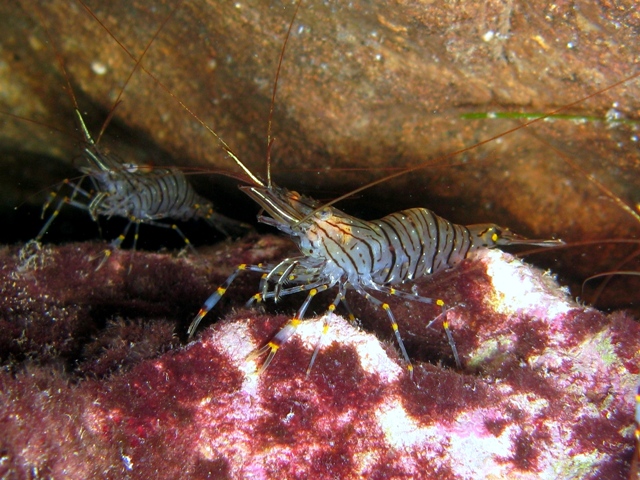
Common Prawn

Common Prawn

Palaemon serratus

Etrusko25, Public domain, via Wikimedia Commons

Rockpool Shrimp

Rockpool Shrimp

Palaemon elegans

Cisamarc, CC BY-SA 4.0, via Wikimedia Commons

Side by side

Common PrawnRockpool Shrimp
Scientific namePalaemon serratus (Pennant, 1777)Palaemon elegans Rathke, 1837
English nameCommon PrawnRockpool Shrimp
GroupCrustaceansCrustaceans
ClassMalacostracaMalacostraca
OrderDecapodaDecapoda
FamilyPalaemonidae PalaemonidsPalaemonidae Palaemonids
GenusPalaemon Glass ShrimpsPalaemon Glass Shrimps
Named in17771837
Environmentmarinemarine
Countries on record18 countries32 countries
GBIF occurrence records13,112 records10,290 records

Rows where the two agree are shown in grey.

Where each is found

Both recorded in 17 countries

Only Common Prawn (1)

Only Rockpool Shrimp (15)

From Catalogue of Life checklists and GBIF occurrence records. A country missing from a list means no record is held, which is not proof of absence.

Checked facts

Common PrawnRockpool Shrimp
Appearance
  • The rostrum curves upwards and has a bifurcated tip. English Wikipedia
  • The species has pinkish-brown coloration with reddish patterns. English Wikipedia
  • The species is a large, round-bodied prawn that can reach 11 centimetres in length. marlin.ac.uk
  • Its body is translucent and has variable markings, generally consisting of red or brown horizontal or oblique lines on the carapace and vertical lines on the abdomen. marlin.ac.uk
  • The first two pairs of walking legs have pincers and yellow-and-brown banding. marlin.ac.uk
  • The head region is covered by a carapace bearing a well-developed, distinctly upward-curving rostrum. marlin.ac.uk
  • The rostrum has 6–7 dorsal teeth, including two behind the eye socket, and 4–5 ventral teeth. marlin.ac.uk
  • The mandible has a three-segmented palp. marlin.ac.uk
  • Its rostrum usually has three ventral teeth, although two or four may occur. invasions.si.edu
  • The rostrum has a pronounced ventral expansion and a single row of setae along its ventral margin. invasions.si.edu
  • The carapace lacks supraorbital, suborbital and hepatic spines but possesses antennal and branchiostegal spines. invasions.si.edu
  • The antennules of the species are divided into three branches. invasions.si.edu
  • Both legs of the first pair possess claws. invasions.si.edu
  • The species has a translucent body marked with reddish-brown lines on its carapace. invasions.si.edu
Habitat
  • The species inhabits coastal rockpools, shallow rocky areas and artificial structures. invasions.si.edu
  • The species occurs in intertidal rockpools that experience seawater temperatures between 15°C and 25°C. pmc.ncbi.nlm.nih.gov
DietNo checked fact yet
  • The species is omnivorous and consumes detritus, algal material and animal prey. pmc.ncbi.nlm.nih.gov
  • Recorded algal food sources include Cladophora, Ectocarpales and Ulva. pmc.ncbi.nlm.nih.gov
  • Recorded animal food sources include gammarids, harpacticoids, chironomids and ostracods. pmc.ncbi.nlm.nih.gov
  • The species consumed the alga Ulva muscoides and the amphipod Hyale perieri in feeding experiments. pmc.ncbi.nlm.nih.gov
Behaviour
  • At 15°C, individuals consumed less Ulva when offered a choice between algae and amphipods. pmc.ncbi.nlm.nih.gov
  • At 25°C, individuals consumed less Hyale when offered a choice between algae and amphipods. pmc.ncbi.nlm.nih.gov
  • The species' oxygen consumption increases significantly as temperature rises. pmc.ncbi.nlm.nih.gov
  • Its feeding preferences may shift towards greater herbivory as temperatures increase. pmc.ncbi.nlm.nih.gov
  • In the southeastern Baltic, the species has largely replaced populations of Palaemon adspersus. invasions.si.edu
ReproductionNo checked fact yet
  • Females carry fertilized egg broods attached to their abdomens after mating. invasions.si.edu
  • Female individuals can carry between 222 and 2,628 eggs, with egg numbers varying according to body size and population. invasions.si.edu
  • The eggs hatch into planktonic larvae known as zoeae. invasions.si.edu
  • The larvae undergo several moults before metamorphosing into postlarvae with developed walking legs and pleopods. invasions.si.edu
  • Individuals reach adulthood at approximately one year of age. invasions.si.edu
LifespanNo checked fact yet
Distribution
  • Palaemon serratus occurs in the Atlantic Ocean between Denmark and Mauritania, as well as in the Mediterranean Sea and Black Sea. English Wikipedia
  • The species is native to the eastern North Atlantic, including Macaronesia, the Baltic Sea, the Mediterranean Sea and the Black Sea. English Wikipedia
  • Its native Northeast Atlantic range extends from the western coast of Norway to Namibia. invasions.si.edu
  • Its native range includes the offshore islands of the Azores, Cape Verde and the Canary Islands. invasions.si.edu
  • The species has been introduced to the Caspian Sea and Aral Sea. English Wikipedia
  • The species was introduced to the Persian Gulf. invasions.si.edu
Conservation
  • The species is subject to concern that current fishing exploitation levels may constitute overfishing. English Wikipedia
  • A minimum landing size is among the measures being considered to limit fishing catches. English Wikipedia
  • The species is considered invasive in parts of the United States. English Wikipedia
  • The species can negatively affect local ecosystems by displacing native shrimp species. invasions.si.edu
Uses
  • A small commercial fishery for this species operates along the west coast of Great Britain, particularly in West Wales. English Wikipedia
  • Commercial fishing for this species in Ireland began at Baltimore, County Cork, during the 1970s. English Wikipedia
  • Irish landings of this species reached a recorded peak of 548 tonnes in 1999. English Wikipedia
  • Galway, Kerry, Cork and Waterford together account for more than 90% of the Irish catch. English Wikipedia
  • In some introduced areas, the species provides a food resource for commercially exploited fish. invasions.si.edu
Similar speciesNo checked fact yet
  • Palaemon serratus, Palaemon longirostris and Palaemon adspersus are identified as similar species within the same genus. English Wikipedia
OtherNo checked fact yet

In brief

Common Prawn

Palaemon serratus occurs in the Atlantic Ocean between Denmark and Mauritania, as well as in the Mediterranean Sea and Black Sea. It has an upward-curving rostrum with a bifurcated tip and pinkish-brown coloration with reddish patterns. Full profile

Rockpool Shrimp

Palaemon elegans is native to the eastern North Atlantic, including Macaronesia, the Baltic Sea, the Mediterranean Sea and the Black Sea, and has been introduced to other seas. Full profile

Compare something else

Page built on 26 November 2026 from the data on the two species pages, where every source is listed.

Cite this page

ScientificNames.org. (2026). Common Prawn vs Rockpool Shrimp. Retrieved November 26, 2026, from https://scientificnames.org/compare/common-prawn-vs-rockpool-shrimp