Species · Crustaceans
Common Prawn Palaemon serratus
The scientific name of the Common Prawn is Palaemon serratus. It is a species of crustacean in the family Palaemonidae (palaemonids), order Decapoda. The name dates from 1777.
- Scientific name
- Palaemon serratus (Pennant, 1777)
- Common name
- Common Prawn
- Genus
- Palaemon
- Family
- Palaemonidae (Palaemonids)
- Order
- Decapoda
- Class
- Malacostraca
- Environment
- marine
- Recorded in
- 18 countries
- Name status
- accepted in the Catalogue of Life
Overview
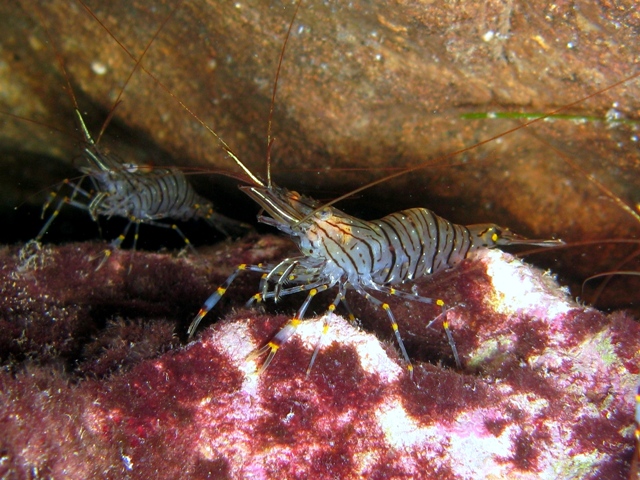
Palaemon serratus occurs in the Atlantic Ocean between Denmark and Mauritania, as well as in the Mediterranean Sea and Black Sea. It has an upward-curving rostrum with a bifurcated tip and pinkish-brown coloration with reddish patterns.
Written 26 November 2026 from the sources listed below. Each statement was checked against the passage it cites; statements that could not be supported were removed.
Appearance
The common prawn is a large, round-bodied prawn that can reach 11 centimetres in length. Its body is translucent, with variable markings generally consisting of red or brown horizontal or oblique lines on the carapace and vertical lines on the abdomen.[1][2]
The head region is covered by a carapace bearing a well-developed, distinctly upward-curving rostrum. The rostrum has 6–7 dorsal teeth, including two behind the eye socket, and 4–5 ventral teeth.[3][4]
The first two pairs of walking legs have pincers and yellow-and-brown banding. The mandible has a three-segmented palp.[5][6]
Habitat
The common prawn inhabits rocky crevices at depths reaching 40 metres.[7]
Behaviour
Individuals live in groups within rocky crevices. The population has a strongly seasonal pattern, with its highest abundance occurring in autumn.[8][9]
Females grow faster than males. Individuals of this species live for approximately 3–5 years.[10][11]
The common prawn can hear sounds across frequencies from 100 Hz to 3 kHz. Individuals of all growth stages can hear tones at 500 Hz, and the hearing range changes as individuals grow.[12][13][14]
Conservation
There is concern that current fishing exploitation levels may constitute overfishing. A minimum landing size is among the measures being considered to limit fishing catches.[15][16]
Uses
A small commercial fishery for the common prawn operates along the west coast of Great Britain, particularly in West Wales.[17]
Commercial fishing for this species in Ireland began at Baltimore, County Cork, during the 1970s. Irish landings reached a recorded peak of 548 tonnes in 1999.[18][19]
Galway, Kerry, Cork and Waterford together account for more than 90% of the Irish catch.[20]
Classification of the Common Prawn
| Kingdom | Animalia |
|---|---|
| Phylum | Arthropoda |
| Subphylum | Crustacea |
| Class | Malacostraca |
| Order | Decapoda |
| Suborder | Pleocyemata |
| Infraorder | Caridea |
| Superfamily | Palaemonoidea |
| Family | Palaemonidae (Palaemonids) |
| Genus | Palaemon (Glass Shrimps) |
| Species | Palaemon serratus (Pennant, 1777) |
Where the Common Prawn is found
Checklists and occurrence records place Palaemon serratus in 18 countries. GBIF holds 13,112 georeferenced records of it.
Countries
- Belgium 2,905
- Croatia 37
- Denmark 10
- France 1,907
- Germany 253
- Greece 27
- Guernsey 29
- Ireland 944
- Isle of Man 43
- Italy 64
- Jersey 55
- Malta 5
- Monaco 3
- Norway 4
- Portugal 527
- Spain 1,271
- The Netherlands 995
- United Kingdom 4,033
Regions and cities with the most records
- Zwijndrecht, Belgium 2,198
- Beveren, Belgium 2,153
- Sint-Gillis-Waas, Belgium 2,143
- Hoboken, Belgium 2,107
- Sint-Niklaas, Belgium 1,995
- Temse, Belgium 1,990
- Wilrijk, Belgium 1,988
- Bornem, Belgium 1,725
- Puurs, Belgium 1,724
- Kontich, Belgium 1,678
- Antwerp, Belgium 1,650
- Willebroek, Belgium 1,626
- Boom, Belgium 1,621
- Borgerhout, Belgium 1,617
- Deurne, Belgium 1,617
- Berchem, Belgium 1,535
- Edegem, Belgium 1,480
- Merksem, Belgium 1,466
- Hamme, Belgium 1,460
- Mortsel, Belgium 1,385
- Lebbeke, Belgium 1,252
- Dendermonde, Belgium 1,244
- Zele, Belgium 1,134
- Duffel, Belgium 1,117
- Ekeren, Belgium 1,110
- Lokeren, Belgium 1,103
- Stabroek, Belgium 1,053
- Kapellen, Belgium 1,048
- Stekene, Belgium 1,019
- Sint-Katelijne-Waver, Belgium 985
- Schoten, Belgium 948
- Brasschaat, Belgium 944
- Mechelen, Belgium 757
- England, United Kingdom 718
- Lier, Belgium 686
- Ranst, Belgium 685
7 more countries have a few records outside this range
These countries hold a few records of Palaemon serratus but lie outside the range the checklists give for it. Such records are often zoo or garden specimens, museum material or vagrants, so the species is not counted as occurring there.
Range as the checklists state it
Eastern Atlantic Ocean
A number beside a place is its count of GBIF occurrence records. A place without a number comes from a checklist alone. Records show where a species has been observed or collected, which can include escapes and vagrants.
Common names
English
- Common Prawn
Names in 16 other languages
- Asturian
- Esguila, esguila de ronchel
- Catalan
- gambet
- Chinese
- 鋸齒長臂蝦
- Croatian
- Mala kozica
- Dutch
- gezaagde steurgarnaal
- French
- Grande crevette rose, bouquet, bouquet commun, crevette, crevette rose
- German
- Große Felsengarnele, Große Felsgarnele, Sägegarnale, Sägegarnele, Sägergarnele, gewöhnliche Felsengarnele
- Greek
- Γαριδάκι
- Italian
- Gamberetto maggiore, Gambero delle rocce, Gambero sega
- Norwegian
- strandreke
- Norwegian Bokmål
- Gruntvannsreke
- Portuguese
- Camarão-branco-legítimo, Camarão-de-Espinho
- Russian
- Пильчатая креветка
- Slovenian
- žagasta kozica
- Spanish
- Camarón común, Camarón serrado, camaron gamba, quisquilla
- Swedish
- tigertångräka
Synonyms
23 other scientific names have been used for this species and are now treated as synonyms of Palaemon serratus.
- Astacus serratus Pennant, 1777
- Cancer captivus Nardo, 1847
- Leander latreillianus Czerniavsky, 1884
- Leander latreillianus aberrans Czerniavsky, 1884
- Leander latreillianus f. gigantea Czerniavsky, 1884
- Leander latreillianus f. transitans Czerniavsky, 1884
- Leander latreillianus f. typica Czerniavsky, 1884
- Leander latreillianus gigantea Czerniavsky, 1884
- Leander latreillianus intermedia Czerniavsky, 1884
- Leander latreillianus sculpta Czerniavsky, 1884
- Leander latreillianus transitans Czerniavsky, 1884
- Leander latreillianus typica Czerniavsky, 1884
- Leander latreillianus var. aberrans Czerniavsky, 1884
- Leander latreillianus var. intermedia Czerniavsky, 1884
- Leander serratus (Pennant, 1777)
- Melicerta triliana Risso, 1816
- Palaemon rostratus Gimenez, 1922
- Palaemon treillianus H. Milne-Edwards, 1837
- Palaemon trilianus (Risso, 1816)
- Palemon oratelli Monod, 1931
- Palemon serratus (Pennant, 1777)
- Palemon treillianus (Risso, 1816)
- Palemon trilianus (Risso, 1816)
Related species
-
 Rockpool ShrimpPalaemon elegans
-
 Baltic PrawnPalaemon adspersus
-
 Migrant PrawnPalaemon macrodactylus
-
 Atlantic Ditch ShrimpPalaemon varians
-
 Delta PrawnPalaemon longirostris
-
 Lake PrawnPalaemon paucidens
-
 Glass ShrimpPalaemon affinis
-
 Indian Bait PrawnPalaemon pacificus
Compare
Questions and answers
What is the scientific name of the Common Prawn?
The scientific name of the Common Prawn is Palaemon serratus. Written with its author, the full name is Palaemon serratus (Pennant, 1777).
Which family does the Common Prawn belong to?
Palaemon serratus belongs to the family Palaemonidae, in the order Decapoda and the class Malacostraca.
Where is the Common Prawn found?
Checklists and occurrence records place Palaemon serratus in 18 countries, including United Kingdom, Belgium, France, Spain, The Netherlands and Ireland.
What is the habitat of prawns?
The common prawn inhabits rocky crevices at depths reaching 40 metres.[7]
Sources
Passages the profile rests on
- The species is a large, round-bodied prawn that can reach 11 centimetres in length. Source passage: “Large round-bodied prawn up to 11 cm in length.” — marlin.ac.uk
- Its body is translucent and has variable markings, generally consisting of red or brown horizontal or oblique lines on the carapace and vertical lines on the abdomen. Source passage: “Translucent with variable markings but generally red/brown horizontal or oblique lines on the carapace and vertical on the abdomen.” — marlin.ac.uk
- The head region is covered by a carapace bearing a well-developed, distinctly upward-curving rostrum. Source passage: “Head region covered by a carapace with a well developed rostrum with distinct upward curve.” — marlin.ac.uk
- The rostrum has 6–7 dorsal teeth, including two behind the eye socket, and 4–5 ventral teeth. Source passage: “Rostrum with 6-7 dorsal teeth, 2 of which are behind the eyesocket, and 4-5 ventral teeth.” — marlin.ac.uk
- The first two pairs of walking legs have pincers and yellow-and-brown banding. Source passage: “First two walking legs (pereiopods) chelate with yellow and brown banding.” — marlin.ac.uk
- The mandible has a three-segmented palp. Source passage: “Mandible with palp of 3 segments (requires microscopic examination).” — marlin.ac.uk
- This species inhabits rocky crevices at depths reaching 40 metres. Source passage: “rocky crevices at depths of up to 40 metres (130 ft).” — English Wikipedia
- Individuals live in groups within rocky crevices. Source passage: “in groups in rocky crevices” — English Wikipedia
- The population has a strongly seasonal pattern, with its highest abundance occurring in autumn. Source passage: “the population is highly seasonal, with a pronounced peak in the autumn.” — English Wikipedia
- Females grow faster than males. Source passage: “Females grow faster than males” — English Wikipedia
- Individuals of this species live for approximately 3–5 years. Source passage: “Individuals live for 3–5 years” — English Wikipedia
- The species can hear sounds across frequencies from 100 Hz to 3 kHz. Source passage: “it is sensitive to frequencies between 100 Hz and 3 kHz” — English Wikipedia
- Individuals of all growth stages can hear tones at 500 Hz. Source passage: “all are capable of hearing tones at 500 Hz.” — English Wikipedia
- The species' hearing range changes as individuals grow. Source passage: “the hearing range of a P. serratus individual changes as it grows” — English Wikipedia
- The species is subject to concern that current fishing exploitation levels may constitute overfishing. Source passage: “there is now concern that the current levels of exploitation may represent overfishing” — English Wikipedia
- A minimum landing size is among the measures being considered to limit fishing catches. Source passage: “measures are being considered to limit the catch, such as a minimum landing size.” — English Wikipedia
- A small commercial fishery for this species operates along the west coast of Great Britain, particularly in West Wales. Source passage: “A small commercial fishery exists for P. serratus on the west coast of Great Britain, chiefly in West Wales” — English Wikipedia
- Commercial fishing for this species in Ireland began at Baltimore, County Cork, during the 1970s. Source passage: “In Ireland, fishing for P. serratus began at Baltimore, County Cork in the 1970s” — English Wikipedia
- Irish landings of this species reached a recorded peak of 548 tonnes in 1999. Source passage: “A peak landing of 548 t was recorded in 1999” — English Wikipedia
- Galway, Kerry, Cork and Waterford together account for more than 90% of the Irish catch. Source passage: “four counties account for over 90% of the catch — Galway, Kerry, Cork and Waterford.” — English Wikipedia
Data
- Catalogue of Life, 2026-10-16 XR cc by
- Global Biodiversity Information Facility CC BY 4.0
- Wikidata CC0
- GeoNames CC BY 4.0
- Wikimedia Commons per image; credit shown with each image
- Within the Catalogue of Life, this name comes from The Integrated Taxonomic Information System cc0
References
- De Grave, Sammy, and C. H. J. M. Fransen. (2011). Carideorum catalogus: the recent species of the Dendrobranchiate, Stenopodidean, Procarididean and Caridean Shrimps (Crustacea: Decapoda). Zoologische Mededelingen, Vol. 85, No. 9.
- De Grave, Sammy, and Christopher W. Ashelby. (2013). A re-appraisal of the systematic status of selected genera in Palaemoninae (Crustacea: Decapoda: Palaemonidae). Zootaxa, Vol. 3734, No. 3. Link
This species in other databases
- Catalogue of Life 9GR6K
- Wikidata Q2103330
- iNaturalist 130385
- WoRMS urn:lsid:marinespecies.org:taxname:107616
Page built on 26 November 2026. See how the catalog is made and all sources and licences.
Cite this page
ScientificNames.org. (2026). Palaemon serratus (Common Prawn). Retrieved November 26, 2026, from https://scientificnames.org/species/palaemon-serratus
“Palaemon serratus (Common Prawn).” ScientificNames.org, 2026, scientificnames.org/species/palaemon-serratus. Accessed 26 Nov. 2026.
ScientificNames.org. “Palaemon serratus (Common Prawn).” Accessed November 26, 2026. https://scientificnames.org/species/palaemon-serratus.
@misc{scientificnames_palaemon_serratus_common_prawn,
  author = {{ScientificNames.org}},
  title = {Palaemon serratus (Common Prawn)},
  year = {2026},
  url = {https://scientificnames.org/species/palaemon-serratus},
  note = {Accessed 2026-11-26}
}