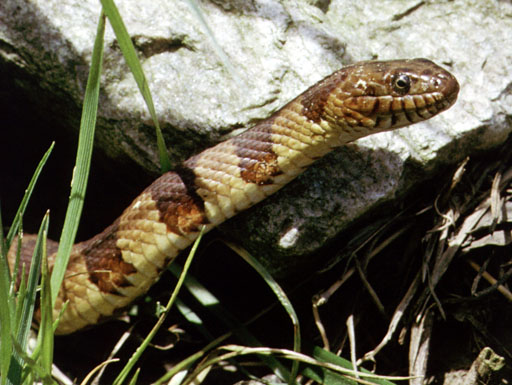
| Appearance | No checked fact yet | - The species has a brown, gray, reddish, or brownish-black body with dark crossbands on the neck and dark blotches along the rest of the body. English Wikipedia
- The species' coloration generally darkens with age, and its body pattern may become difficult to distinguish. English Wikipedia
- The belly can be white, yellow, or gray and usually has reddish or black crescent-shaped markings. English Wikipedia
- Adult individuals can become almost entirely black. English Wikipedia
- The species has keeled scales and a divided anal plate. animaldiversity.org
- Juveniles have reddish-brown saddles against a tan, brown, or gray background. animaldiversity.org
- The species has 21–25 scales at midbody. animaldiversity.org
- Juvenile individuals have dark crossbands against a light-brown, tan, or gray background. in.gov
|
|---|
| Size | - Adults reach a total length of approximately 41–81 cm, including the tail. English Wikipedia
| No checked fact yet |
|---|
| Habitat | - The species inhabits free-flowing streams with rocky substrates and shallow riffles. tpwd.texas.gov
- The species uses rock debris and crevices as shelter. tpwd.texas.gov
- The species can inhabit reservoirs when suitable shoreline habitat is available. tpwd.texas.gov
- Preferred habitats include rocky beaches with silty substrates and free-flowing, cloudy water. English Wikipedia
- The species uses crayfish burrows, rock ledges, debris piles, and concrete low-water crossings as winter hibernation sites. tpwd.texas.gov
| - The species inhabits streams, lakes, ponds, and wetlands. English Wikipedia
- Juveniles typically occupy smaller streams adjacent to the larger waterways inhabited by adults. English Wikipedia
- The species uses rivers, streams, sloughs, lakes, ponds, bogs, marshes, and impoundments. animaldiversity.org
- Northern water snakes prefer open areas with basking opportunities and relatively still water. animaldiversity.org
- Individuals may shelter beneath flat rocks, logs, and boards when not basking or searching for food. animaldiversity.org
- The species prefers warm, permanent, shallow water with access to basking locations. in.gov
|
|---|
| Diet | - The species feeds primarily on minnows, including red shiners and bullhead minnows, mosquitofish, channel and flathead catfish, gizzard shad, and sunfish. tpwd.texas.gov
| - The species feeds on small fish, tadpoles, frogs, worms, leeches, crayfish, large insects, mollusks, annelids, salamanders, other snakes, turtles, small birds, and mammals. English Wikipedia
- The species is both carnivorous and a scavenger. animaldiversity.org
- Northern water snakes swallow their prey alive rather than constricting it. animaldiversity.org
- The species also consumes frogs, toads, salamanders, and carrion in Indiana. in.gov
|
|---|
| Behaviour | - The species is active from March through October. tpwd.texas.gov
- During hot summer weather, the species is primarily active in the early morning and evening. tpwd.texas.gov
- The species captures prey by waiting near concentrations of fish or searching beneath and around rocks in riffles. tpwd.texas.gov
- Natural predators of the species include king snakes, coachwhips, racers, raccoons, herons, hawks, and owls. tpwd.texas.gov
| - The species is active both during daylight and nighttime. English Wikipedia
- The species commonly basks on rocks, stumps, and brush. English Wikipedia
- The species uses smell and sight to locate prey. English Wikipedia
- The species commonly dives into the water when disturbed while basking. English Wikipedia
- When cornered or captured, the species generally defends itself. English Wikipedia
- Northern water snakes are more active during daylight hours despite being observed both day and night. animaldiversity.org
- When escaping predators, northern water snakes may dive and anchor themselves to vegetation or logs underwater. animaldiversity.org
- When threatened, northern water snakes flatten their bodies and jaws and strike and bite. animaldiversity.org
- The species may release foul-smelling musk and defecate when threatened. animaldiversity.org
- The species may flatten its head and strike when cornered or restrained. in.gov
|
|---|
| Reproduction | | |
|---|
| Distribution | - The species is endemic to Texas in the United States. English Wikipedia
- The species occurs in west-central Texas in the Colorado and Concho river systems. English Wikipedia
| No checked fact yet |
|---|
| Conservation | - The species was designated as threatened by the U.S. Fish and Wildlife Service in 1986. English Wikipedia
- The species was removed from the Federal List of Endangered and Threatened Wildlife in 2011 following habitat restoration efforts. English Wikipedia
- Habitat restoration efforts have included cedar brush removal and the construction of artificial instream riffle structures. English Wikipedia
- Habitat loss has contributed to the species' decline. tpwd.texas.gov
- Reservoir construction has flooded substantial areas of former stream habitat upstream of dams. tpwd.texas.gov
- Dams restrict streamflow and prevent floodwaters from scouring streambeds. tpwd.texas.gov
- Dams have contributed to siltation of rocky streambeds, vegetation encroachment, and loss of riffle habitat needed by juveniles. tpwd.texas.gov
- The species has colonized artificial riffles constructed to compensate for natural habitat loss. tpwd.texas.gov
- The species is protected under Texas law, which prohibits hunting, selling, collecting, or possessing it. English Wikipedia
| - Introduced common watersnakes in California are considered invasive and may compete with the threatened giant garter snake. English Wikipedia
- The species may threaten vulnerable fish and amphibians through excessive predation. English Wikipedia
- The Lake Erie watersnake subspecies was removed from the United States Federal List of Endangered and Threatened Wildlife on August 16, 2011. English Wikipedia
- The Lake Erie watersnake population increased to 11,980 individuals by 2009. English Wikipedia
|
|---|
| Uses | No checked fact yet | - The species may benefit sport fishing by consuming diseased and dying fish and reducing fish overpopulation. animaldiversity.org
- The species may cause problems for fish hatcheries and fish farms. animaldiversity.org
|
|---|
| Similar species | - The species closely resembles Nerodia harteri in appearance. English Wikipedia
- Nerodia paucimaculata was initially classified as a subspecies of the Brazos water snake, Nerodia harteri. English Wikipedia
- The species was elevated to full species status by Densmore and colleagues in 1992. English Wikipedia
| - The common watersnake is frequently mistaken for the venomous cottonmouth. English Wikipedia
- The common watersnake has round pupils and lacks heat-sensing pits, distinguishing it from the cottonmouth. English Wikipedia
|
|---|
| Other | No checked fact yet | - The species is nonvenomous and harmless to humans. English Wikipedia
- The saliva contains a mild hemotoxic anticoagulant that can increase bleeding from bites. English Wikipedia
|
|---|