Species · Reptiles
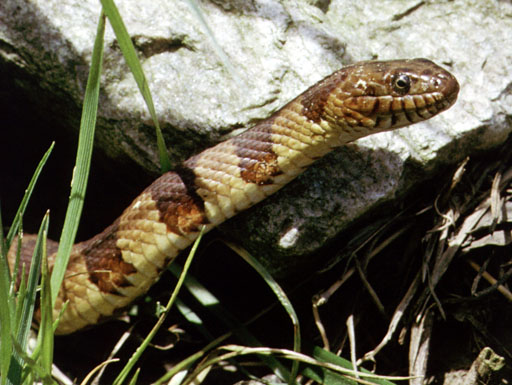
Concho Water Snake Nerodia paucimaculata
The scientific name of the Concho Water Snake is Nerodia paucimaculata. It is a species of reptile in the family Colubridae (colubrid), order Squamata. The name dates from 1961.
- Scientific name
- Nerodia paucimaculata (Tinkle & Conant, 1961)
- Common name
- Concho Water Snake
- Genus
- Nerodia
- Family
- Colubridae (Colubrid)
- Order
- Squamata
- Class
- Reptilia
- Red List category
- NT Near Threatened
- Recorded in
- 1 country
- Name status
- accepted in the Catalogue of Life
Overview
Nerodia paucimaculata is endemic to Texas in the United States and occurs in the Colorado and Concho river systems of west-central Texas.
Written 26 November 2026 from the sources listed below. Each statement was checked against the passage it cites; statements that could not be supported were removed.
Appearance
Adults reach a total length of approximately 41–81 cm, including the tail.[1]
Habitat
The Concho Water Snake inhabits free-flowing streams with rocky substrates and shallow riffles. Preferred habitats include rocky beaches with silty substrates and free-flowing, cloudy water.[2][3]
It uses rock debris and crevices as shelter and can inhabit reservoirs when suitable shoreline habitat is available.[4][5]
Winter hibernation sites include crayfish burrows, rock ledges, debris piles, and concrete low-water crossings.[6]
Diet
The Concho Water Snake feeds primarily on minnows, including red shiners and bullhead minnows. Its diet also includes mosquitofish, channel and flathead catfish, gizzard shad, and sunfish.[7]
Behaviour
The Concho Water Snake is active from March through October. During hot summer weather, it is primarily active in the early morning and evening.[8][9]
It captures prey by waiting near concentrations of fish or searching beneath and around rocks in riffles.[10]
Natural predators include king snakes, coachwhips, racers, raccoons, herons, hawks, and owls.[11]
Reproduction and life cycle
Females usually produce approximately 10 eggs per litter. Young snakes hatch between late July and September.[12][13]
Conservation
The Concho Water Snake was designated as threatened by the U.S. Fish and Wildlife Service in 1986. It was removed from the Federal List of Endangered and Threatened Wildlife in 2011 following habitat restoration efforts.[14][15]
Habitat loss has contributed to the species' decline. Reservoir construction has flooded substantial areas of former stream habitat upstream of dams.[16][17]
Dams restrict streamflow and prevent floodwaters from scouring streambeds. They have contributed to siltation of rocky streambeds, vegetation encroachment, and loss of riffle habitat needed by juveniles.[18][19]
Habitat restoration efforts have included cedar brush removal and the construction of artificial instream riffle structures. The species has colonized artificial riffles constructed to compensate for natural habitat loss.[20][21]
The species is protected under Texas law, which prohibits hunting, selling, collecting, or possessing it.[22]
Similar species
The Concho Water Snake closely resembles Nerodia harteri. Nerodia paucimaculata was initially classified as a subspecies of the Brazos water snake, Nerodia harteri, and was elevated to full species status by Densmore and colleagues in 1992.[23][24][25]
Classification of the Concho Water Snake
| Kingdom | Animalia |
|---|---|
| Phylum | Chordata |
| Subphylum | Vertebrata |
| Infraphylum | Gnathostomata |
| Parvphylum | Osteichthyes |
| Megaclass | Tetrapoda |
| Class | Reptilia (Reptile) |
| Order | Squamata (Snakes) |
| Suborder | Serpentes (Snakes) |
| Infraorder | Alethinophidia |
| Family | Colubridae (Colubrid) |
| Subfamily | Natricinae |
| Genus | Nerodia (Water Snakes) |
| Species | Nerodia paucimaculata (Tinkle & Conant, 1961) |
Where the Concho Water Snake is found
Checklists and occurrence records place Nerodia paucimaculata in 1 country. GBIF holds 364 georeferenced records of it.
Countries
Regions and cities with the most records
Range as the checklists state it
USA (C Texas: Colorado River drainage from the Coke and Runnels counties line to near Bend, San Saba County on the Colorado River and in the Concho River from San Angelo [Tom Green County] to its confluence with the Colorado).
A number beside a place is its count of GBIF occurrence records. A place without a number comes from a checklist alone. Records show where a species has been observed or collected, which can include escapes and vagrants.
Common names
English
- Concho Water Snake
Names in 1 other language
- Portuguese
- Cobra-d'água-de-Concho
Synonyms
2 other scientific names have been used for this species and are now treated as synonyms of Nerodia paucimaculata.
- Natrix harteri paucimaculata Tinkle & Conant, 1961
- Nerodia harteri paucimaculata (Tinkle & Conant, 1961)
Related species
-
 Common WatersnakeNerodia sipedon
-
 Banded Water SnakeNerodia fasciata
-
 Diamond-backed WatersnakeNerodia rhombifer
-
 Plain-bellied Water SnakeNerodia erythrogaster
-
 Green Water SnakeNerodia cyclopion
-
 Salt Marsh SnakeNerodia clarkii
-
 Brown Water SnakeNerodia taxispilota
-
 Florida Green Water SnakeNerodia floridana
Compare
Questions and answers
What is the scientific name of the Concho Water Snake?
The scientific name of the Concho Water Snake is Nerodia paucimaculata. Written with its author, the full name is Nerodia paucimaculata (Tinkle & Conant, 1961).
Which family does the Concho Water Snake belong to?
Nerodia paucimaculata belongs to the family Colubridae, in the order Squamata and the class Reptilia.
Where is the Concho Water Snake found?
Checklists and occurrence records place Nerodia paucimaculata in 1 country: United States.
What is the conservation status of the Concho Water Snake?
The IUCN Red List category recorded for Nerodia paucimaculata is Near Threatened (NT).
What is the diet of a water snake?
The Concho Water Snake feeds primarily on minnows, including red shiners and bullhead minnows. It also eats mosquitofish, channel and flathead catfish, gizzard shad, and sunfish.[7]
Sources
Passages the profile rests on
- Adults reach a total length of approximately 41–81 cm, including the tail. Source passage: “The Concho water snake grows to a total length (including tail) of 16 to 32 inches (41–81 cm)” — English Wikipedia
- The species inhabits free-flowing streams with rocky substrates and shallow riffles. Source passage: “The Concho water snake lives in free-flowing streams over rocks and shallow riffles” — tpwd.texas.gov
- Preferred habitats include rocky beaches with silty substrates and free-flowing, cloudy water. Source passage: “Research shows that Concho Water Snakes typically prefer rocky beaches with a silty substrate and free-flowing, cloudy water for reproduction and general activity.” — English Wikipedia
- The species uses rock debris and crevices as shelter. Source passage: “using rock debris and crevices for cover” — tpwd.texas.gov
- The species can inhabit reservoirs when suitable shoreline habitat is available. Source passage: “Concho water snakes can live in reservoirs with suitable shoreline habitat” — tpwd.texas.gov
- The species uses crayfish burrows, rock ledges, debris piles, and concrete low-water crossings as winter hibernation sites. Source passage: “These snakes hibernate during the winter in areas such as crayfish burrows, rock ledges, debris piles, and concrete low water crossings.” — tpwd.texas.gov
- The species feeds primarily on minnows, including red shiners and bullhead minnows, mosquitofish, channel and flathead catfish, gizzard shad, and sunfish. Source passage: “Minnows (red shiners and bullhead minnows), mosquitofish, channel and flathead catfish, gizzard shad, and sunfish make up the bulk of its diet.” — tpwd.texas.gov
- The species is active from March through October. Source passage: “Concho water snakes are active from March through October.” — tpwd.texas.gov
- During hot summer weather, the species is primarily active in the early morning and evening. Source passage: “In the heat of summer, the snakes are active primarily in the early morning and evening.” — tpwd.texas.gov
- The species captures prey by waiting near concentrations of fish or searching beneath and around rocks in riffles. Source passage: “The snakes catch prey by remaining stationary near fish concentrations or by actively searching under and around rocks in riffles.” — tpwd.texas.gov
- Natural predators of the species include king snakes, coachwhips, racers, raccoons, herons, hawks, and owls. Source passage: “Natural predators of the Concho water snake include king snakes, coachwhips, racers, raccoons, herons, hawks, and owls.” — tpwd.texas.gov
- Females usually produce approximately 10 eggs per litter. Source passage: “Females usually lay about 10 eggs per litter.” — tpwd.texas.gov
- Young snakes hatch between late July and September. Source passage: “The baby snakes hatch from late July through September.” — tpwd.texas.gov
- The species was designated as threatened by the U.S. Fish and Wildlife Service in 1986. Source passage: “In 1986, the Concho Water Snake was designated as a threatened species by the U.S. Fish and Wildlife Service due to the decline of its native habitat.” — English Wikipedia
- The species was removed from the Federal List of Endangered and Threatened Wildlife in 2011 following habitat restoration efforts. Source passage: “In 2011, the Concho Water Snake was delisted from the Federal List of Endangered and Threatened Wildlife as a result of successful habitat restoration efforts.” — English Wikipedia
- Habitat loss has contributed to the species' decline. Source passage: “Habitat loss has been the reason for the snake's decline.” — tpwd.texas.gov
- Reservoir construction has flooded substantial areas of former stream habitat upstream of dams. Source passage: “Reservoir construction has flooded many miles of former stream habitat above the dams.” — tpwd.texas.gov
- Dams restrict streamflow and prevent floodwaters from scouring streambeds. Source passage: “The dams restrict streamflow and prevent floodwaters from scouring the streambeds.” — tpwd.texas.gov
- Dams have contributed to siltation of rocky streambeds, vegetation encroachment, and loss of riffle habitat needed by juveniles. Source passage: “This has resulted in siltation of rocky streambeds, encroaching vegetation, and loss of riffle habitat required by young snakes.” — tpwd.texas.gov
- Habitat restoration efforts have included cedar brush removal and the construction of artificial instream riffle structures. Source passage: “These efforts include, but are not limited to, the implementation of cedar brush removal and Artificial instream riffle structures.” — English Wikipedia
- The species has colonized artificial riffles constructed to compensate for natural habitat loss. Source passage: “The snakes have colonized artificial riffles that have been built to offset loss of natural habitat.” — tpwd.texas.gov
- The species is protected under Texas law, which prohibits hunting, selling, collecting, or possessing it. Source passage: “they are protected by Texas law, which prohibits the hunting, selling, collection, or possession of the species.” — English Wikipedia
- The species closely resembles Nerodia harteri in appearance. Source passage: “and looks very much like N. harteri.” — English Wikipedia
- Nerodia paucimaculata was initially classified as a subspecies of the Brazos water snake, Nerodia harteri. Source passage: “Nerodia paucimaculata was originally considered to be a subspecies of the Brazos water snake, N. harteri” — English Wikipedia
- The species was elevated to full species status by Densmore and colleagues in 1992. Source passage: “but was elevated to full species status by Densmore et al. in 1992.” — English Wikipedia
Data
- Catalogue of Life, 2026-10-16 XR cc by
- Global Biodiversity Information Facility CC BY 4.0
- Wikidata CC0
- GeoNames CC BY 4.0
- Within the Catalogue of Life, this name comes from The Reptile Database cc by
References
- Tinkle, D. W., & CONANT, R. (1961). The rediscovery of the water snake, Natrix harteri, in western Texas with the description of a new subspecies. Southwestern Naturalist 6: 33-44.
- Rose, F.L. and Selcer, K.W. (1989). Genetic divergence of the allopatric populations of Nerodia harteri. Journal of Herpetology 23 (3): 261 –266.
- Conant, R., & Collins, J. T. (1991). A Field Guide to Reptiles and Amphibians of Eastern/Central North America, 3rd ed. Houghton Mifflin (Boston/New York), Xx + 450 P.
- Densmore III,L.D.; Rose,F.L. & Kain,S.J. (1992). Mitochondrial DNA evolution and speciation in water snakes (genus Nerodia) with special reference to Nerodia harteri. Herpetologica 48 (1): 60-68.
- Thornton, Okla W., Jr.;Smith, Jerry R. (1993). New county records of amphibians and reptiles from West-Central Texas. Herpetological Review 24 (1): 35-36.
- Smith, J. R.;Brown, Chuck;Thornton, Okla W., Jr. (1996). Geographic Distribution. Nerodia harteri paucimaculata. Herpetological Review 27 (1): 35.
- Whiting, Martin J.;Dixon, James R.;Greene, Brian D. (1997). Spatial ecology of the Concho water snake (Nerodia herteri paucimaculata) in a large lake system. Journal of Herpetology 31 (3): 327-335.
- Greene, B.D., J.R. Dixon, M.J. Whiting, & J.M. Mueller. (1999). Reproductive ecology of the Concho water snake, Nerodia harteri paucimaculata . Copeia 1999 (3): 700-708.
- Dixon, James R. (2000). Amphibians and reptiles of Texas, second edition. Texas A&M University Press, 421 Pp.
- Werler, John E. & James R. Dixon. (2000). Texas Snakes. University of Texas Press, 544 Pages.
- Tennant, A., & Bartlett, R. D. (2000). Snakes of North America - Eastern and Central Regions. Gulf Publishing, Houston, TX, 588 Pp.
- Tennant, A. (2003). Snakes of North America - Eastern and Central Regions, revised edition. Lone Star Books, 605 Pp.
- Ernst, C. H., & Ernst, E. M. (2003). Snakes of the United States and Canada. Smithsonian Inst. Press, Washington, 668 Pp.
- Whiting, Martin J., James R. Dixon, Brian D. Greene, James M. Mueller, Okla W. Thornton Jr., Jeff S. Hatfield, James D. Nichols & James E. Hines. (2008). Population Dynamics of the Concho Water Snake in Rivers and Reservoirs. Copeia 2008 (2): 438-445.
- Crother, B. I. (ed.). (2012). Standard Common and Current Scientific Names for North American Amphibians, Turtles, Reptiles, and Crocodilians, Seventh Edition. Herpetological Circular 39: 1-92.
- Wallach, Van; Kenneth L. Williams, Jeff Boundy. (2014). Snakes of the World: A Catalogue of Living and Extinct Species. [type catalogue]. Taylor and Francis, CRC Press, 1237 Pp.
- Siegel, Dustin S.; Stanley E. Trauth, Justin L. Rheubert, Brian Rabe, Brenton Ruopp, Aurélien Miralles, Christopher M. Murray, and Robert D. Aldridge. (2014). Novel Cloacal Glands in Snakes: The Phylogenetic Distribution of Ventral Urodaeal Glands in Thamnophiini. Herpetologica 70 (3): 279-289.
- Weidler, & M, J. (2019). Protected areas of Texas in relation to Texas reptiles. Herpetological Review 50 (3): 462-473.
- Bassett, L., & Pandelis, G. (2024). Updated geographic distributions for Texas reptiles. Reptiles & Amphibians, 31(1): E21492-E21492.
This species in other databases
Page built on 27 November 2026. See how the catalog is made and all sources and licences.
Cite this page
ScientificNames.org. (2026). Nerodia paucimaculata (Concho Water Snake). Retrieved November 27, 2026, from https://scientificnames.org/species/nerodia-paucimaculata
“Nerodia paucimaculata (Concho Water Snake).” ScientificNames.org, 2026, scientificnames.org/species/nerodia-paucimaculata. Accessed 27 Nov. 2026.
ScientificNames.org. “Nerodia paucimaculata (Concho Water Snake).” Accessed November 27, 2026. https://scientificnames.org/species/nerodia-paucimaculata.
@misc{scientificnames_nerodia_paucimaculata_concho_water_snake,
  author = {{ScientificNames.org}},
  title = {Nerodia paucimaculata (Concho Water Snake)},
  year = {2026},
  url = {https://scientificnames.org/species/nerodia-paucimaculata},
  note = {Accessed 2026-11-27}
}