Comparison

Blackish Pewee vs Olive-sided Flycatcher

Blackish Pewee (Contopus nigrescens) and Olive-sided Flycatcher (Contopus cooperi) both belong to the genus Contopus (pewee) and part ways below it. Both are recorded in 3 countries.
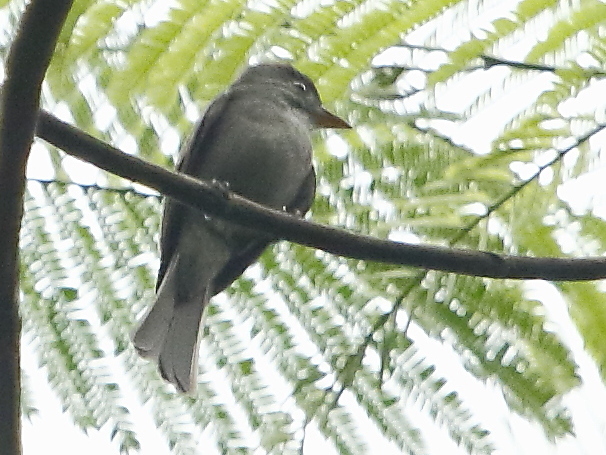
Blackish Pewee

Blackish Pewee

Contopus nigrescens

Hector Bottai, CC BY-SA 4.0, via Wikimedia Commons

Olive-sided Flycatcher

Olive-sided Flycatcher

Contopus cooperi

Becky Matsubara from El Sobrante, California, CC BY 2.0, via Wikimedia Commons

Side by side

Blackish PeweeOlive-sided Flycatcher
Scientific nameContopus nigrescens (P. L. Sclater & Salvin, 1880)Contopus cooperi (Nuttall, 1831)
English nameBlackish PeweeOlive-sided Flycatcher
GroupBirdsBirds
ClassAves BirdAves Bird
OrderPasseriformes PasserinePasseriformes Passerine
FamilyTyrannidae Tyrant FlycatcherTyrannidae Tyrant Flycatcher
GenusContopus PeweeContopus Pewee
Named in18801831
Red List categoryLeast ConcernLeast Concern
EnvironmentNot recordedterrestrial
Countries on record5 countries20 countries
GBIF occurrence records841 records494,502 records

Rows where the two agree are shown in grey.

Where each is found

Both recorded in 3 countries

Only Blackish Pewee (2)

Only Olive-sided Flycatcher (17)

From Catalogue of Life checklists and GBIF occurrence records. A country missing from a list means no record is held, which is not proof of absence.

Checked facts

Blackish PeweeOlive-sided Flycatcher
Appearance
  • Adult males and females have identical plumage. English Wikipedia
  • Adults of the nominate subspecies have a blackish-gray crown with a slight crest and a dark sooty-gray face. English Wikipedia
  • The nominate subspecies has a dark sooty-gray back and tail, with blackish-brown wings. English Wikipedia
  • The underparts are sooty gray, with a slightly paler throat. English Wikipedia
  • Juveniles have broad whitish wing bars and pale feather tips on their upperparts. English Wikipedia
  • The subspecies C. n. canescens is generally grayer than the nominate subspecies. English Wikipedia
  • Both subspecies have brown irises, broad flat bills, and black legs and feet. English Wikipedia
  • The olive tones on the bird's back and wings are most visible in favourable lighting and when its feathers are freshly moulted. English Wikipedia
  • The species has a relatively long bill and long wings for its body size. English Wikipedia
  • Some individuals can raise their head feathers to produce the appearance of a small crest. English Wikipedia
  • Male and female Olive-sided Flycatchers have similar appearances. English Wikipedia
Size
  • The Olive-sided Flycatcher is smaller than an American robin but larger than sparrows. English Wikipedia
Habitat
  • The nominate subspecies inhabits humid Andean montane forests, particularly their canopy and edges. English Wikipedia
  • The Peruvian population of C. n. canescens inhabits humid Andean montane forests, especially their canopy and edges. English Wikipedia
  • Populations of C. n. canescens in Guyana and Brazil inhabit terra firme forest in foothills. English Wikipedia
  • Guyana and Brazilian populations typically occupy the canopy and edges of forests. English Wikipedia
  • In Ecuador, the species occurs at elevations between 400 and 900 m. English Wikipedia
  • In Peru, the species occurs at elevations between 600 and 1,500 m. English Wikipedia
  • During breeding, the species mainly occupies open areas and edges of boreal, coniferous, and temperate western forests. English Wikipedia
  • Its breeding habitat can occur at elevations up to 10,000 feet. English Wikipedia
  • Breeding habitat is consistently located near water. English Wikipedia
  • The species sometimes nests in cities and on farms. English Wikipedia
  • Winter habitats include tropical montane and tropical lowland evergreen forests. English Wikipedia
  • The species is associated with habitats containing very tall trees. English Wikipedia
Diet
  • The Olive-sided Flycatcher primarily catches flying insects while airborne. English Wikipedia
  • Its recorded insect prey includes bees, wasps, moths, beetles, and grasshoppers. English Wikipedia
  • The species sometimes eats fruit during migration and the non-breeding season. English Wikipedia
Behaviour
  • Olive-sided Flycatchers commonly perch upright on dead branches or trees. English Wikipedia
  • Males sing during breeding to attract mates, using a characteristic three-note song. English Wikipedia
  • The species' most frequent call consists of three rapid successive pip sounds. English Wikipedia
  • Males sometimes produce growls or squeaks during conflicts with other males in the mating season. English Wikipedia
Reproduction
  • In eastern Brazil, the breeding season may extend from July through February. English Wikipedia
  • The breeding season in Peru apparently begins in September. English Wikipedia
  • The only documented nest was a shallow, open cup constructed from moss, lichen, plant fibers, and spider web. English Wikipedia
  • The female alone constructed the documented nest. English Wikipedia
Distribution
  • The species is recorded in Brazil, Ecuador, Guyana, and Peru, with a possible occurrence in Colombia. English Wikipedia
  • The nominate subspecies occurs intermittently along much of the eastern Andean slope in Ecuador. English Wikipedia
  • The species may occur in far southern Colombia, although this occurrence is considered hypothetical. English Wikipedia
  • The Peruvian population of C. n. canescens occurs intermittently along the eastern Andean slope in northern and central Peru. English Wikipedia
  • Other populations of C. n. canescens occur in southern Guyana and scattered locations in eastern Amazonian Brazil. English Wikipedia
  • A sighting in far northern Peru near the Ecuadorian border may represent either subspecies. English Wikipedia
  • Its breeding range extends from California and New Mexico north to central Alaska. English Wikipedia
  • The non-breeding range is mainly in northern South America, with a smaller area in Central America. English Wikipedia
Conservation
  • The Olive-sided Flycatcher was classified as Near Threatened globally by the IUCN in 2016. English Wikipedia
  • Canada lists the Olive-sided Flycatcher as threatened under its Species at Risk Act. English Wikipedia
  • The global population is estimated at approximately 1.9 million individuals. English Wikipedia
  • The global population has declined by approximately 79% over the past 50 years. English Wikipedia
  • The species' population is estimated to be declining by approximately 3% annually. English Wikipedia
  • The California range outline remains stable despite a substantial decline in breeding numbers. nrm.dfg.ca.gov
Similar speciesNo checked fact yet
  • The Olive-sided Flycatcher can be confused with the greater pewee, western wood-pewee, eastern wood-pewee, and eastern phoebe. English Wikipedia
  • The greater pewee differs from the Olive-sided Flycatcher by having a plain grey breast rather than a vest-like chest. English Wikipedia
  • The Olive-sided Flycatcher weighs twice as much as western and eastern wood-pewees. English Wikipedia
  • The eastern phoebe differs from the Olive-sided Flycatcher by having whiter underparts. English Wikipedia
Other
  • The species was originally described under the scientific name Myiochanes nigrescens. English Wikipedia
  • The species currently has two recognized subspecies. English Wikipedia
  • The nominate subspecies has a song described as a short, somewhat buzzy phrase repeated every three to four seconds. English Wikipedia
  • The species is classified in the genus Contopus, family Tyrannidae, and order Passeriformes. English Wikipedia

In brief

Blackish Pewee

The Blackish Pewee is a bird with two recognized subspecies. It is recorded in Brazil, Ecuador, Guyana, and Peru, with a possible occurrence in Colombia. It has predominantly sooty-gray plumage, brown irises, a broad flat bill, and black legs and feet. Full profile

Olive-sided Flycatcher

The Olive-sided Flycatcher is a bird in the genus Contopus, family Tyrannidae, and order Passeriformes. It breeds from California and New Mexico north to central Alaska and spends the non-breeding season mainly in northern South America, with a smaller area in Central America. It primarily catches flying insects while airborne and commonly perches upright on dead branches or trees. Full profile

Compare something else

Page built on 28 November 2026 from the data on the two species pages, where every source is listed.

Cite this page

ScientificNames.org. (2026). Blackish Pewee vs Olive-sided Flycatcher. Retrieved November 28, 2026, from https://scientificnames.org/compare/blackish-pewee-vs-olive-sided-flycatcher