Species · Birds
Blackish Pewee Contopus nigrescens
The scientific name of the Blackish Pewee is Contopus nigrescens. It is a species of bird in the family Tyrannidae (tyrant flycatcher), order Passeriformes. The name dates from 1880.
- Scientific name
- Contopus nigrescens (P. L. Sclater & Salvin, 1880)
- Common name
- Blackish Pewee
- Genus
- Contopus
- Family
- Tyrannidae (Tyrant Flycatcher)
- Order
- Passeriformes
- Class
- Aves
- Red List category
- LC Least Concern
- Recorded in
- 5 countries
- Name status
- accepted in the Catalogue of Life
Overview
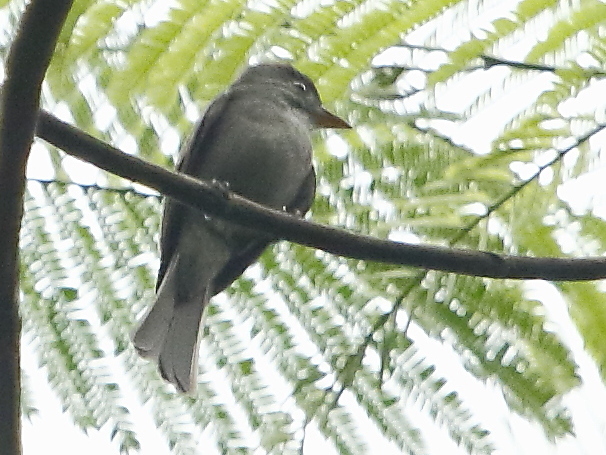
The Blackish Pewee is a bird with two recognized subspecies. It is recorded in Brazil, Ecuador, Guyana, and Peru, with a possible occurrence in Colombia. It has predominantly sooty-gray plumage, brown irises, a broad flat bill, and black legs and feet.
Written 27 November 2026 from the sources listed below. Each statement was checked against the passage it cites; statements that could not be supported were removed.
Appearance
Adult males and females have identical plumage. Adults of the nominate subspecies have a blackish-gray crown with a slight crest and a dark sooty-gray face.[1][2]
The nominate subspecies has a dark sooty-gray back and tail, blackish-brown wings, and sooty-gray underparts with a slightly paler throat. The subspecies C. n. canescens is generally grayer than the nominate subspecies.[3][4][5]
Juveniles have broad whitish wing bars and pale feather tips on their upperparts. Both subspecies have brown irises, broad flat bills, and black legs and feet.[6][7]
The Blackish Pewee measures approximately 13 cm in length. A recorded male weighed 9 g and a recorded female weighed 10 g.[8][9][10]
Habitat
The nominate subspecies inhabits humid Andean montane forests, particularly their canopy and edges. The Peruvian population of C. n. canescens occupies similar forests, especially their canopy and edges.[11][12]
Populations of C. n. canescens in Guyana and Brazil inhabit terra firme forest in foothills. They typically occupy the canopy and edges of forests.[13][14]
In Ecuador, the species occurs at elevations between 400 and 900 m. In Peru, it occurs at elevations between 600 and 1,500 m.[15][16]
The nominate subspecies occurs intermittently along much of the eastern Andean slope in Ecuador. The Peruvian population of C. n. canescens occurs intermittently along the eastern Andean slope in northern and central Peru.[17][18]
Other populations of C. n. canescens occur in southern Guyana and scattered locations in eastern Amazonian Brazil. A sighting in far northern Peru near the Ecuadorian border may represent either subspecies.[19][20]
Diet
The Blackish Pewee feeds on insects.[21]
Behaviour
The species generally forages alone or in pairs. It catches prey in mid-air by making sallies from exposed perches.[22][23]
The bird typically perches upright high in trees at forest edges or beside watercourses. After catching prey, it usually returns to the same perch and shakes or shivers its tail when landing.[24][25][26]
The Blackish Pewee is resident throughout the year. It sings mainly in the morning but also sings at other times of day, and gives calls throughout the day.[27][28][29]
The species sings from elevated perches. The nominate subspecies has a song described as a short, somewhat buzzy phrase repeated every three to four seconds.[30][31]
Reproduction and life cycle
In eastern Brazil, the breeding season may extend from July through February. In Peru, the breeding season apparently begins in September.[32][33]
The only documented nest was a shallow, open cup constructed from moss, lichen, plant fibers, and spider web. The female alone constructed the nest.[34][35]
Conservation
The Blackish Pewee is classified as Least Concern by the IUCN. Its population size is unknown and is believed to be decreasing.[36][37]
No immediate threats to the species have been identified. Deforestation is perceived as a risk.[38][39]
The species is described as local and scarce in Ecuador and rare and local in Peru.[40][41]
Classification of the Blackish Pewee
| Kingdom | Animalia |
|---|---|
| Phylum | Chordata |
| Subphylum | Vertebrata |
| Infraphylum | Gnathostomata |
| Parvphylum | Osteichthyes |
| Megaclass | Tetrapoda |
| Class | Aves (Bird) |
| Order | Passeriformes (Passerine) |
| Family | Tyrannidae (Tyrant Flycatcher) |
| Genus | Contopus (Pewee) |
| Species | Contopus nigrescens (P. L. Sclater & Salvin, 1880) |
Where the Blackish Pewee is found
Checklists and occurrence records place Contopus nigrescens in 5 countries across South America. GBIF holds 841 georeferenced records of it.
Countries
Regions and cities with the most records
- San Martín Department, Peru 224
- Orellana Province, Ecuador 191
- Pará, Brazil 174
- Zamora Chinchipe, Ecuador 128
- La Banda, Peru 51
- Parauapebas, Brazil 33
- Upper Takutu-Upper Essequibo, Guyana 24
- Pastaza Province, Ecuador 14
- Morona-Santiago Province, Ecuador 12
- Amazonas, Peru 7
- Maranhão, Brazil 7
- Loreto, Peru 5
- Pasco, Peru 5
- Armenia, Colombia 4
- Calarcá, Colombia 4
- Circasia, Colombia 4
- Montenegro, Colombia 4
- Moyobamba, Peru 4
- Napo, Ecuador 4
- Quimbaya, Colombia 4
- Quindío Department, Colombia 4
- Tocantins, Brazil 4
- Zamora, Ecuador 3
Range as the checklists state it
South America
A number beside a place is its count of GBIF occurrence records. A place without a number comes from a checklist alone. Records show where a species has been observed or collected, which can include escapes and vagrants.
Common names
English
- Blackish Pewee
Names in 24 other languages
- Catalan
- piuí negrós
- Chinese
- 淡黑綠霸鶲, 黑绿霸鹟
- Croatian
- crni muhar
- Czech
- tyranovec černavý
- Danish
- Sortgrå Pivi
- Dutch
- Zwarte Piewie
- Esperanto
- nigreta pivio
- Finnish
- tummapiivi
- French
- Moucherolle noirâtre, Pioui noirâtre
- German
- Dunkelschnäppertyrann, Einfarbtyrann
- Italian
- Piuì nerastro
- Japanese
- クロモリタイランチョウ
- Lithuanian
- juosvasis pivis
- Norwegian
- kokspivi
- Polish
- piwik czarniawy
- Portuguese
- Piui-preto, piuí-preto
- Russian
- Одноцветный пиви, Черноватый пиви
- Serbian
- Crnkasti pivi
- Slovak
- pamuchár černastý
- Spanish
- Pibí negruzco
- Swedish
- svartpivi
- Turkish
- Karaca Pivi
- Ukrainian
- піві еквадорський
- Welsh
- piwi du
Synonyms
One other scientific name has been used for this species and is now treated as a synonym of Contopus nigrescens.
- Myiochanes nigrescens P. L. Sclater & Salvin, 1880
Subspecies and varieties
- Contopus nigrescens canescens subspecies
- Contopus nigrescens nigrescens subspecies
Related species
-
 Eastern Wood PeweeContopus virens
-
 Olive-sided FlycatcherContopus cooperi
-
 Western Wood PeweeContopus sordidulus
-
 Greater PeweeContopus pertinax
-
 Smoke-colored PeweeContopus fumigatus
-
 Cuban PeweeContopus caribaeus
-
 Northern Tropical PeweeContopus bogotensis
-
 Lesser Antillean PeweeContopus latirostris
Compare
Questions and answers
What is the scientific name of the Blackish Pewee?
The scientific name of the Blackish Pewee is Contopus nigrescens. Written with its author, the full name is Contopus nigrescens (P. L. Sclater & Salvin, 1880).
Which family does the Blackish Pewee belong to?
Contopus nigrescens belongs to the family Tyrannidae, in the order Passeriformes and the class Aves.
Where is the Blackish Pewee found?
Checklists and occurrence records place Contopus nigrescens in 5 countries: Ecuador, Peru, Brazil, Guyana and Colombia.
What is the conservation status of the Blackish Pewee?
The IUCN Red List category recorded for Contopus nigrescens is Least Concern (LC).
How many subspecies of the Blackish Pewee are recognized?
Two subspecies are recognized.[42]
Where does the Blackish Pewee occur?
It is recorded in Brazil, Ecuador, Guyana, and Peru, with a possible occurrence in far southern Colombia.[43][44]
What does the Blackish Pewee eat?
It feeds on insects, which it catches in mid-air by making sallies from exposed perches.[21][23]
Is the Blackish Pewee migratory?
The species is resident throughout the year.[27]
When does the Blackish Pewee breed?
In eastern Brazil, the breeding season may extend from July through February. In Peru, it apparently begins in September.[32][33]
What is the conservation status of the Blackish Pewee?
It is classified as Least Concern by the IUCN, although its population size is unknown and believed to be decreasing.[36][37]
What threats affect the Blackish Pewee?
No immediate threats have been identified, but deforestation is perceived as a risk.[38][39]
What was the original scientific name of the Blackish Pewee?
The species was originally described under the scientific name Myiochanes nigrescens.[45]
Sources
Passages the profile rests on
- Adult males and females have identical plumage. Source passage: “The sexes have the same plumage.” — English Wikipedia
- Adults of the nominate subspecies have a blackish-gray crown with a slight crest and a dark sooty-gray face. Source passage: “Adults of the nominate subspecies have a blackish gray crown with a slight crest and slightly paler gray lores on an otherwise dark sooty gray face.” — English Wikipedia
- The nominate subspecies has a dark sooty-gray back and tail, with blackish-brown wings. Source passage: “Their back is also dark sooty gray. Their wings are blackish brown and their tail dark sooty gray.” — English Wikipedia
- The underparts are sooty gray, with a slightly paler throat. Source passage: “Their underparts are sooty gray that is slightly paler on the throat.” — English Wikipedia
- The subspecies C. n. canescens is generally grayer than the nominate subspecies. Source passage: “Subspecies C. n. canescens is generally grayer than the nominate” — English Wikipedia
- Juveniles have broad whitish wing bars and pale feather tips on their upperparts. Source passage: “Juveniles have wide whitish wing bars and pale tips on the upperparts' feathers.” — English Wikipedia
- Both subspecies have brown irises, broad flat bills, and black legs and feet. Source passage: “Both subspecies have a brown iris, a wide flat bill with a black maxilla and pale grayish ochre mandible, and black legs and feet.” — English Wikipedia
- The blackish pewee measures approximately 13 cm in length. Source passage: “The blackish pewee is about 13 cm (5.1 in) long” — English Wikipedia
- A recorded male weighed 9 g. Source passage: “one male weighed 9 g (0.32 oz)” — English Wikipedia
- A recorded female weighed 10 g. Source passage: “and a female 10 g (0.35 oz).” — English Wikipedia
- The nominate subspecies inhabits humid Andean montane forests, particularly their canopy and edges. Source passage: “The nominate subspecies and the Peruvian population of C. n. canescens are found in humid Andean montane forest, especially in the canopy and on its edges.” — English Wikipedia
- The Peruvian population of C. n. canescens inhabits humid Andean montane forests, especially their canopy and edges. Source passage: “the Peruvian population of C. n. canescens are found in humid Andean montane forest, especially in the canopy and on its edges.” — English Wikipedia
- Populations of C. n. canescens in Guyana and Brazil inhabit terra firme forest in foothills. Source passage: “The populations of C. n. canescens in Guyana and Brazil inhabit terra firme forest in foothills” — English Wikipedia
- Guyana and Brazilian populations typically occupy the canopy and edges of forests. Source passage: “again typically in the canopy and on the forest's edges.” — English Wikipedia
- In Ecuador, the species occurs at elevations between 400 and 900 m. Source passage: “In elevation it occurs between 400 and 900 m (1,300 and 3,000 ft) in Ecuador” — English Wikipedia
- In Peru, the species occurs at elevations between 600 and 1,500 m. Source passage: “and between 600 and 1,500 m (2,000 and 4,900 ft) in Peru.” — English Wikipedia
- The nominate subspecies occurs intermittently along much of the eastern Andean slope in Ecuador. Source passage: “The nominate subspecies is found intermittently along most of the eastern slope of the Andes of Ecuador.” — English Wikipedia
- The Peruvian population of C. n. canescens occurs intermittently along the eastern Andean slope in northern and central Peru. Source passage: “One population of subspecies C. n. canescens is found intermittently on the eastern slope of the Andes in northern and central Peru.” — English Wikipedia
- Other populations of C. n. canescens occur in southern Guyana and scattered locations in eastern Amazonian Brazil. Source passage: “Others are found in southern Guyana and in scattered locations in eastern Amazonian Brazil.” — English Wikipedia
- A sighting in far northern Peru near the Ecuadorian border may represent either subspecies. Source passage: “A single sight record in far northern Peru near the Ecuadoran border might be of either subspecies.” — English Wikipedia
- The blackish pewee feeds on insects. Source passage: “The blackish pewee feeds on insects” — English Wikipedia
- The species generally forages alone or in pairs. Source passage: “It typically forages singly or in pairs.” — English Wikipedia
- The blackish pewee catches prey in mid-air by making sallies from exposed perches. Source passage: “captures prey in mid-air with sallies from it ("hawking").” — English Wikipedia
- The bird typically perches upright high in trees at forest edges or beside watercourses. Source passage: “It sits erect on an exposed perch high in a tree at the forest edge or along watercourses” — English Wikipedia
- After catching prey, the bird usually returns to the same perch. Source passage: “It usually returns to the same perch after a sally” — English Wikipedia
- The bird shakes or shivers its tail when landing back on its perch. Source passage: “"shivers" its tail upon landing.” — English Wikipedia
- The blackish pewee is resident throughout the year. Source passage: “The blackish pewee is a year-round resident.” — English Wikipedia
- The species sings mainly in the morning but also sings at other times of day. Source passage: “The species sings mostly in the morning but also during the rest of the day” — English Wikipedia
- The blackish pewee gives calls throughout the day. Source passage: “it calls throughout the day.” — English Wikipedia
- The species sings from elevated perches. Source passage: “It sings from a high perch.” — English Wikipedia
- The nominate subspecies has a song described as a short, somewhat buzzy phrase repeated every three to four seconds. Source passage: “a snappy but somewhat burry chí-bew repeated at 3 to 4-second intervals” — English Wikipedia
- In eastern Brazil, the breeding season may extend from July through February. Source passage: “In eastern Brazil it may span at least from July to February.” — English Wikipedia
- The breeding season in Peru apparently begins in September. Source passage: “In Peru it apparently begins in September.” — English Wikipedia
- The only documented nest was a shallow, open cup constructed from moss, lichen, plant fibers, and spider web. Source passage: “The one known nest was a shallow open cup made from moss, lichen, plant fibers, and spider web.” — English Wikipedia
- The female alone constructed the documented nest. Source passage: “The female alone constructed it.” — English Wikipedia
- The blackish pewee is classified as Least Concern by the IUCN. Source passage: “The IUCN has assessed the blackish pewee as being of Least Concern.” — English Wikipedia
- The population size of the species is unknown and is believed to be decreasing. Source passage: “Its population size is not known and is believed to be decreasing.” — English Wikipedia
- No immediate threats to the species have been identified. Source passage: “No immediate threats have been identified.” — English Wikipedia
- Deforestation is perceived as a risk to the blackish pewee. Source passage: “[The] Blackish Pewee is perceived to be at risk from deforestation” — English Wikipedia
- The species is described as local and scarce in Ecuador. Source passage: “"local and scarce" in Ecuador” — English Wikipedia
- The species is described as rare and local in Peru. Source passage: “"rare and local" in Peru.” — English Wikipedia
- The species currently has two recognized subspecies. Source passage: “It now has two subspecies” — English Wikipedia
- The species is recorded in Brazil, Ecuador, Guyana, and Peru, with a possible occurrence in Colombia. Source passage: “It is found in Brazil, Ecuador, Guyana, Peru, and possibly Colombia.” — English Wikipedia
- The species may occur in far southern Colombia, although this occurrence is considered hypothetical. Source passage: “It might also occur slightly further north in far southern Colombia, where the South American Classification Committee of the American Ornithological Society deems it hypothetical.” — English Wikipedia
- The species was originally described under the scientific name Myiochanes nigrescens. Source passage: “The blackish pewee was originally described as Myiochanes nigrescens.” — English Wikipedia
Data
- Catalogue of Life, 2026-10-16 XR cc by
- Global Biodiversity Information Facility CC BY 4.0
- Wikidata CC0
- GeoNames CC BY 4.0
- Wikimedia Commons per image; credit shown with each image
- Within the Catalogue of Life, this name comes from The Integrated Taxonomic Information System cc0
References
- Gill, Frank, & and Minturn Wright. (2006). Birds of the World: Recommended English Names.
This species in other databases
Page built on 27 November 2026. See how the catalog is made and all sources and licences.
Cite this page
ScientificNames.org. (2026). Contopus nigrescens (Blackish Pewee). Retrieved November 27, 2026, from https://scientificnames.org/species/contopus-nigrescens
“Contopus nigrescens (Blackish Pewee).” ScientificNames.org, 2026, scientificnames.org/species/contopus-nigrescens. Accessed 27 Nov. 2026.
ScientificNames.org. “Contopus nigrescens (Blackish Pewee).” Accessed November 27, 2026. https://scientificnames.org/species/contopus-nigrescens.
@misc{scientificnames_contopus_nigrescens_blackish_pewee,
  author = {{ScientificNames.org}},
  title = {Contopus nigrescens (Blackish Pewee)},
  year = {2026},
  url = {https://scientificnames.org/species/contopus-nigrescens},
  note = {Accessed 2026-11-27}
}