Comparison

Blackish Pewee vs Western Wood Pewee

Blackish Pewee (Contopus nigrescens) and Western Wood Pewee (Contopus sordidulus) both belong to the genus Contopus (pewee) and part ways below it. Both are recorded in 3 countries.
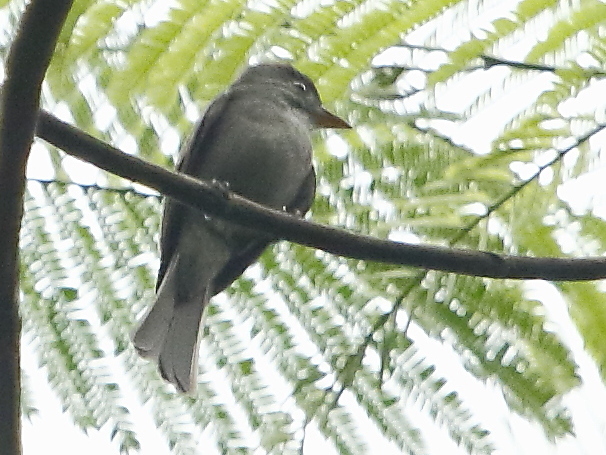
Blackish Pewee

Blackish Pewee

Contopus nigrescens

Hector Bottai, CC BY-SA 4.0, via Wikimedia Commons

Western Wood Pewee

Western Wood Pewee

Contopus sordidulus

JerryFriedman, CC BY-SA 3.0, via Wikimedia Commons

Side by side

Blackish PeweeWestern Wood Pewee
Scientific nameContopus nigrescens (P. L. Sclater & Salvin, 1880)Contopus sordidulus P. L. Sclater, 1859
English nameBlackish PeweeWestern Wood Pewee
GroupBirdsBirds
ClassAves BirdAves Bird
OrderPasseriformes PasserinePasseriformes Passerine
FamilyTyrannidae Tyrant FlycatcherTyrannidae Tyrant Flycatcher
GenusContopus PeweeContopus Pewee
Named in18801859
Red List categoryLeast ConcernLeast Concern
EnvironmentNot recordedterrestrial
Countries on record5 countries16 countries
GBIF occurrence records841 records1,177,650 records

Rows where the two agree are shown in grey.

Where each is found

Both recorded in 3 countries

Only Blackish Pewee (2)

Only Western Wood Pewee (13)

From Catalogue of Life checklists and GBIF occurrence records. A country missing from a list means no record is held, which is not proof of absence.

Checked facts

Blackish PeweeWestern Wood Pewee
Appearance
  • Adult males and females have identical plumage. English Wikipedia
  • Adults of the nominate subspecies have a blackish-gray crown with a slight crest and a dark sooty-gray face. English Wikipedia
  • The nominate subspecies has a dark sooty-gray back and tail, with blackish-brown wings. English Wikipedia
  • The underparts are sooty gray, with a slightly paler throat. English Wikipedia
  • Juveniles have broad whitish wing bars and pale feather tips on their upperparts. English Wikipedia
  • The subspecies C. n. canescens is generally grayer than the nominate subspecies. English Wikipedia
  • Both subspecies have brown irises, broad flat bills, and black legs and feet. English Wikipedia
  • Adults have gray-olive upperparts and light underparts with olive coloration across the breast. English Wikipedia
  • The species has two wing bars and a dark bill with yellow coloration at the base of the lower mandible. English Wikipedia
  • Adults have a grayish throat, whereas juveniles have a duller throat coloration. animaldiversity.org
  • Juveniles have less vibrant wing bars than adults. animaldiversity.org
  • The species has dark brown flanks and sides with indistinct streaks extending toward the lower sides. animaldiversity.org
  • Its tertials have more conspicuous fringes than its wing bars. animaldiversity.org
  • The species has short tails relative to its body proportions. animaldiversity.org
  • Its upper tail coverts extend to the midpoint of its primary extensions. animaldiversity.org
  • The lower mandible is approximately 50 percent darker than the upper mandible. animaldiversity.org
  • The throat, belly, and area beneath the tail are whitish. animaldiversity.org
Size
Habitat
  • The nominate subspecies inhabits humid Andean montane forests, particularly their canopy and edges. English Wikipedia
  • The Peruvian population of C. n. canescens inhabits humid Andean montane forests, especially their canopy and edges. English Wikipedia
  • Populations of C. n. canescens in Guyana and Brazil inhabit terra firme forest in foothills. English Wikipedia
  • Guyana and Brazilian populations typically occupy the canopy and edges of forests. English Wikipedia
  • In Ecuador, the species occurs at elevations between 400 and 900 m. English Wikipedia
  • In Peru, the species occurs at elevations between 600 and 1,500 m. English Wikipedia
  • Its breeding habitat consists of open wooded areas in western North America. English Wikipedia
  • During summer, the species inhabits evergreen forests, woodlands, coniferous forests, and forests with either open or closed canopies. animaldiversity.org
  • During winter, the species also occupies agricultural fields, meadows, grasslands, and thickets. animaldiversity.org
  • Western Wood-Pewees generally prefer dry environments. animaldiversity.org
  • The species generally occupies tall treetops close to land. animaldiversity.org
  • California black oak forests provide suitable nesting habitat for this species. English Wikipedia
Diet
Behaviour
Reproduction
  • In eastern Brazil, the breeding season may extend from July through February. English Wikipedia
  • The breeding season in Peru apparently begins in September. English Wikipedia
  • The only documented nest was a shallow, open cup constructed from moss, lichen, plant fibers, and spider web. English Wikipedia
  • The female alone constructed the documented nest. English Wikipedia
Distribution
  • The species is recorded in Brazil, Ecuador, Guyana, and Peru, with a possible occurrence in Colombia. English Wikipedia
  • The nominate subspecies occurs intermittently along much of the eastern Andean slope in Ecuador. English Wikipedia
  • The species may occur in far southern Colombia, although this occurrence is considered hypothetical. English Wikipedia
  • The Peruvian population of C. n. canescens occurs intermittently along the eastern Andean slope in northern and central Peru. English Wikipedia
  • Other populations of C. n. canescens occur in southern Guyana and scattered locations in eastern Amazonian Brazil. English Wikipedia
  • A sighting in far northern Peru near the Ecuadorian border may represent either subspecies. English Wikipedia
  • The species occurs in western North America from east-central Alaska to northwestern Minnesota and south to southern Baja. animaldiversity.org
  • The species migrates south from its northern range during autumn. animaldiversity.org
  • Its winter distribution extends south to Panama. animaldiversity.org
Conservation
  • The species is described as abundant, although population trends differ among regions. animaldiversity.org
  • Habitat loss on breeding and wintering grounds is suggested as a possible cause of regional population declines. animaldiversity.org
UsesNo checked fact yet
Similar speciesNo checked fact yet
  • The Western Wood-Pewee closely resembles the Eastern Wood-Pewee in appearance. English Wikipedia
  • The Western Wood-Pewee and Eastern Wood-Pewee were formerly classified as a single species. English Wikipedia
  • The Western Wood-Pewee can be distinguished from the Eastern Wood-Pewee by its communication calls. animaldiversity.org
Other
  • The species was originally described under the scientific name Myiochanes nigrescens. English Wikipedia
  • The species currently has two recognized subspecies. English Wikipedia
  • The nominate subspecies has a song described as a short, somewhat buzzy phrase repeated every three to four seconds. English Wikipedia
  • The species has no known preference for nesting on living rather than dead branches. animaldiversity.org
  • Its nest coloration and shape help it resemble a tree stump and remain inconspicuous. animaldiversity.org

In brief

Blackish Pewee

The Blackish Pewee is a bird with two recognized subspecies. It is recorded in Brazil, Ecuador, Guyana, and Peru, with a possible occurrence in Colombia. It has predominantly sooty-gray plumage, brown irises, a broad flat bill, and black legs and feet. Full profile

Western Wood Pewee

Contopus sordidulus occurs in western North America and migrates south to Panama during winter. It has gray-olive upperparts, light underparts, two wing bars, and a dark bill with yellow coloration at the base of the lower mandible. Full profile

Compare something else

Page built on 28 November 2026 from the data on the two species pages, where every source is listed.

Cite this page

ScientificNames.org. (2026). Blackish Pewee vs Western Wood Pewee. Retrieved November 28, 2026, from https://scientificnames.org/compare/blackish-pewee-vs-western-wood-pewee