| Appearance | - Adult males and females have identical plumage. English Wikipedia
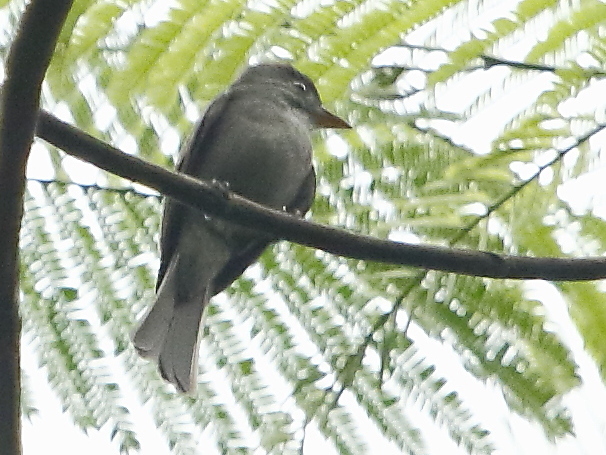
- Adults of the nominate subspecies have a blackish-gray crown with a slight crest and a dark sooty-gray face. English Wikipedia
- The nominate subspecies has a dark sooty-gray back and tail, with blackish-brown wings. English Wikipedia
- The underparts are sooty gray, with a slightly paler throat. English Wikipedia
- Juveniles have broad whitish wing bars and pale feather tips on their upperparts. English Wikipedia
- The subspecies C. n. canescens is generally grayer than the nominate subspecies. English Wikipedia
- Both subspecies have brown irises, broad flat bills, and black legs and feet. English Wikipedia
| - Adult eastern wood pewees have gray-olive upperparts and light underparts with an olive wash across the breast. English Wikipedia
- Each wing has two pale wing bars and long primary flight feathers that create a slim, pointed wingtip. English Wikipedia
- The upper bill is dark while the lower bill is yellowish. English Wikipedia
- Eastern wood pewees have brown eyes and dark or blackish bill tips with orange-yellow bases. animaldiversity.org
|
|---|
| Size | | |
|---|
| Habitat | - The nominate subspecies inhabits humid Andean montane forests, particularly their canopy and edges. English Wikipedia
- The Peruvian population of C. n. canescens inhabits humid Andean montane forests, especially their canopy and edges. English Wikipedia
- Populations of C. n. canescens in Guyana and Brazil inhabit terra firme forest in foothills. English Wikipedia
- Guyana and Brazilian populations typically occupy the canopy and edges of forests. English Wikipedia
- In Ecuador, the species occurs at elevations between 400 and 900 m. English Wikipedia
- In Peru, the species occurs at elevations between 600 and 1,500 m. English Wikipedia
| - Eastern wood pewees breed in deciduous forests, mixed woods, and pine plantations in eastern North America. English Wikipedia
- Eastern wood pewees inhabit both coniferous and deciduous forests, including young and mature stands. animaldiversity.org
- Eastern wood pewees occupy both upper and lower forest canopies. animaldiversity.org
- Eastern wood pewees also breed in orchards, roadside trees, urban savannas, and riparian habitats. animaldiversity.org
|
|---|
| Diet | | |
|---|
| Behaviour | | - Eastern wood pewees catch prey in flight after waiting on perches at intermediate heights in trees. English Wikipedia
- Eastern wood pewees sometimes hover to capture prey from vegetation. English Wikipedia
- Eastern wood pewees are primarily active during daylight and may begin activity up to 45 minutes before sunrise. animaldiversity.org
- Eastern wood pewees are generally solitary during migration and on their wintering grounds. animaldiversity.org
- Male eastern wood pewees defend breeding territories aggressively against neighboring birds. English Wikipedia
- Male eastern wood pewees can mate with two females simultaneously. English Wikipedia
- Male eastern wood pewees defend breeding territories by singing. animaldiversity.org
- Eastern wood pewees are territorial during breeding but not during winter. animaldiversity.org
|
|---|
| Reproduction | - In eastern Brazil, the breeding season may extend from July through February. English Wikipedia
- The breeding season in Peru apparently begins in September. English Wikipedia
- The only documented nest was a shallow, open cup constructed from moss, lichen, plant fibers, and spider web. English Wikipedia
- The female alone constructed the documented nest. English Wikipedia
| - Eastern wood pewees construct open cup nests from grasses, bark, and lichen. English Wikipedia
- Eastern wood pewee nests are attached to horizontal tree branches using spider webs. English Wikipedia
- Eastern wood pewee nests are generally located around 9.1 m above the ground. English Wikipedia
- Common nest trees include oaks, pines, birches, and maples. English Wikipedia
- Female eastern wood pewees usually lay three eggs, although clutches of two eggs also occur. English Wikipedia
- Eastern wood pewee eggs are translucent white with brown flecking concentrated near their larger ends. English Wikipedia
- Female eastern wood pewees incubate eggs for approximately 12–13 days. animaldiversity.org
- Eastern wood pewee eggs hatch approximately 12–14 days after incubation begins. English Wikipedia
- Both parents feed eastern wood pewee nestlings. English Wikipedia
- Eastern wood pewee nestlings generally fledge 15–17 days after hatching. English Wikipedia
- Female eastern wood pewees may produce a second clutch after successfully raising their first brood. animaldiversity.org
- Eastern wood pewees generally breed once annually between May and August. animaldiversity.org
|
|---|
| Distribution | - The species is recorded in Brazil, Ecuador, Guyana, and Peru, with a possible occurrence in Colombia. English Wikipedia
- The nominate subspecies occurs intermittently along much of the eastern Andean slope in Ecuador. English Wikipedia
- The species may occur in far southern Colombia, although this occurrence is considered hypothetical. English Wikipedia
- The Peruvian population of C. n. canescens occurs intermittently along the eastern Andean slope in northern and central Peru. English Wikipedia
- Other populations of C. n. canescens occur in southern Guyana and scattered locations in eastern Amazonian Brazil. English Wikipedia
- A sighting in far northern Peru near the Ecuadorian border may represent either subspecies. English Wikipedia
| - The breeding range of eastern wood pewees includes eastern North America. English Wikipedia
- Eastern wood pewees migrate to Central America, the Caribbean, and the Andes region of northern South America. English Wikipedia
|
|---|
| Conservation | | - The eastern wood pewee is considered common and widespread and is not globally threatened according to the IUCN. English Wikipedia
- Eastern wood pewee populations have declined in recent decades. English Wikipedia
- Loss of forest habitat in the wintering range is considered a possible cause of eastern wood pewee population declines. English Wikipedia
|
|---|
| Other | - The species was originally described under the scientific name Myiochanes nigrescens. English Wikipedia
- The species currently has two recognized subspecies. English Wikipedia
- The nominate subspecies has a song described as a short, somewhat buzzy phrase repeated every three to four seconds. English Wikipedia
| No checked fact yet |
|---|