Comparison
Copaiba vs Copaiba Balsam
Copaiba (Copaifera langsdorffii) and Copaiba Balsam (Copaifera officinalis) both belong to the genus Copaifera (copaiferas) and part ways below it. Both are recorded in 5 countries.


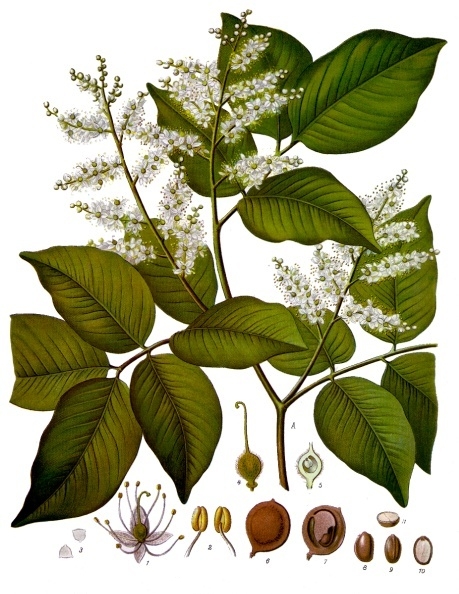
Copaiba Balsam
Copaifera officinalis
Franz Eugen Köhler, Köhler's Medizinal-Pflanzen, Public domain, via Wikimedia Commons

Side by side
| Copaiba | Copaiba Balsam | |
|---|---|---|
| Scientific name | Copaifera langsdorffii Desf. | Copaifera officinalis L. |
| English name | Copaiba | Copaiba Balsam |
| Group | Flowering plants | Flowering plants |
| Class | Magnoliopsida | Magnoliopsida |
| Order | Fabales | Fabales |
| Family | Fabaceae Bean | Fabaceae Bean |
| Genus | Copaifera Copaiferas | Copaifera Copaiferas |
| Red List category | Least Concern | Not recorded |
| Countries on record | 6 countries | 14 countries |
| GBIF occurrence records | 7,288 records | 405 records |
Rows where the two agree are shown in grey.
Where each is found
Both recorded in 5 countries
Only Copaiba (1)
Only Copaiba Balsam (9)
From Catalogue of Life checklists and GBIF occurrence records. A country missing from a list means no record is held, which is not proof of absence.
Checked facts
| Copaiba | Copaiba Balsam | |
|---|---|---|
| Size |
| No checked fact yet |
| Habitat |
| No checked fact yet |
| Distribution |
|
|
| Uses |
|
|
| Other |
|
|
In brief
Copaiba
Copaifera langsdorffii occurs in tropical rainforest environments and grows primarily in seasonally dry environments, with a native distribution extending from Guyana to Misiones in Argentina. Its porous wood contains capillaries filled with oil, and the tree produces terpene hydrocarbons in its wood and leaves. Full profile
Copaiba Balsam
Copaiba balsam is native to Bolivia, Brazil, and Venezuela and has been introduced to Cuba, the Dominican Republic, Trinidad and Tobago, Sierra Leone, India, and Sri Lanka. Its oleoresin exhibits greater bactericidal activity against common pathogens than the oleoresin of Copaifera langsdorffii. Full profile
Compare something else
Page built on 29 November 2026 from the data on the two species pages, where every source is listed.
Cite this page
ScientificNames.org. (2026). Copaiba vs Copaiba Balsam. Retrieved November 29, 2026, from https://scientificnames.org/compare/copaiba-vs-copaiba-balsam
“Copaiba vs Copaiba Balsam.” ScientificNames.org, 2026, scientificnames.org/compare/copaiba-vs-copaiba-balsam. Accessed 29 Nov. 2026.
ScientificNames.org. “Copaiba vs Copaiba Balsam.” Accessed November 29, 2026. https://scientificnames.org/compare/copaiba-vs-copaiba-balsam.
@misc{scientificnames_copaiba_vs_copaiba_balsam,
  author = {{ScientificNames.org}},
  title = {Copaiba vs Copaiba Balsam},
  year = {2026},
  url = {https://scientificnames.org/compare/copaiba-vs-copaiba-balsam},
  note = {Accessed 2026-11-29}
}