Species · Flowering plants
Copaiba Balsam Copaifera officinalis
The scientific name of the Copaiba Balsam is Copaifera officinalis. It is a species of flowering plant in the family Fabaceae (bean), order Fabales.
- Scientific name
- Copaifera officinalis L.
- Common name
- Copaiba Balsam
- Genus
- Copaifera
- Family
- Fabaceae (Bean)
- Order
- Fabales
- Class
- Magnoliopsida
- Recorded in
- 14 countries
- Name status
- accepted in the Catalogue of Life
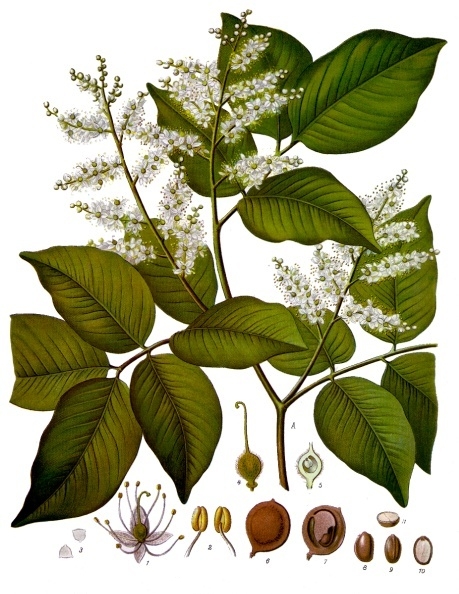
Overview
Copaiba balsam is native to Bolivia, Brazil, and Venezuela and has been introduced to Cuba, the Dominican Republic, Trinidad and Tobago, Sierra Leone, India, and Sri Lanka. Its oleoresin exhibits greater bactericidal activity against common pathogens than the oleoresin of Copaifera langsdorffii.
Written 26 November 2026 from the sources listed below. Each statement was checked against the passage it cites; statements that could not be supported were removed.
Uses
The oleoresin extracted from copaiba balsam is used for industrial, artisanal, and medicinal purposes. It is also known as balsam of copaiba or, after refining, copaiba oil.[1][2]
The oleoresin exhibits greater bactericidal activity against common pathogens than the oleoresin of Copaifera langsdorffii.[3]
Classification of the Copaiba Balsam
| Kingdom | Plantae |
|---|---|
| Subkingdom | Pteridobiotina |
| Phylum | Tracheophyta |
| Class | Magnoliopsida |
| Order | Fabales |
| Family | Fabaceae (Bean) |
| Genus | Copaifera (Copaiferas) |
| Species | Copaifera officinalis L. |
Where the Copaiba Balsam is found
Checklists and occurrence records place Copaifera officinalis in 14 countries across Africa, Asia, North America and South America. GBIF holds 405 georeferenced records of it.
Countries where it is native or its origin is not stated
Countries where it has been introduced
Regions and cities with the most records
- Casanare Department, Colombia 74
- Meta Department, Colombia 18
- Bolívar, Venezuela 17
- Amazonas, Brazil 8
- Pará, Brazil 6
- Cojedes, Venezuela 5
- Machiques, Venezuela 5
- Monte Alegre, Brazil 5
- Zulia, Venezuela 5
- Anzoátegui, Venezuela 4
- Bahia, Brazil 4
- Upper Takutu-Upper Essequibo, Guyana 4
- Vichada Department, Colombia 4
- Porto Seguro, Brazil 3
- Vaupés, Colombia 3
10 more countries have a few records outside this range
These countries hold a few records of Copaifera officinalis but lie outside the range the checklists give for it. Such records are often zoo or garden specimens, museum material or vagrants, so the species is not counted as occurring there.
A number beside a place is its count of GBIF occurrence records. A place without a number comes from a checklist alone. Records show where a species has been observed or collected, which can include escapes and vagrants.
Common names
English
- Copaiba Balsam
Names in 8 other languages
- Chinese
- 柯柏胶树, 柯柏膠樹, 香漆豆
- Czech
- kopaiva lékařská
- French
- bois de sang, copahu, copayer
- German
- Copaibabaum
- Portuguese
- Copabeira
- Slovak
- kopainovník lekársky
- Spanish
- Abey hembra, Aceite, Algarrobo, Amacey, Cabima, Cabimo, Canime, Copaiba
- Swedish
- kopaiva
Synonyms
5 other scientific names have been used for this species and are now treated as synonyms of Copaifera officinalis.
- Copaiba officinalis (L.) Kuntze
- Copaiba officinalis Adans.
- Copaifera jacquiniana G.Don
- Copaifera jacquinii Desf.
- Copaiva officinalis (L.) Jacq.
Related species
-
 CopaibaCopaifera langsdorffii
- Copaifera salikounda
- CopaibaCopaifera epunctata
- Copaifera panamensis
- CopaibaCopaifera martii
-
 Copaifera baumiana
- Copaifera paupera
- Copaifera trapezifolia
Compare
Questions and answers
What is the scientific name of the Copaiba Balsam?
The scientific name of the Copaiba Balsam is Copaifera officinalis. Written with its author, the full name is Copaifera officinalis L..
Which family does the Copaiba Balsam belong to?
Copaifera officinalis belongs to the family Fabaceae, in the order Fabales and the class Magnoliopsida.
Where is the Copaiba Balsam found?
Checklists and occurrence records place Copaifera officinalis in 14 countries, including Venezuela, Colombia, Brazil, Guyana, Paraguay and Peru.
What is copaiba balsam good for?
Its oleoresin is used for industrial, artisanal, and medicinal purposes.[1]
What is another name for copaiba?
The oleoresin is also known as balsam of copaiba or, after refining, copaiba oil.[2]
Where does copaiba come from?
Copaiba balsam is native to Bolivia, Brazil, and Venezuela.[4]
Sources
Passages the profile rests on
- The oleoresin extracted from Copaifera officinalis is used for industrial, artisanal, and medicinal purposes. Source passage: “which has industrial, artisanal, and medicinal purposes.” — English Wikipedia
- The oleoresin of Copaifera officinalis is also known as balsam of copaiba or, after refining, copaiba oil. Source passage: “sometimes termed balsam of copaiba or, when refined, copaiba oil” — English Wikipedia
- The oleoresin of Copaifera officinalis exhibits greater bactericidal activity against common pathogens than the oleoresin of Copaifera langsdorffii. Source passage: “Its oleoresin exhibits better bactericidal activity against common pathogens than that of Copaifera langsdorffii.” — English Wikipedia
- Copaifera officinalis is native to Bolivia, Brazil, and Venezuela. Source passage: “native to Bolivia, Brazil, and Venezuela.” — English Wikipedia
Data
- Catalogue of Life, 2026-10-16 XR cc by
- Global Biodiversity Information Facility CC BY 4.0
- Wikidata CC0
- GeoNames CC BY 4.0
- Wikimedia Commons per image; credit shown with each image
- Within the Catalogue of Life, this name comes from The World Checklist of Vascular Plants (WCVP): Fabaceae cc by
References
- Sp. Pl., ed. 2.: 557 (1762) where the name was published
This species in other databases
- Catalogue of Life Y2XS
- Wikidata Q15530082
- iNaturalist 428203
- World Flora Online wfo-0000165230
- GRIN 312667
Page built on 27 November 2026. See how the catalog is made and all sources and licences.
Cite this page
ScientificNames.org. (2026). Copaifera officinalis (Copaiba Balsam). Retrieved November 27, 2026, from https://scientificnames.org/species/copaifera-officinalis
“Copaifera officinalis (Copaiba Balsam).” ScientificNames.org, 2026, scientificnames.org/species/copaifera-officinalis. Accessed 27 Nov. 2026.
ScientificNames.org. “Copaifera officinalis (Copaiba Balsam).” Accessed November 27, 2026. https://scientificnames.org/species/copaifera-officinalis.
@misc{scientificnames_copaifera_officinalis_copaiba_balsam,
  author = {{ScientificNames.org}},
  title = {Copaifera officinalis (Copaiba Balsam)},
  year = {2026},
  url = {https://scientificnames.org/species/copaifera-officinalis},
  note = {Accessed 2026-11-27}
}