Comparison
Copaiba Balsam vs Copaiba
Copaiba Balsam (Copaifera officinalis) and Copaiba (Copaifera langsdorffii) both belong to the genus Copaifera (copaiferas) and part ways below it. Both are recorded in 5 countries.
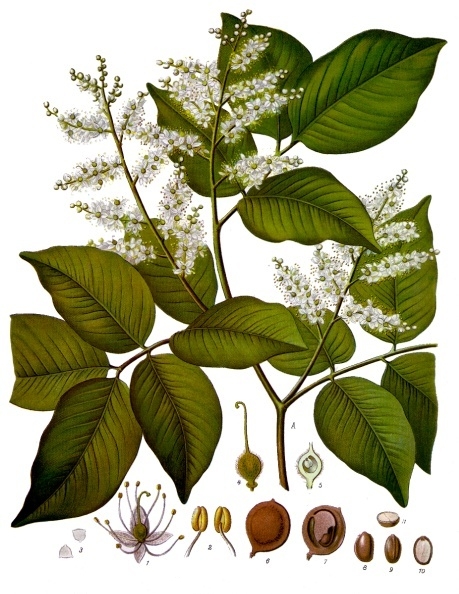
Copaiba Balsam
Copaifera officinalis
Franz Eugen Köhler, Köhler's Medizinal-Pflanzen, Public domain, via Wikimedia Commons


Side by side
| Copaiba Balsam | Copaiba | |
|---|---|---|
| Scientific name | Copaifera officinalis L. | Copaifera langsdorffii Desf. |
| English name | Copaiba Balsam | Copaiba |
| Group | Flowering plants | Flowering plants |
| Class | Magnoliopsida | Magnoliopsida |
| Order | Fabales | Fabales |
| Family | Fabaceae Bean | Fabaceae Bean |
| Genus | Copaifera Copaiferas | Copaifera Copaiferas |
| Red List category | Not recorded | Least Concern |
| Countries on record | 14 countries | 6 countries |
| GBIF occurrence records | 405 records | 7,288 records |
Rows where the two agree are shown in grey.
Where each is found
Both recorded in 5 countries
Only Copaiba Balsam (9)
Only Copaiba (1)
From Catalogue of Life checklists and GBIF occurrence records. A country missing from a list means no record is held, which is not proof of absence.
Checked facts
| Copaiba Balsam | Copaiba | |
|---|---|---|
| Size | No checked fact yet |
|
| Habitat | No checked fact yet |
|
| Distribution |
|
|
| Uses |
|
|
| Other |
|
|
In brief
Copaiba Balsam
Copaiba balsam is native to Bolivia, Brazil, and Venezuela and has been introduced to Cuba, the Dominican Republic, Trinidad and Tobago, Sierra Leone, India, and Sri Lanka. Its oleoresin exhibits greater bactericidal activity against common pathogens than the oleoresin of Copaifera langsdorffii. Full profile
Copaiba
Copaifera langsdorffii occurs in tropical rainforest environments and grows primarily in seasonally dry environments, with a native distribution extending from Guyana to Misiones in Argentina. Its porous wood contains capillaries filled with oil, and the tree produces terpene hydrocarbons in its wood and leaves. Full profile
Compare something else
Page built on 29 November 2026 from the data on the two species pages, where every source is listed.
Cite this page
ScientificNames.org. (2026). Copaiba Balsam vs Copaiba. Retrieved November 29, 2026, from https://scientificnames.org/compare/copaiba-balsam-vs-copaiba
“Copaiba Balsam vs Copaiba.” ScientificNames.org, 2026, scientificnames.org/compare/copaiba-balsam-vs-copaiba. Accessed 29 Nov. 2026.
ScientificNames.org. “Copaiba Balsam vs Copaiba.” Accessed November 29, 2026. https://scientificnames.org/compare/copaiba-balsam-vs-copaiba.
@misc{scientificnames_copaiba_balsam_vs_copaiba,
  author = {{ScientificNames.org}},
  title = {Copaiba Balsam vs Copaiba},
  year = {2026},
  url = {https://scientificnames.org/compare/copaiba-balsam-vs-copaiba},
  note = {Accessed 2026-11-29}
}