Comparison
Mahi-mahi vs Pompano Dolphinfish
Mahi-mahi (Coryphaena hippurus) and Pompano Dolphinfish (Coryphaena equiselis) both belong to the genus Coryphaena (mahi-mahis) and part ways below it. Both are recorded in 31 countries.


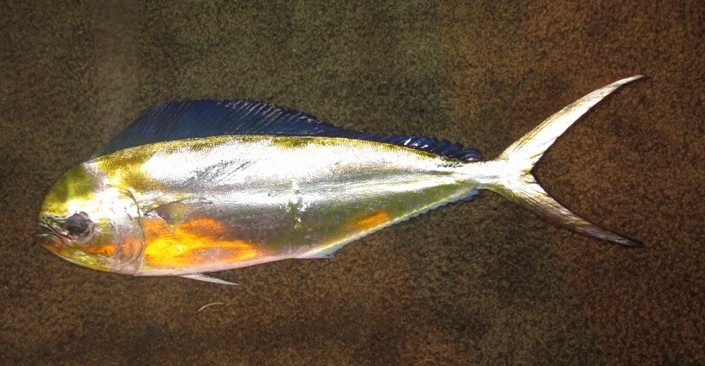
Pompano Dolphinfish
Coryphaena equiselis
NOAA/FPIR Observer Program, Public domain, via Wikimedia Commons

Side by side
| Mahi-mahi | Pompano Dolphinfish | |
|---|---|---|
| Scientific name | Coryphaena hippurus Linnaeus, 1758 | Coryphaena equiselis Linnaeus, 1758 |
| English name | Mahi-mahi | Pompano Dolphinfish |
| Group | Fishes | Fishes |
| Class | Teleostei Teleost | Teleostei Teleost |
| Order | Carangiformes | Carangiformes |
| Family | Coryphaenidae Dorados | Coryphaenidae Dorados |
| Genus | Coryphaena Mahi-mahis | Coryphaena Mahi-mahis |
| Named in | 1758 | 1758 |
| Red List category | Least Concern | Least Concern |
| Environment | brackish, marine | marine |
| Countries on record | 51 countries | 40 countries |
| GBIF occurrence records | 113,188 records | 1,215 records |
Rows where the two agree are shown in grey.
Where each is found
Both recorded in 31 countries
- Bahamas
- Barbados
- Belize
- Bermuda
- Bonaire, Saint Eustatius and Saba
- Brazil
- British Virgin Islands
- Canada
- Cayman Islands
- Colombia
- Costa Rica
- Cuba
- Dominican Republic
- Ecuador
- El Salvador
- Guatemala
- Haiti
- Honduras
- Jamaica
- Japan
- Martinique
- Mexico
- Nicaragua
- Panama
- Peru
- Portugal
- Taiwan
- Trinidad and Tobago
- U.S. Virgin Islands
- United States
- Venezuela
Only Mahi-mahi (20)
- Anguilla
- Antigua and Barbuda
- Aruba
- Australia
- British Indian Ocean Territory
- Chile
- Curacao
- Dominica
- French Guiana
- Greenland
- Guadeloupe
- Guyana
- Puerto Rico
- Saint Barthelemy
- Saint Kitts and Nevis
- Saint Lucia
- Saint Vincent and the Grenadines
- Seychelles
- Suriname
- Turks and Caicos Islands
Only Pompano Dolphinfish (9)
From Catalogue of Life checklists and GBIF occurrence records. A country missing from a list means no record is held, which is not proof of absence.
Checked facts
| Mahi-mahi | Pompano Dolphinfish | |
|---|---|---|
| Appearance |
| No checked fact yet |
| Size |
| No checked fact yet |
| Habitat |
| No checked fact yet |
| Diet |
| No checked fact yet |
| Behaviour |
| No checked fact yet |
| Reproduction |
| No checked fact yet |
| Distribution |
| No checked fact yet |
| Uses |
| No checked fact yet |
| Other |
| No checked fact yet |
In brief
Mahi-mahi
Mahi-mahi is a carnivorous fish in the family Coryphaenidae, order Carangiformes, and class Teleostei. It inhabits offshore temperate, tropical, and subtropical waters of the Atlantic, Pacific, and Indian Oceans. It has a laterally compressed body and a long dorsal fin extending from the head almost to the tail. Full profile
Compare something else
Page built on 24 November 2026 from the data on the two species pages, where every source is listed.
Cite this page
ScientificNames.org. (2026). Mahi-mahi vs Pompano Dolphinfish. Retrieved November 24, 2026, from https://scientificnames.org/compare/mahi-mahi-vs-pompano-dolphinfish
“Mahi-mahi vs Pompano Dolphinfish.” ScientificNames.org, 2026, scientificnames.org/compare/mahi-mahi-vs-pompano-dolphinfish. Accessed 24 Nov. 2026.
ScientificNames.org. “Mahi-mahi vs Pompano Dolphinfish.” Accessed November 24, 2026. https://scientificnames.org/compare/mahi-mahi-vs-pompano-dolphinfish.
@misc{scientificnames_mahi_mahi_vs_pompano_dolphinfish,
  author = {{ScientificNames.org}},
  title = {Mahi-mahi vs Pompano Dolphinfish},
  year = {2026},
  url = {https://scientificnames.org/compare/mahi-mahi-vs-pompano-dolphinfish},
  note = {Accessed 2026-11-24}
}