Species · Fishes
Mahi-mahi Coryphaena hippurus
The scientific name of the Mahi-mahi is Coryphaena hippurus. It is a species of fish in the family Coryphaenidae (dorados), order Carangiformes. The name dates from 1758.
- Scientific name
- Coryphaena hippurus Linnaeus, 1758
- Common name
- Mahi-mahi
- Genus
- Coryphaena
- Family
- Coryphaenidae (Dorados)
- Order
- Carangiformes
- Class
- Teleostei
- Red List category
- LC Least Concern
- Environment
- brackish, marine
- Recorded in
- 51 countries
- Name status
- accepted in the Catalogue of Life

Overview
Mahi-mahi is a carnivorous fish in the family Coryphaenidae, order Carangiformes, and class Teleostei. It inhabits offshore temperate, tropical, and subtropical waters of the Atlantic, Pacific, and Indian Oceans. It has a laterally compressed body and a long dorsal fin extending from the head almost to the tail.
Written 24 November 2026 from the sources listed below. Each statement was checked against the passage it cites; statements that could not be supported were removed.
Appearance
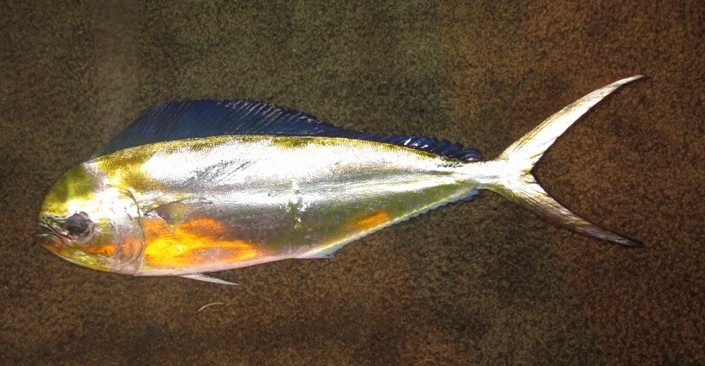
Mahi-mahi has a long, slender, tapered body adapted for high-speed swimming. Its single long dorsal fin extends from the head almost to the tail, and its caudal and anal fins are sharply concave.[1][2][3]
Its sides are golden, with bright blue and green coloration across its sides and back. Its dorsal surface is bright blue-green, its underside is yellowish-white, and its pectoral fins are iridescent blue.[4][5][6]
Mature males develop prominent foreheads that often project above the body, while females have rounded heads. Its coloration changes after it leaves the water and eventually fades to muted yellow-grey after death.[7][8][9]
Typical catches weigh between 7 and 13 kg and measure approximately one metre in length. The species commonly reaches one metre but can grow to two metres, and its maximum recorded weight is 39.5 kg.[10][11][12]
Habitat
Mahi-mahi inhabits offshore temperate, tropical, and subtropical waters. It occurs in tropical and subtropical regions of the Atlantic, Pacific, and Indian Oceans and has been recorded as far north as Ireland.[13][14][15]
It commonly occurs in pelagic areas near floating objects, beneath which its prey apparently seek shelter. Young individuals are commonly found among floating rafts of Sargassum.[16][17]
The species is particularly common around the Gulf of Mexico, Costa Rica, Hawaii, and the Indian Ocean. It is a top predator in Atlantic Sargassum habitats.[18][19]
Diet
Mahi-mahi is carnivorous and consumes small pelagic bony fishes, including flying fish, sargassum fish, and triggerfish. Its diet also includes juvenile tuna, billfish, jack, and mackerel.[20][21]
Its diet includes crabs and other crustaceans, squid and other epipelagic cephalopods, and scyphozoans. Zooplankton has also been recorded among its food.[22][23][21][24]
Individuals observed in the western Mediterranean feed primarily on teleosts, cephalopods, and crustaceans. The size of prey consumed increases positively with the size of the fish.[25][26]
Behaviour
Mahi-mahi can swim at speeds of up to 50 knots. Individuals must swim continuously to ventilate their gills because of their oxygen requirements.[27][28]
Individuals observed in the western Mediterranean feed primarily during daylight. Cannibalism has also been observed among individuals of this species.[29][30]
Reproduction and life cycle
Mahi-mahi has separate male and female sexes. Both reach sexual maturity during their first year, usually at four to five months of age, and spawning can begin at a body length of 20 cm.[31][32][33]
Females can spawn two to three times annually, with each spawning event producing between 80,000 and 1,000,000 eggs. The species normally spawns throughout the year in warm ocean currents.[34][35][36]
In waters at 28 °C, larvae have been recorded throughout the year, with higher numbers in spring and autumn.[37]
Uses
Mahi-mahi is harvested commercially and is highly valued as a sport fish. It is a popular food fish in Australia.[38][39]
Commercial fisheries in Australia commonly catch and sell mahi-mahi as a byproduct of tuna and swordfish fishing. Fishermen in French Polynesia use harpoons from specially designed boats to catch the species.[40][41]
Similar species
Mahi-mahi is not closely related to dolphins despite sharing the common name dolphinfish.[42]
Classification of the Mahi-mahi
| Kingdom | Animalia |
|---|---|
| Phylum | Chordata |
| Subphylum | Vertebrata |
| Infraphylum | Gnathostomata |
| Parvphylum | Osteichthyes |
| Gigaclass | Actinopterygii |
| Superclass | Actinopteri |
| Class | Teleostei (Teleost) |
| Order | Carangiformes |
| Family | Coryphaenidae (Dorados) |
| Genus | Coryphaena (Mahi-mahis) |
| Species | Coryphaena hippurus Linnaeus, 1758 |
Where the Mahi-mahi is found
Checklists and occurrence records place Coryphaena hippurus in 51 countries. GBIF holds 113,188 georeferenced records of it.
Countries
- Anguilla 52
- Antigua and Barbuda 55
- Aruba 11
- Australia 1,924
- Bahamas 1,405
- Barbados 40
- Belize 4
- Bermuda 70
- Bonaire, Saint Eustatius and Saba 22
- Brazil 590
- British Indian Ocean Territory 323
- British Virgin Islands 22
- Canada 43
- Cayman Islands 33
- Chile 40,918
- Colombia 304
- Costa Rica 77
- Cuba 2,872
- Curacao 6
- Dominica 20
- Dominican Republic 90
- Ecuador 169
- El Salvador 18
- French Guiana 18
- Greenland 11
- Guadeloupe 15
- Guatemala 253
- Guyana 25
- Haiti 389
- Honduras 14
- Jamaica 36
- Japan 466
- Martinique 21
- Mexico 2,002
- Nicaragua 12
- Panama 71
- Peru 88
- Portugal 313
- Puerto Rico 254
- Saint Barthelemy 7
- Saint Kitts and Nevis 4
- Saint Lucia 3
- Saint Vincent and the Grenadines 5
- Seychelles 1,150
- Suriname 45
- Taiwan 402
- Trinidad and Tobago 12
- Turks and Caicos Islands 13
- U.S. Virgin Islands 283
- United States 58,117
- Venezuela 91
Regions and cities with the most records
- Sunrise, United States 397
- Florida, United States 366
- Hollywood, United States 345
- Fort Lauderdale, United States 327
- Miami Beach, United States 276
- West Palm Beach, United States 156
- Boca Raton, United States 154
- Boynton Beach, United States 153
- Delray Beach, United States 153
- Deerfield Beach, United States 132
- Jupiter, United States 131
- Pompano Beach, United States 126
- North Miami, United States 100
- Miami, United States 79
- Sinaloa, Mexico 68
- Cozumel, Mexico 66
- Manabí, Ecuador 56
- Nord-Ouest, Haiti 51
- New South Wales, Australia 50
- Ginowan, Japan 48
- Naha, Japan 48
- Okinawa, Japan 48
- Urasoe, Japan 48
- Tomigusuku, Japan 47
- Itoman, Japan 46
- Allapattah, United States 42
- Little Havana, United States 41
- Coconut Creek, United States 34
- Texas, United States 34
- Coral Gables, United States 33
- Palm Beach Gardens, United States 31
- Port Macquarie, Australia 30
- Galápagos, Ecuador 27
- Flagami, United States 26
- Hialeah, United States 24
- Baie Sainte Anne, Seychelles 23
69 more countries have a few records outside this range
These countries hold a few records of Coryphaena hippurus but lie outside the range the checklists give for it. Such records are often zoo or garden specimens, museum material or vagrants, so the species is not counted as occurring there.
- Albania 5
- Algeria 5
- Angola 38
- Benin 5
- Cabo Verde 25
- China 125
- Comoros 91
- Croatia 30
- Egypt 3
- Equatorial Guinea 10
- Faroe Islands 95
- France 52
- French Polynesia 25
- French Southern Territories 39
- Gabon 115
- Germany 12
- Ghana 34
- Greece 22
- Guam 4
- Guinea 32
- Iceland 11
- India 75
- Indonesia 58
- Ireland 7
- Israel 27
- Italy 70
- Ivory Coast 52
- Kenya 7
- Kiribati 3
- Lebanon 28
- Liberia 87
- Madagascar 238
- Malaysia 10
- Malta 3
- Marshall Islands 3
- Mauritius 241
- Mayotte 244
- Mozambique 50
- Myanmar 5
- New Caledonia 178
- New Zealand 9
- Norfolk Island 3
- Norway 9
- Oman 18
- Pakistan 5
- Papua New Guinea 5
- Philippines 66
- Reunion 41
- Russia 5
- Samoa 3
- Sao Tome and Principe 38
- Senegal 5
- Sierra Leone 56
- Somalia 20
- South Africa 74
- South Korea 170
- Spain 179
- Sri Lanka 8
- Svalbard and Jan Mayen 10
- Tanzania 25
- Thailand 16
- Tunisia 3
- Turkey 13
- United Kingdom 94
- United States Minor Outlying Islands 6
- Vanuatu 3
- Vietnam 4
- Wallis and Futuna 19
- Yemen 22
A number beside a place is its count of GBIF occurrence records. A place without a number comes from a checklist alone. Records show where a species has been observed or collected, which can include escapes and vagrants.
Common names
English
- Mahi-mahi
- Common Dolphin-fish
- Dolphin-fish
- Fei Niau Fu
- Green Dolphin
- Hyaadoi Duet
- Common Dolphinfish
- Dolphin
- Dolphinfish
- Mahi Mahi
Names in 35 other languages
- Albanian
- Korifene, korifena, peshku delfin
- Arabic
- Anfalous, Bakhti Bakhti, Lambouqa, Lamboûka, Lambuka, Lámbug, Lämbukeh, Mrena
- Catalan
- Dofins
- Chinese
- 鬼頭刀
- Croatian
- Pjegava lampuga
- Czech
- zlak nachový
- Danish
- Almindelig guldmakrel, guldmakrel
- Dutch
- goudmakreel
- Finnish
- dolfiini
- French
- Clic, Dauphin, Daurade coryphène, Dorade, Dorade Coryphène, corphène commune, coryphène commune, cotyphène commune
- Galician
- Golfiño
- German
- Goldmakrele, gemeine Goldmakrele, grosse Goldmakrele
- Greek
- Kynigos, Kynigòs, Kynygós, Κυνηγός
- Hawaiian
- Mahi mahi lapa, Mahi mahi oma
- Hebrew
- רעמתן כחלחל
- Hindi
- सूंस
- Indonesian
- Lemadang
- Italian
- Capone, Capuni, Catalusso, Cataluzo, Cavaglia, Corifena cavallina, Lampuca, Lampuga cavallina
- Japanese
- Shibr, シイラ
- Korean
- 만새기
- Malagasy
- Ndroaro bory
- Maltese
- Lampuka
- Norwegian
- gullmakrell
- Papiamento
- Cabishot, Doro [Doró] cabishot, Drado cabishot, Dradoe, Dradu, Dradu kabishòt
- Polish
- koryfena smagla
- Portuguese
- Dalfinho, Delfim, Doirado, Dourado Comum, Dourado-real, Mahi-mahi-dourado, Peixe sol, Sanpjer
- Russian
- Большая корифена, Золотистая макрель, дорадо
- Slovenian
- Delfini
- Spanish
- Dorado Común, Dorado Delfin, Dorado de Mar, Llampuga, dorado, dorado commún, lampuga
- Swedish
- guldmakrill
- Tagalog
- Dolpin
- Thai
- ปลาอีโต้มอญ
- Turkish
- Yaladerma baliği, lambuga
- Vietnamese
- Cá duo
- div
- ފިޔަލަ
Synonyms
25 other scientific names have been used for this species and are now treated as synonyms of Coryphaena hippurus.
- Coriphaena hippurus Linnaeus, 1758
- Corypaena hippurua Linnaeus, 1758
- Coryphaena argyrurus Valenciennes, 1833
- Coryphaena chrysurus Lacepède, 1801
- Coryphaena dolfyn Valenciennes, 1833
- Coryphaena dorado Valenciennes, 1833
- Coryphaena fasciolata Pallas, 1770
- Coryphaena hipporus Linnaeus, 1758
- Coryphaena hyppurus Linnaeus, 1758
- Coryphaena immaculata Agassiz, 1831
- Coryphaena imperialis Rafinesque, 1810
- Coryphaena margravii Valenciennes, 1833
- Coryphaena nortoniana Lowe, 1839
- Coryphaena scomberoides Valenciennes, 1833
- Coryphaena scomberoïdes Valenciennes, 1833
- Coryphaena suerii Valenciennes, 1833
- Coryphaena virgata Valenciennes, 1833
- Coryphaena vlamingii Valenciennes, 1833
- Coryphena imperialis Rafinesque, 1810
- Ectenias brunneus Jordan & Thompson, 1914
- Ecterias brunneus Jordan & Evermann, 1914
- Lampugus siculus Valenciennes, 1833
- Lepimphis hippuroides Rafinesque, 1810
- Coryphaena japonica Temminck & Schlegel, 1845 ambiguous synonym
- Scomber pelagicus Linnaeus, 1758 ambiguous synonym
Subspecies and varieties
- Coryphaena hippurus dampieri subspecies
Related species
Compare
Questions and answers
What is the scientific name of the Mahi-mahi?
The scientific name of the Mahi-mahi is Coryphaena hippurus. Written with its author, the full name is Coryphaena hippurus Linnaeus, 1758.
Which family does the Mahi-mahi belong to?
Coryphaena hippurus belongs to the family Coryphaenidae, in the order Carangiformes and the class Teleostei.
Where is the Mahi-mahi found?
Checklists and occurrence records place Coryphaena hippurus in 51 countries, including United States, Chile, Cuba, Mexico, Australia and Bahamas.
What is the conservation status of the Mahi-mahi?
The IUCN Red List category recorded for Coryphaena hippurus is Least Concern (LC).
What other names does the Mahi-mahi have?
Coryphaena hippurus is also known in English as Common Dolphin-fish, Dolphin-fish, Fei Niau Fu, Green Dolphin, Hyaadoi Duet and Common Dolphinfish.
Why is mahi-mahi on the avoid list?
Mahi-mahi is susceptible to ciguatera poisoning through the accumulation of toxins in its flesh.[43]
What is a mahi-mahi diet?
Mahi-mahi is carnivorous. It eats small pelagic bony fishes, crabs, other crustaceans, squid, other epipelagic cephalopods, scyphozoans, and juvenile tuna, billfish, jack, and mackerel. Zooplankton has also been recorded in its diet.[20][22][23][21][24]
Sources
Passages the profile rests on
- The species has a laterally compressed body and a single long dorsal fin extending from the head almost to the tail. Source passage: “Mahi-mahi have compressed bodies and one very long dorsal fin extending from the head almost to the tail fin.” — English Wikipedia
- Its caudal and anal fins are sharply concave. Source passage: “Their caudal fins and anal fins are sharply concave.” — English Wikipedia
- The species has a long, slender, tapered body adapted for high-speed swimming. Source passage: “Coryphaena hippurus has a long, slender, tapered body specialized for swimming at high speeds.” — animaldiversity.org
- Its sides are golden, while its sides and back display bright blue and green coloration. Source passage: “golden on the sides, and bright blues and greens on the sides and back.” — English Wikipedia
- Its pectoral fins are iridescent blue. Source passage: “The pectoral fins of the mahi-mahi are iridescent blue.” — English Wikipedia
- Its dorsal surface is bright blue-green, while its underside is yellowish-white. Source passage: “C. hippurus is a bright blue-green dorsally, and yellowish-white with pigments ventrally.” — animaldiversity.org
- Mature males develop a prominent forehead that often projects above the body. Source passage: “Mature males have distinctive "foreheads"; it grows as the fish matures and often protrudes well above the body proper” — English Wikipedia
- Females have rounded heads, unlike the prominent foreheads of mature males. Source passage: “females have a rounded head.” — English Wikipedia
- Its coloration changes after it leaves the water and eventually fades to muted yellow-grey after death. Source passage: “Out of the water, the fish often change color (giving rise to their Spanish name, dorado, 'golden'), going through several hues before finally fading to a muted yellow-grey upon death.” — English Wikipedia
- Typical catches weigh between 7 and 13 kg and measure approximately one metre in length. Source passage: “Catches typically are 7 to 13 kg (15 to 29 lb) and a meter (3 ft) in length.” — English Wikipedia
- The species commonly reaches one metre in length but can grow to two metres. Source passage: “Dolphin fish commonly reach 1 meter in length, but can reach up to 2 meters.” — animaldiversity.org
- The maximum recorded weight is 39.5 kg. Source passage: “with a maximum recorded weight of 39.5 kg.” — animaldiversity.org
- The species inhabits offshore temperate, tropical, and subtropical waters. Source passage: “surface-dwelling ray-finned fish found in off-shore temperate, tropical, and subtropical waters worldwide.” — English Wikipedia
- The species occurs in tropical and subtropical regions of the Atlantic, Pacific, and Indian Oceans. Source passage: “Tropical and subtropical areas of the Atlantic, Pacific, and Indian Oceans.” — animaldiversity.org
- The species has been recorded as far north as Ireland. Source passage: “Coryphaena hippurus has been detected and studied as far north as Ireland” — animaldiversity.org
- It commonly occurs in pelagic areas near floating objects, beneath which its prey apparently seek shelter. Source passage: “In pelagic regions, Coryphaena hippurus is commonly found near floating objects, apparently because its prey seek refuge under the objects” — animaldiversity.org
- Young individuals are commonly found among floating rafts of Sargassum. Source passage: “their young are commonly found in rafts of Sargassum weeds.” — English Wikipedia
- The species is a top predator in Atlantic Sargassum habitats. Source passage: “The dolphin fish is a top predator in the Atlantic Sargassum.” — animaldiversity.org
- The species is particularly common around the Gulf of Mexico, Costa Rica, Hawaii, and the Indian Ocean. Source passage: “These fish are most commonly found in the waters around the Gulf of Mexico, Costa Rica, Hawaii, and the Indian Ocean.” — English Wikipedia
- The species is carnivorous and consumes small pelagic bony fishes, including flying fish, sargassum fish, and triggerfish. Source passage: “feeding on small, pelagic bony fish (such as flying fish, man-o-war fish, sargassum fish, and triggerfish)” — English Wikipedia
- Its diet also includes scyphozoans and juvenile tuna, billfish, jack, and mackerel. Source passage: “scyphozoans, and juveniles of large, teleost forage fish such as tuna, billfish, jack, mackerel” — English Wikipedia
- Its diet includes crabs and other crustaceans. Source passage: “crabs, other crustaceans” — English Wikipedia
- The species feeds on squid and other epipelagic cephalopods. Source passage: “squid, other epipelagic cephalopods” — English Wikipedia
- The species has also been recorded consuming zooplankton. Source passage: “They have also been known to eat zooplankton.” — English Wikipedia
- Individuals observed in the western Mediterranean feed primarily on teleosts, cephalopods, and crustaceans. Source passage: “Dolphin observed in the western Mediterranean are visual generalist predators, and hence feed primarily during the day, when adequate sunlight is available. They feed on teleosts, cephalopods, and crustaceans” — animaldiversity.org
- The size of prey consumed increases positively with the size of the fish. Source passage: “with a positive correlation between dolphin size and prey size” — animaldiversity.org
- The species can swim at speeds of up to 50 knots. Source passage: “swimming as fast as 50 knots (92.6 km/h; 57.5 mph).” — English Wikipedia
- Individuals must swim continuously to ventilate their gills because of their oxygen requirements. Source passage: “Due to their oxygen needs, dolphin must swim continuously to ventilate their gills.” — animaldiversity.org
- Cannibalism has been observed among individuals of this species. Source passage: “Intraspecies cannibalism has been observed in some members” — animaldiversity.org
- Individuals observed in the western Mediterranean feed primarily during daylight. Source passage: “Dolphin observed in the western Mediterranean are visual generalist predators, and hence feed primarily during the day, when adequate sunlight is available.” — animaldiversity.org
- Males and females reach sexual maturity during their first year, usually at four to five months of age. Source passage: “Males and females are sexually mature in their first year, usually by the age of 4–5 months.” — English Wikipedia
- Spawning can begin when individuals reach a body length of 20 cm. Source passage: “Spawning can occur at body lengths of 20 cm (7.9 in).” — English Wikipedia
- The species has separate male and female sexes. Source passage: “gonochoric/gonochoristic/dioecious (sexes separate)” — animaldiversity.org
- Females can spawn two to three times annually. Source passage: “Females may spawn two to three times per year” — animaldiversity.org
- Each spawning event can produce between 80,000 and 1,000,000 eggs. Source passage: “produce between 80,000 and 1,000,000 eggs per event.” — animaldiversity.org
- The species normally spawns throughout the year in warm ocean currents. Source passage: “They spawn in warm ocean currents throughout much of the year” — English Wikipedia
- In waters at 28 °C, larvae have been recorded throughout the year, with higher numbers in spring and autumn. Source passage: “In waters at 28 °C (82 °F), mahi-mahi larvae are found year-round, with greater numbers detected in spring and fall.” — English Wikipedia
- The species is harvested commercially and is highly valued as a sport fish. Source passage: “C. hippurus is one of the most popular sportfish globally. Because it is prized for its meat as well, it is harvested commercially both in the wild and via aquaculture” — animaldiversity.org
- The species is a popular food fish in Australia. Source passage: “It is a popular food fish in Australia” — English Wikipedia
- Commercial fisheries in Australia commonly catch and sell it as a byproduct of tuna and swordfish fishing. Source passage: “usually caught and sold as a byproduct by tuna and swordfish commercial fishing operators.” — English Wikipedia
- Fishermen in French Polynesia use harpoons from specially designed boats to catch this species. Source passage: “In French Polynesia, fishermen use harpoons, using a specifically designed boat, the poti marara, to pursue it” — English Wikipedia
- The species is not closely related to dolphins despite sharing the common name dolphinfish. Source passage: “they are not related to dolphins” — English Wikipedia
- The species is susceptible to ciguatera poisoning through the accumulation of toxins in its flesh. Source passage: “The mahi-mahi is also a common vector for ciguatera poisoning.” — English Wikipedia
Data
- Catalogue of Life, 2026-10-16 XR cc by
- Global Biodiversity Information Facility CC BY 4.0
- Wikidata CC0
- GeoNames CC BY 4.0
- Wikimedia Commons per image; credit shown with each image
- Within the Catalogue of Life, this name comes from World Register of Marine Species cc by
References
- Linnaeus, C. (1758). Systema Naturae per regna tria naturae, secundum classes, ordines, genera, species, cum characteribus, differentiis, synonymis, locis. Tomus I. Editio decima, reformata. Laurentii Salvii. Holmiae [Stockholm]. [iii] + 824 pp. https://doi.org/10.5962/bhl.title.542 Link where the name was published
This species in other databases
- Catalogue of Life 6B72Q
- Wikidata Q14443
- iNaturalist 98531
- WoRMS urn:lsid:marinespecies.org:taxname:126846
- ITIS 168791
Page built on 24 November 2026. See how the catalog is made and all sources and licences.
Cite this page
ScientificNames.org. (2026). Coryphaena hippurus (Mahi-mahi). Retrieved November 24, 2026, from https://scientificnames.org/species/coryphaena-hippurus
“Coryphaena hippurus (Mahi-mahi).” ScientificNames.org, 2026, scientificnames.org/species/coryphaena-hippurus. Accessed 24 Nov. 2026.
ScientificNames.org. “Coryphaena hippurus (Mahi-mahi).” Accessed November 24, 2026. https://scientificnames.org/species/coryphaena-hippurus.
@misc{scientificnames_coryphaena_hippurus_mahi_mahi,
  author = {{ScientificNames.org}},
  title = {Coryphaena hippurus (Mahi-mahi)},
  year = {2026},
  url = {https://scientificnames.org/species/coryphaena-hippurus},
  note = {Accessed 2026-11-24}
}