Comparison

Corythomantis botoque vs Spring Peeper

Corythomantis botoque (Corythomantis botoque) and Spring Peeper (Pseudacris crucifer) both belong to the family Hylidae (hylids) and part ways below it.
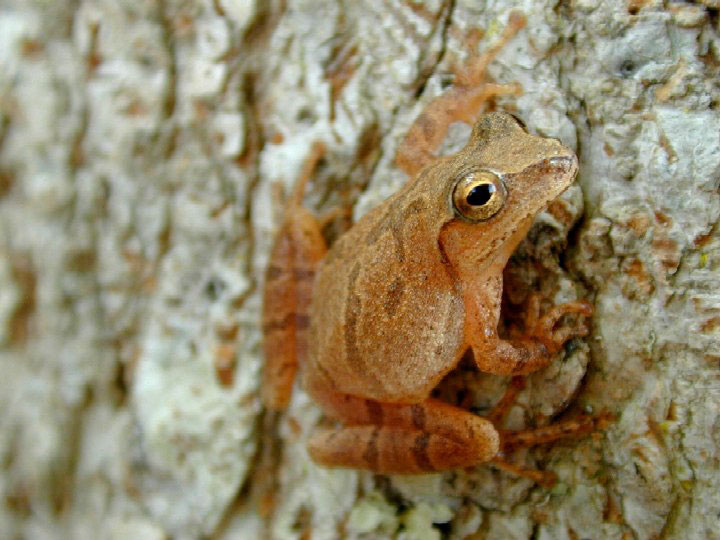
Spring Peeper

Spring Peeper

Pseudacris crucifer

USGS, Public domain, via Wikimedia Commons

Side by side

Corythomantis botoqueSpring Peeper
Scientific nameCorythomantis botoque Marques, Haddad & Garda, 2021Pseudacris crucifer (Wied-Neuwied, 1838)
English nameNot recordedSpring Peeper
GroupAmphibiansAmphibians
ClassAmphibia AmphibiansAmphibia Amphibians
OrderAnura FrogsAnura Frogs
FamilyHylidae HylidsHylidae Hylids
GenusCorythomantis Greening's FrogsPseudacris Chorus Frog
Named in20211838
Red List categoryNot recordedLeast Concern
EnvironmentNot recordedfreshwater, terrestrial
Countries on recordNot recorded2 countries
GBIF occurrence recordsNot recorded81,811 records

Rows where the two agree are shown in grey.

Where each is found

Only Spring Peeper (2)

From Catalogue of Life checklists and GBIF occurrence records. A country missing from a list means no record is held, which is not proof of absence.

Checked facts

Corythomantis botoqueSpring Peeper
AppearanceNo checked fact yet
  • The spring peeper typically has pink, tan, light brown, or gray skin and an X-shaped marking on its back. mdc.mo.gov
  • The species has a cream-colored belly, a dark line across its head, and dark bars on its legs. mdc.mo.gov
  • Spring peepers have adhesive pads on their fingertips and toe tips. mdc.mo.gov
  • Females are generally lighter-colored and have bulkier abdomens than males. English Wikipedia
  • The skin coloration of spring peepers can change within 15 to 45 minutes in response to temperature and light. English Wikipedia
SizeNo checked fact yet
  • Male spring peepers measure 18–30 mm in body length, while females measure 20–35 mm. English Wikipedia
HabitatNo checked fact yet
  • Spring peepers inhabit marshy woodland and non-wooded lowlands near ponds and swamps. animaldiversity.org
  • The species commonly inhabits forests and regenerating woodlands near temporary or semipermanent wetlands. English Wikipedia
  • Spring peepers frequently breed in fishless ponds and temporary pools. mdc.mo.gov
  • Spring peepers generally remain close to the ground or concealed in leaf litter despite their climbing ability. animaldiversity.org
DietNo checked fact yet
  • Adult spring peepers eat small insects and spiders, including ants, beetles, and flies. animaldiversity.org
  • Spring peeper tadpoles feed on algae, detritus, and microorganisms. animaldiversity.org
  • Adult spring peepers forage among leaf litter and surface debris for small insects and spiders. mdc.mo.gov
BehaviourNo checked fact yet
  • Male spring peepers produce clear, high-pitched calls that rise slightly in pitch at the end. mdc.mo.gov
  • Male spring peepers repeat their calls approximately once per second. mdc.mo.gov
  • Spring peeper choruses can resemble the sound of hundreds of small jingle bells. mdc.mo.gov
  • Spring peepers are usually concealed during daylight and become active around dusk. mdc.mo.gov
  • Spring peepers may become active during daylight when heavy rain persists. mdc.mo.gov
  • Spring peepers generally migrate at night. English Wikipedia
  • Male spring peepers establish small territories around breeding pools and compete through frequent calling. animaldiversity.org
  • Females preferentially select larger males as mates. animaldiversity.org
  • Some males use a satellite strategy, remaining near calling males without calling themselves to intercept females. English Wikipedia
ReproductionNo checked fact yet
  • Spring peepers in northern regions generally breed between March and June. English Wikipedia
  • Spring peepers in southern regions breed between October and March, depending on local temperature. English Wikipedia
  • Female spring peepers typically lay approximately 900 eggs per clutch, although clutches can contain up to 1,000 eggs. English Wikipedia
  • Female spring peepers deposit their eggs individually or in groups of two or three. English Wikipedia
  • Spring peeper eggs are attached individually to dead leaves, grasses, or sticks in shallow water. mdc.mo.gov
  • Spring peeper eggs generally hatch within 6–12 days. animaldiversity.org
  • Spring peeper tadpoles typically undergo metamorphosis after 45–90 days. animaldiversity.org
  • Spring peepers generally reach sexual maturity at two years of age. mdc.mo.gov
  • Male spring peepers provide no parental care after fertilization. animaldiversity.org
ConservationNo checked fact yet
  • Spring peepers are listed as protected in New Jersey and threatened in Kansas. animaldiversity.org
  • Spring peepers have become threatened in some states where wetland habitat has declined. mdc.mo.gov
  • Spring peepers may help control populations of insects. animaldiversity.org
UsesNo checked fact yet
Similar speciesNo checked fact yet
  • Spring peepers differ from some other Pseudacris species by lacking white lines on their lips. English Wikipedia

In brief

Spring Peeper

Pseudacris crucifer inhabits forests, woodlands, marshy lowlands, and areas near ponds, swamps, and temporary wetlands. It typically has an X-shaped marking on its back, adhesive pads on its fingertips and toe tips, and skin that can change color in response to temperature and light. Full profile

Compare something else

Page built on 26 November 2026 from the data on the two species pages, where every source is listed.

Cite this page

ScientificNames.org. (2026). Corythomantis botoque vs Spring Peeper. Retrieved November 26, 2026, from https://scientificnames.org/compare/corythomantis-botoque-vs-spring-peeper