Species · Amphibians
Spring Peeper Pseudacris crucifer
The scientific name of the Spring Peeper is Pseudacris crucifer. It is a species of amphibian in the family Hylidae (hylids), order Anura. The name dates from 1838.
- Scientific name
- Pseudacris crucifer (Wied-Neuwied, 1838)
- Common name
- Spring Peeper
- Genus
- Pseudacris
- Family
- Hylidae (Hylids)
- Order
- Anura
- Class
- Amphibia
- Red List category
- LC Least Concern
- Environment
- freshwater, terrestrial
- Recorded in
- 2 countries
- Name status
- accepted in the Catalogue of Life
Overview
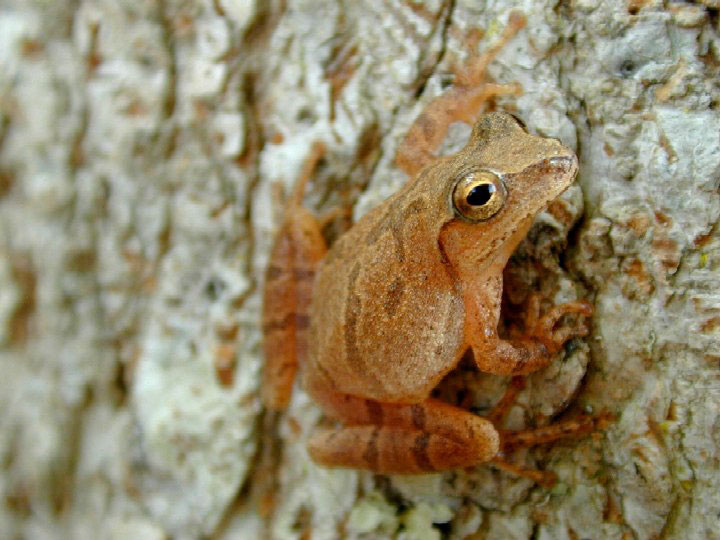
Pseudacris crucifer inhabits forests, woodlands, marshy lowlands, and areas near ponds, swamps, and temporary wetlands. It typically has an X-shaped marking on its back, adhesive pads on its fingertips and toe tips, and skin that can change color in response to temperature and light.
Written 24 November 2026 from the sources listed below. Each statement was checked against the passage it cites; statements that could not be supported were removed.
Appearance
Spring Peeper typically has pink, tan, light brown, or gray skin with an X-shaped marking on its back. Its belly is cream-colored, and it has a dark line across its head and dark bars on its legs.[1][2]
Spring Peepers have adhesive pads on their fingertips and toe tips. Their skin coloration can change within 15 to 45 minutes in response to temperature and light.[3][4]
Females are generally lighter-colored than males and have bulkier abdomens. Adult males measure 18–30 mm in body length, while females measure 20–35 mm.[5][6]
Habitat
Spring Peepers inhabit marshy woodland and non-wooded lowlands near ponds and swamps. They commonly occur in forests and regenerating woodlands near temporary or semipermanent wetlands.[7][8]
They frequently breed in fishless ponds and temporary pools. Despite their climbing ability, they generally remain close to the ground or concealed in leaf litter.[9][10]
Diet
Adult Spring Peepers eat small insects and spiders, including ants, beetles, and flies. They forage among leaf litter and surface debris for food.[11][12]
Spring Peeper tadpoles feed on algae, detritus, and microorganisms.[13]
Behaviour
Male Spring Peepers produce clear, high-pitched calls that rise slightly in pitch at the end. They repeat their calls approximately once per second, and choruses can resemble the sound of hundreds of small jingle bells.[14][15][16]
Spring Peepers are usually concealed during daylight and become active around dusk. They may also become active during daylight when heavy rain persists.[17][18]
Spring Peepers generally migrate at night. They use small territories around breeding pools, where males compete through frequent calling.[19][20]
Females preferentially select larger males as mates. Some males use a satellite strategy, remaining near calling males without calling themselves to intercept females.[21][22]
Reproduction and life cycle
Spring Peepers in northern regions generally breed between March and June. In southern regions, breeding generally occurs between October and March, depending on local temperature.[23][24]
Females typically lay approximately 900 eggs per clutch, although clutches can contain up to 1,000 eggs. They deposit eggs individually or in groups of two or three.[25][26]
Eggs are attached individually to dead leaves, grasses, or sticks in shallow water. They generally hatch within 6–12 days.[27][28]
Tadpoles typically undergo metamorphosis after 45–90 days. Spring Peepers generally reach sexual maturity at two years of age.[29][30]
Male Spring Peepers provide no parental care after fertilization.[31]
Conservation
Spring Peepers are listed as protected in New Jersey and threatened in Kansas. They have become threatened in some states where wetland habitat has declined.[32][33]
Uses
Spring Peepers serve as indicators of wetland ecosystem health. They may also help control populations of insects.[34][35]
Similar species
Spring Peepers differ from some other Pseudacris species by lacking white lines on their lips. This feature distinguishes them from those species.[36]
Classification of the Spring Peeper
| Kingdom | Animalia |
|---|---|
| Phylum | Chordata |
| Subphylum | Vertebrata |
| Infraphylum | Gnathostomata |
| Parvphylum | Osteichthyes |
| Megaclass | Tetrapoda |
| Class | Amphibia (Amphibians) |
| Order | Anura (Frogs) |
| Family | Hylidae (Hylids) |
| Genus | Pseudacris (Chorus Frog) |
| Species | Pseudacris crucifer (Wied-Neuwied, 1838) |
Where the Spring Peeper is found
Checklists and occurrence records place Pseudacris crucifer in 2 countries across North America. GBIF holds 81,811 georeferenced records of it.
Countries
Regions and cities with the most records
- Ontario, Canada 12,411
- New York, United States 6,058
- Michigan, United States 4,676
- Virginia, United States 4,281
- Massachusetts, United States 3,938
- Ohio, United States 3,803
- Quebec, Canada 2,855
- Maine, United States 2,835
- Pennsylvania, United States 2,787
- Connecticut, United States 2,570
- Vermont, United States 2,164
- Maryland, United States 2,124
- North Carolina, United States 1,889
- Wisconsin, United States 1,745
- Indiana, United States 1,630
- Nova Scotia, Canada 1,381
- New Hampshire, United States 1,380
- New Jersey, United States 1,195
- Rhode Island, United States 1,058
- Minnesota, United States 1,036
- Missouri, United States 1,025
- New Brunswick, Canada 955
- Tennessee, United States 817
- Alabama, United States 775
- West Virginia, United States 708
- Georgia, United States 695
- Aylmer, Canada 688
- Florida, United States 662
- Illinois, United States 658
- Ottawa, Canada 642
- Ottawa South, Canada 619
- Aspen Hill, United States 618
- Nepean, Canada 617
- Bethesda, United States 610
- Wheaton, United States 605
- Gatineau, Canada 595
Range as the checklists state it
North America
Caribbean
A number beside a place is its count of GBIF occurrence records. A place without a number comes from a checklist alone. Records show where a species has been observed or collected, which can include escapes and vagrants.
Common names
English
- Spring Peeper
- Northern Spring Peeper
- Pinkletink
- Southern Spring Peeper
Names in 10 other languages
- Czech
- rosnička křížkovaná
- Dutch
- Kruisboomkikker
- French
- rainette crucifère
- German
- Wasserpfeifer
- Japanese
- サエズリアマガエル
- Polish
- Rzekotka krzyżowa
- Russian
- Свистящая квакша
- Scottish Gaelic
- Màgan
- mic
- jijawej
- oji
- Shkiminookamik Makakii
Synonyms
13 other scientific names have been used for this species and are now treated as synonyms of Pseudacris crucifer.
- Acris pickeringii (Holbrook, 1839)
- Hyla crucifer Wied-Neuwied, 1838
- Hyla crucifer bartramiana Harper, 1939
- Hyla crucifer crucifer Wied-Neuwied, 1838
- Hyla crucifera Wied-Neuwied, 1838
- Hyla crucifera bartramiana Harper, 1939
- Hyla crucifera crucifera Wied-Neuwied, 1838
- Hyla pickeringii (Holbrook, 1839)
- Hyliola pickeringii (Holbrook, 1839)
- Hylodes pickeringii Holbrook, 1839
- Parapseudacris crucifer (Wied-Neuwied, 1838)
- Pseudacris crucifer bartramiana (Harper, 1939)
- Pseudacris crucifer crucifer (Wied-Neuwied, 1838)
Related species
-
 Pacific Tree FrogPseudacris regilla
-
 Boreal Chorus FrogPseudacris maculata
-
 Western Chorus FrogPseudacris triseriata
-
 Little Grass FrogPseudacris ocularis
-
 California Tree FrogPseudacris cadaverina
-
 Upland Chorus FrogPseudacris feriarum
-
 Ornate Chorus FrogPseudacris ornata
-
 Appalachian Mountain Chorus FrogPseudacris brachyphona
Compare
Questions and answers
What is the scientific name of the Spring Peeper?
The scientific name of the Spring Peeper is Pseudacris crucifer. Written with its author, the full name is Pseudacris crucifer (Wied-Neuwied, 1838).
Which family does the Spring Peeper belong to?
Pseudacris crucifer belongs to the family Hylidae, in the order Anura and the class Amphibia.
Where is the Spring Peeper found?
Checklists and occurrence records place Pseudacris crucifer in 2 countries: United States and Canada.
What is the conservation status of the Spring Peeper?
The IUCN Red List category recorded for Pseudacris crucifer is Least Concern (LC).
What other names does the Spring Peeper have?
Pseudacris crucifer is also known in English as Northern Spring Peeper, Pinkletink and Southern Spring Peeper.
Sources
Passages the profile rests on
- The spring peeper typically has pink, tan, light brown, or gray skin and an X-shaped marking on its back. Source passage: “The general color can be pink, tan, light brown, or gray. The X-shaped mark may be very faint in light-colored frogs or dark on darker ones.” — mdc.mo.gov
- The species has a cream-colored belly, a dark line across its head, and dark bars on its legs. Source passage: “A dark line runs across the top of the head and between the eyes, and there are dark bars on the legs. The belly is a plain cream color.” — mdc.mo.gov
- Spring peepers have adhesive pads on their fingertips and toe tips. Source passage: “The tips of fingers and toes have adhesive pads.” — mdc.mo.gov
- The skin coloration of spring peepers can change within 15 to 45 minutes in response to temperature and light. Source passage: “Skin color of Spring Peepers is also affected by temperature and light. Coloration is dynamic and adaptable in this species. It can be altered quickly, in 15 to 45 minutes” — English Wikipedia
- Females are generally lighter-colored and have bulkier abdomens than males. Source passage: “Females are lighter-colored, while males are slightly smaller and usually have dark throats. Females have a bulkier abdomen.” — English Wikipedia
- Male spring peepers measure 18–30 mm in body length, while females measure 20–35 mm. Source passage: “Males have a body length ranging from 18–30 millimetres (0.71–1.18 in), and females have a body length ranging from 20–35 millimetres (0.79–1.38 in).” — English Wikipedia
- Spring peepers inhabit marshy woodland and non-wooded lowlands near ponds and swamps. Source passage: “This frog is found in marshy woods and non-wooded lowlands near ponds and swamps.” — animaldiversity.org
- The species commonly inhabits forests and regenerating woodlands near temporary or semipermanent wetlands. Source passage: “Spring peepers live primarily in forests and regenerating woodlands near ephemeral or semipermanent wetlands.” — English Wikipedia
- Spring peepers frequently breed in fishless ponds and temporary pools. Source passage: “Breeding occurs in fishless woodland ponds, temporary pools, water-filled ditches, or semipermanent, fishless swamps” — mdc.mo.gov
- Spring peepers generally remain close to the ground or concealed in leaf litter despite their climbing ability. Source passage: “Although it is a good climber, spring peepers seem to prefer to be on the ground or hiding in leaf litter.” — animaldiversity.org
- Adult spring peepers eat small insects and spiders, including ants, beetles, and flies. Source passage: “Pseudacris crucifer is insectivorous, eating mainly small insects including ants, beetles, flies, and spiders.” — animaldiversity.org
- Adult spring peepers forage among leaf litter and surface debris for small insects and spiders. Source passage: “Spring peepers forage on leaf litter and other surface debris for a variety of small insects and spiders.” — mdc.mo.gov
- Spring peeper tadpoles feed on algae, detritus, and microorganisms. Source passage: “Larvae graze on algae, detritus, and micro-organisms.” — animaldiversity.org
- Male spring peepers produce clear, high-pitched calls that rise slightly in pitch at the end. Source passage: “The call of male spring peepers is a clear, high-pitched peep, with a slight rise in pitch at the end.” — mdc.mo.gov
- Male spring peepers repeat their calls approximately once per second. Source passage: “The peeping call is repeated about once per second.” — mdc.mo.gov
- Spring peeper choruses can resemble the sound of hundreds of small jingle bells. Source passage: “A chorus of spring peepers can sound like hundreds of small jingle bells.” — mdc.mo.gov
- Spring peepers are usually concealed during daylight and become active around dusk. Source passage: “The spring peeper usually remains hidden during the day and becomes active at dusk” — mdc.mo.gov
- Spring peepers may become active during daylight when heavy rain persists. Source passage: “it may, however, become active during the day if heavy rains persist.” — mdc.mo.gov
- Spring peepers generally migrate at night. Source passage: “Spring peepers almost always migrate at night.” — English Wikipedia
- Male spring peepers establish small territories around breeding pools and compete through frequent calling. Source passage: “Each male establishes a small territory and begins calling quite frequently.” — animaldiversity.org
- Females preferentially select larger males as mates. Source passage: “Female spring peepers typically choose mates in a size-selective fashion -- larger males are preferred and are more successful breeders.” — animaldiversity.org
- Some males use a satellite strategy, remaining near calling males without calling themselves to intercept females. Source passage: “A segment of the male population, known as 'satellite males' do not make these calls, but instead position themselves near loud males and attempt to intercept females” — English Wikipedia
- Spring peepers in northern regions generally breed between March and June. Source passage: “In northern areas, they breed between March and June, when the warm rains start.” — English Wikipedia
- Spring peepers in southern regions breed between October and March, depending on local temperature. Source passage: “Spring peepers breed in southern areas from October to March, depending on the local temperature.” — English Wikipedia
- Female spring peepers typically lay approximately 900 eggs per clutch, although clutches can contain up to 1,000 eggs. Source passage: “P. crucifer typically lays around 900 eggs per clutch, but up to 1000 are possible.” — English Wikipedia
- Female spring peepers deposit their eggs individually or in groups of two or three. Source passage: “Females will lay eggs singularly or in groups of two or three.” — English Wikipedia
- Spring peeper eggs are attached individually to dead leaves, grasses, or sticks in shallow water. Source passage: “The eggs are laid singly, attached to dead leaves, grasses, or sticks in shallow water.” — mdc.mo.gov
- Spring peeper eggs generally hatch within 6–12 days. Source passage: “The eggs hatch within 6 to 12 days” — animaldiversity.org
- Spring peeper tadpoles typically undergo metamorphosis after 45–90 days. Source passage: “The larval stage can last from 45 to 90 days” — animaldiversity.org
- Spring peepers generally reach sexual maturity at two years of age. Source passage: “They become sexually mature at age two.” — mdc.mo.gov
- Male spring peepers provide no parental care after fertilization. Source passage: “Males provide no parental care or investment, just fertilization.” — animaldiversity.org
- Spring peepers are listed as protected in New Jersey and threatened in Kansas. Source passage: “It is listed as "Protected" in New Jersey and "Threatened" in Kansas.” — animaldiversity.org
- Spring peepers have become threatened in some states where wetland habitat has declined. Source passage: “It has become threatened in states where wetland habitat has shrunk.” — mdc.mo.gov
- Spring peepers may help control populations of insects. Source passage: “Spring peepers may help to control certain insect populations.” — animaldiversity.org
- Spring peepers serve as indicators of wetland ecosystem health. Source passage: “Spring peepers have also been shown to act as indicators of wetland health” — English Wikipedia
- Spring peepers differ from some other Pseudacris species by lacking white lines on their lips. Source passage: “Unlike some other Pseudacris species, P. crucifer does not have white lines on its lips” — English Wikipedia
Data
- Catalogue of Life, 2026-10-16 XR cc by
- Global Biodiversity Information Facility CC BY 4.0
- Wikidata CC0
- GeoNames CC BY 4.0
- Wikimedia Commons per image; credit shown with each image
- Within the Catalogue of Life, this name comes from The Integrated Taxonomic Information System cc0
References
- Frost, Darrel R. (1997). Amphibian Species of the World, A Taxonomic and Geographic Reference. Second Edition.
- Crother, Brian I., Jeff Boundy, Jonathan A. Campbell, et al. / Moriarty, John J., ed. (2000). Scientific and Standard English Names of Amphibians and Reptiles of North America North of Mexico, with Comments Regarding Confidence in Our Understanding. Herpetological Circular, No. 29.
- Crother, Brian I., Jeff Boundy, Frank T. Burbrink, et al. / Moriarty, John J., ed. (2008). Scientific and Standard English Names of Amphibians and Reptiles of North America North of Mexico, With Comments Regarding Confidence in Our Understanding, Sixth Ed. Herpetological Circular No. 37.
This species in other databases
- Catalogue of Life 4NH9F
- Wikidata Q135015
- iNaturalist 24268
- WoRMS urn:lsid:marinespecies.org:taxname:1729573
Page built on 24 November 2026. See how the catalog is made and all sources and licences.
Cite this page
ScientificNames.org. (2026). Pseudacris crucifer (Spring Peeper). Retrieved November 24, 2026, from https://scientificnames.org/species/pseudacris-crucifer
“Pseudacris crucifer (Spring Peeper).” ScientificNames.org, 2026, scientificnames.org/species/pseudacris-crucifer. Accessed 24 Nov. 2026.
ScientificNames.org. “Pseudacris crucifer (Spring Peeper).” Accessed November 24, 2026. https://scientificnames.org/species/pseudacris-crucifer.
@misc{scientificnames_pseudacris_crucifer_spring_peeper,
  author = {{ScientificNames.org}},
  title = {Pseudacris crucifer (Spring Peeper)},
  year = {2026},
  url = {https://scientificnames.org/species/pseudacris-crucifer},
  note = {Accessed 2026-11-24}
}