| Appearance | - The cougar's coat ranges from silvery-grey to reddish tawny, with lighter colouring on its underbody. English Wikipedia
- Cougar kittens are born with spotted coats, blue eyes, and rings on their tails. English Wikipedia
- Adult cougars have short, coarse fur with upper-body colouring ranging from yellowish brown to grayish brown. animaldiversity.org
- The cougar's tail is approximately one-third of its total body length. animaldiversity.org
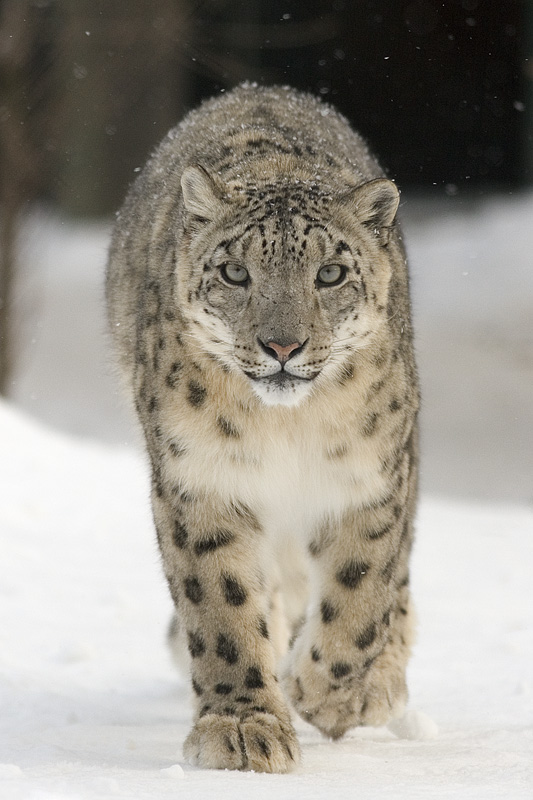
| - The snow leopard has thick whitish-to-grey fur with black spots on its head and neck and larger rosettes on its back, flanks and bushy tail. English Wikipedia
- The snow leopard has a short muzzle, domed forehead and large nasal cavities. English Wikipedia
- The snow leopard has small, rounded ears, broad paws and a thick tail. English Wikipedia
- The snow leopard has thick fur with individual hairs measuring 5–12 cm long. English Wikipedia
- The snow leopard has a whitish underbelly. English Wikipedia
- The snow leopard has long canine teeth measuring 28.6 mm. English Wikipedia
- The snow leopard has short legs and a stocky body. English Wikipedia
|
|---|
| Size | - Adult cougars stand approximately 60–90 centimetres tall at the shoulders. English Wikipedia
- Adult male cougars average approximately 2.4 metres in total length, measured from nose to tail tip. English Wikipedia
- Adult females average approximately 2.05 metres in total length. English Wikipedia
- Adult male cougars generally weigh between 53 and 72 kilograms. English Wikipedia
- Adult female cougars generally weigh between 34 and 48 kilograms. English Wikipedia
- Male cougars are larger than females, with male head-and-body lengths of 1,020–1,540 millimetres and female lengths of 860–1,310 millimetres. animaldiversity.org
- The cougar can leap vertically approximately 5.5 metres. English Wikipedia
| |
|---|
| Habitat | - Cougars occupy forests, deserts, and open areas with sparse vegetation at elevations reaching 5,800 metres. English Wikipedia
- The species prefers habitats containing dense underbrush and rocky areas. English Wikipedia
- In the Yucatán Peninsula, cougars inhabit secondary and semi-deciduous forests in El Eden Ecological Reserve. English Wikipedia
- In central Argentina, cougars occupy bushland with abundant vegetation cover and prey. English Wikipedia
- Cougars use montane coniferous forests, tropical lowland forests, grasslands, dry brush country, and swamps. animaldiversity.org
- Dense vegetation, caves, and rocky crevices provide shelter for cougars. animaldiversity.org
| - The snow leopard inhabits alpine and subalpine zones, particularly at elevations of 3,000–4,500 m. English Wikipedia
- The snow leopard prefers rocky, broken terrain. English Wikipedia
- During summer, the snow leopard commonly occupies alpine meadows and rocky regions above the tree line at elevations of 2,700–6,000 m. English Wikipedia
- During winter, the snow leopard descends to elevations of approximately 1,200–2,000 m. English Wikipedia
- The snow leopard can move through snow up to 85 cm deep. English Wikipedia
- Snow leopards occupy alpine habitats at elevations ranging from 900 to 4,500 m. pmc.ncbi.nlm.nih.gov
|
|---|
| Diet | - Deer are the cougar's primary prey across much of its range. English Wikipedia
- Cougars prey on mule deer, white-tailed deer, elk, moose, mountain goats, and bighorn sheep. English Wikipedia
- Cougars also consume rodents, lagomorphs, birds, smaller carnivores, and domestic animals. English Wikipedia
- Magellanic penguins constitute most recorded cougar prey items in two national parks in Patagonia. English Wikipedia
- In the Great Basin, mule deer are a primary prey species of cougars. nrm.dfg.ca.gov
- A meta-analysis found that cougars consume at least 232 different prey species across the Americas. pmc.ncbi.nlm.nih.gov
- Cougars consume more large-bodied prey species at greater distances from the equator. pmc.ncbi.nlm.nih.gov
- Cougars consume more small prey and birds when occupying the role of apex predator. pmc.ncbi.nlm.nih.gov
| - The snow leopard is a carnivore that actively hunts its prey. English Wikipedia
- The snow leopard's preferred wild prey includes Himalayan blue sheep, Himalayan tahr, argali, markhor and wild goats. English Wikipedia
- The snow leopard also hunts smaller mammals, including Himalayan marmots, pikas and voles. English Wikipedia
- The snow leopard also preys on domestic livestock. English Wikipedia
- The snow leopard consumes grass and twigs in addition to animal prey. English Wikipedia
- The snow leopard's preferred prey generally weighs between 36 and 76 kg. English Wikipedia
- In the Himalayas, the snow leopard commonly hunts Himalayan blue sheep, Siberian ibex, white-bellied musk deer and wild boar. English Wikipedia
- The snow leopard's preferred prey species have an average weight of approximately 55 ± 5 kg. pmc.ncbi.nlm.nih.gov
- The snow leopard's diet can include pikas, hares and game birds such as chukar partridges and snowcocks. pmc.ncbi.nlm.nih.gov
- An individual snow leopard requires approximately 1.5 kg of meat per day. pmc.ncbi.nlm.nih.gov
- Across its range, the snow leopard predominantly consumes larger-bodied wild hoofed mammals, with prey selection varying according to availability. dsc.duq.edu
- Livestock accounts for between 0% and 33% of the snow leopard's dietary repertoire in the studied populations. dsc.duq.edu
|
|---|
| Behaviour | - Cougars are predominantly solitary animals. English Wikipedia
- Cougars are territorial and maintain relatively low population densities. English Wikipedia
- Cougars are ambush predators that stalk prey before attacking. English Wikipedia
- After killing prey, cougars cover the carcass with vegetation and return to feed over several days. English Wikipedia
- Cougars primarily use vision, smell, and hearing to perceive their surroundings. animaldiversity.org
- Cougars communicate using hisses, growls, purrs, yowls, and screams. animaldiversity.org
- Cougars mark territorial boundaries by depositing urine or faeces near trees bearing scrapes. animaldiversity.org
| - The snow leopard is solitary and is mostly active around dawn and twilight. English Wikipedia
- The snow leopard commonly rests near cliffs and ridges that provide vantage points and shade. English Wikipedia
- The snow leopard uses its long, flexible tail to maintain balance in rocky terrain. English Wikipedia
- The snow leopard can wrap its thick, fur-covered tail around its face for protection while sleeping. English Wikipedia
|
|---|
| Reproduction | | No checked fact yet |
|---|
| Lifespan | | No checked fact yet |
|---|
| Distribution | - The cougar occurs throughout North, Central and South America. English Wikipedia
- The cougar's range extends from Yukon in Canada to the southern Andes in Chile. English Wikipedia
| - The snow leopard is native to the mountain ranges of Asia, extending from the eastern Hindu Kush and Himalayas to southern Siberia, Mongolia and western China. English Wikipedia
|
|---|
| Conservation | - The cougar is classified as Least Concern on the IUCN Red List. English Wikipedia
- Historical hunting and continuing human development have reduced cougar populations across much of their former range. English Wikipedia
- The eastern cougar population has been considered locally extinct across most of eastern North America since the early twentieth century. English Wikipedia
- Hunting pressure, extermination efforts, and habitat destruction have restricted the historical distribution of cougars. animaldiversity.org
| - The snow leopard is classified as Vulnerable on the IUCN Red List in document 1. English Wikipedia
- The global population of mature snow leopards is estimated at fewer than 10,000 individuals. English Wikipedia
- Poaching and habitat destruction are major threats to the snow leopard. English Wikipedia
- The snow leopard is listed in Appendix I of CITES. English Wikipedia
- Snow leopards are threatened by habitat loss, reduced prey availability, retaliatory killings and climate change. dsc.duq.edu
- Reduced availability of wild prey can increase livestock predation and retaliatory killings of snow leopards. pmc.ncbi.nlm.nih.gov
- Conservation of the snow leopard depends partly on maintaining populations of its preferred wild prey. pmc.ncbi.nlm.nih.gov
|
|---|
| Uses | No checked fact yet | - The snow leopard is widely used in heraldry and as an emblem in Central Asia and parts of North India. English Wikipedia
|
|---|
| Other | - The cougar is the largest member of the Felinae capable of purring. English Wikipedia
- The cougar is more closely related to the jaguarundi and cheetah than to other large cats. English Wikipedia
- The cougar is not a true lion belonging to the genus Panthera. English Wikipedia
| No checked fact yet |
|---|