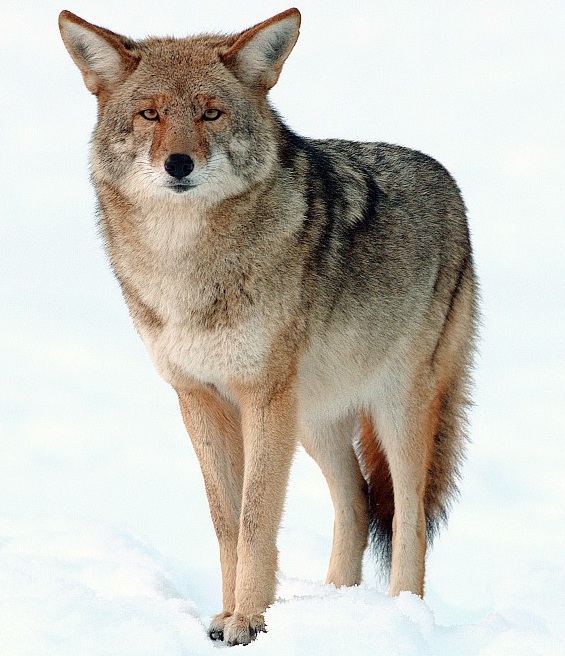
| Appearance | - The coyote typically has a coat combining light gray, reddish or fulvous, black, and white coloration. English Wikipedia
- Coyotes have pointed ears, a narrow muzzle, and a bushy tail with a black tip. nps.gov
- Coyotes generally have a grey-brown coat with black-tipped hairs along their backs. nps.gov
- The coyote has longer ears and a relatively larger braincase than the gray wolf. English Wikipedia
- Coyotes carry their tails downward when walking or running. English Wikipedia
| - The golden jackal has a coarse, relatively short coat whose base color ranges from pale creamy yellow in summer to dark tawny beige in winter. English Wikipedia
- The golden jackal has an elongated torso, relatively short legs and tail, and a narrow, pointed muzzle. English Wikipedia
- Golden jackals in rocky mountainous habitats may have grayer coats than individuals elsewhere. English Wikipedia
- The golden jackal sheds its coat twice annually, during spring and autumn. English Wikipedia
|
|---|
| Size | - Male coyotes typically weigh between 8 and 20 kg. English Wikipedia
- Female coyotes typically weigh between 7 and 18 kg. English Wikipedia
- Adult coyotes have an average total body length, including the tail, of 1.0 to 1.35 m. English Wikipedia
- The coyote's tail measures approximately 40 cm in length. English Wikipedia
- The average shoulder height of coyotes ranges from 18 to 23 inches. nps.gov
- Coyotes average approximately 20 to 35 pounds in weight according to the Jewel Cave National Monument account. nps.gov
- Northern coyote subspecies average approximately 18 kg, compared with 11.5 kg for southern Mexican subspecies. English Wikipedia
| - Male golden jackals measure 71–85 cm in body length, while females measure 69–73 cm. English Wikipedia
- Male golden jackals weigh 6–14 kg, while females weigh 7–11 kg. English Wikipedia
- Both male and female golden jackals have a shoulder height of 45–50 cm. English Wikipedia
- The golden jackal has a tail approximately 25 cm long. animaldiversity.org
- The golden jackal has a standing height of approximately 40 cm according to Animal Diversity Web. animaldiversity.org
|
|---|
| Habitat | | - Golden jackals commonly inhabit valleys and areas beside rivers, tributaries, canals, lakes, and seashores. English Wikipedia
- Golden jackals are uncommon in foothills and low mountains. English Wikipedia
- In Central Asia, golden jackals avoid waterless deserts but occupy desert edges and oases. English Wikipedia
- Golden jackals inhabit dense prickly-bush thickets, reed floodplains, and forests. English Wikipedia
- Golden jackals can occupy elevations exceeding 1,000 m on Himalayan slopes. English Wikipedia
- Golden jackals in India occupy foothills surrounding cultivated areas and enter human settlements at night to feed on garbage. English Wikipedia
- Golden jackals in Cambodia's Eastern Plains Landscape inhabit seasonally dry deciduous forest. pmc.ncbi.nlm.nih.gov
- Golden jackals in eastern Cambodia avoid dense forests and streams and strongly select dirt roads. pmc.ncbi.nlm.nih.gov
- Golden jackals in the Eastern Plains Landscape of Cambodia occupied areas not occupied by leopards and dholes. pmc.ncbi.nlm.nih.gov
- Golden jackals generally prefer dry open country, arid short grasslands, and steppe landscapes. animaldiversity.org
|
|---|
| Diet | - Coyotes preferentially prey on Dall's sheep, white-tailed deer, eastern cottontail rabbits, and California voles. pmc.ncbi.nlm.nih.gov
- Coyotes avoid preying on small mammals, including carnivorans and arboreal species. pmc.ncbi.nlm.nih.gov
- Coyotes consume deer, rabbits, hares, rodents, birds, reptiles, amphibians, fish, and invertebrates. English Wikipedia
- Coyotes occasionally consume fruits and vegetables. English Wikipedia
- Coyotes in the southern United States may consume more frogs than coyotes in other regions. nps.gov
- Coyotes in the Yukon may consume more berries. nps.gov
- Vegetation consumption by coyotes is greatest during summer and autumn. research.fs.usda.gov
| - Golden jackals consume fruit, insects, and small ungulates. English Wikipedia
- Golden jackals consume small birds, rodents, small vertebrates, insects, carrion, fruit, and vegetable matter. English Wikipedia
- Golden jackals in eastern Cambodia obtained approximately 26% of consumed dietary biomass from processional termites. pmc.ncbi.nlm.nih.gov
- Wild pigs contributed approximately 20% of the dietary biomass consumed by golden jackals in eastern Cambodia. pmc.ncbi.nlm.nih.gov
- Muntjac contributed approximately 20% of the dietary biomass consumed by golden jackals in eastern Cambodia. pmc.ncbi.nlm.nih.gov
- Golden jackals in eastern Cambodia selectively consumed muntjac over larger ungulate species. pmc.ncbi.nlm.nih.gov
- Golden jackals consume approximately 54% animal food and 46% plant food. animaldiversity.org
- Golden jackals consume young gazelles, rodents, hares, ground birds, eggs, reptiles, frogs, fish, insects, and fruit. animaldiversity.org
|
|---|
| Behaviour | - Coyotes can live either in family units or in loosely organized packs of unrelated individuals. English Wikipedia
- Coyotes can hunt either individually or in groups. pmc.ncbi.nlm.nih.gov
- Coyotes may form groups of five to six adults under favorable conditions. nps.gov
- Coyote packs containing more than ten animals have been observed. nps.gov
- Coyotes may establish and defend territories or survive as nonterritorial transient individuals. pmc.ncbi.nlm.nih.gov
- Coyotes characteristically produce howls that rapidly change in tone and pitch. English Wikipedia
| - Golden jackals are social animals whose basic family unit consists of a breeding pair and their young. English Wikipedia
- Golden jackal pairs are strictly monogamous. animaldiversity.org
- Golden jackal pairs forage and rest together. animaldiversity.org
- Golden jackal pairs are three times more likely to succeed in hunting than solitary individuals. animaldiversity.org
- Golden jackals are strictly nocturnal in human-inhabited areas but may be partly active during daylight elsewhere. animaldiversity.org
- Golden jackals communicate and locate one another using a variety of howls. animaldiversity.org
- Golden jackals sometimes bury pieces of meat using their forepaws and noses. animaldiversity.org
- Golden jackals in eastern Cambodia maintained mutually exclusive home ranges with an average annual area of 47.1 km². pmc.ncbi.nlm.nih.gov
|
|---|
| Reproduction | | - The gestation period of golden jackals is 63 days. animaldiversity.org
- Golden jackal litters generally contain two to four pups, although litter sizes can range from one to nine. animaldiversity.org
- Golden jackal pups are born in dens within their parents' marked territories. animaldiversity.org
- Golden jackal births occur mainly in January and February in East Africa and April and May in Southeast Europe, while tropical Asian births occur throughout the year. animaldiversity.org
- Golden jackal pups are nursed for approximately eight weeks before weaning. animaldiversity.org
- Golden jackals reach sexual maturity at approximately eleven months. animaldiversity.org
|
|---|
| Distribution | - Coyotes are native to North America. English Wikipedia
- Coyotes occur throughout North and Central America. animaldiversity.org
- Coyotes have expanded their geographic range by approximately 40 percent over the past 120 years. research.fs.usda.gov
- Coyotes currently occur in every US state except Hawaii and extend as far north as the Arctic. nps.gov
- Coyotes were first sighted in eastern Panama in 2013. English Wikipedia
| |
|---|
| Conservation | - The coyote is classified as Least Concern by the International Union for Conservation of Nature. English Wikipedia
- Human persecution is a major cause of coyote mortality. nps.gov
- Trapping for their pelts is one of the major causes of coyote mortality throughout their range. nps.gov
- Coyotes have expanded their range despite substantial persecution related to actual or perceived livestock predation. pmc.ncbi.nlm.nih.gov
| No checked fact yet |
|---|
| Uses | No checked fact yet | - Golden jackals are sometimes hunted for their fur. animaldiversity.org
- Golden jackals have been used in scent-detection operations at Sheremetyevo Airport through jackal-dog hybrid Sulimov dogs. English Wikipedia
|
|---|
| Similar species | No checked fact yet | - The golden jackal differs from the Arabian wolf through its smaller body, shorter legs and tail, more elongated torso, less prominent forehead, and narrower muzzle. English Wikipedia
|
|---|
| Name origin | | No checked fact yet |
|---|