Comparison

Yellow-legged Rain Frog vs Fitzinger's Robber Frog

Yellow-legged Rain Frog (Craugastor andi) and Fitzinger's Robber Frog (Craugastor fitzingeri) both belong to the genus Craugastor (northern rainfrogs) and part ways below it. Both are recorded in 2 countries.

Yellow-legged Rain Frog

Craugastor andi
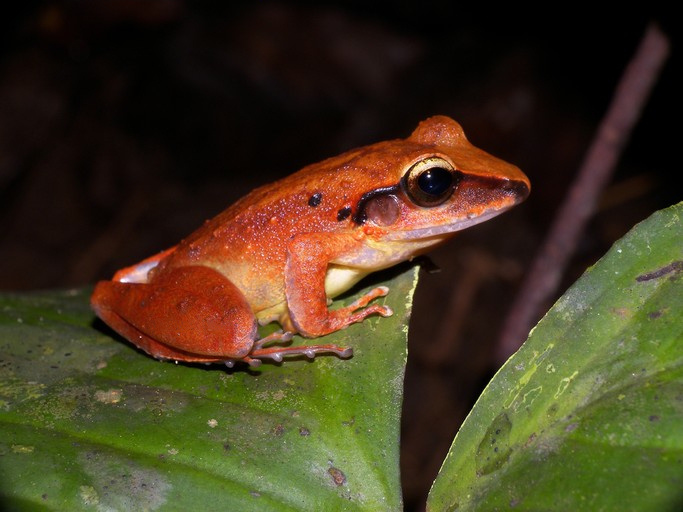
Fitzinger's Robber Frog

Fitzinger's Robber Frog

Craugastor fitzingeri

Esteban Alzate, CC BY-SA 2.5, via Wikimedia Commons

Side by side

Yellow-legged Rain FrogFitzinger's Robber Frog
Scientific nameCraugastor andi (Savage, 1974)Craugastor fitzingeri (Schmidt, 1857)
English nameYellow-legged Rain FrogFitzinger's Robber Frog
GroupAmphibiansAmphibians
ClassAmphibia AmphibiansAmphibia Amphibians
OrderAnura FrogsAnura Frogs
FamilyCraugastoridae Robber FrogsCraugastoridae Robber Frogs
GenusCraugastor Northern RainfrogsCraugastor Northern Rainfrogs
Named in19741857
Red List categoryCritically EndangeredLeast Concern
Countries on record2 countries7 countries
GBIF occurrence records69 records5,682 records

Rows where the two agree are shown in grey.

Where each is found

Both recorded in 2 countries

Only Fitzinger's Robber Frog (5)

From Catalogue of Life checklists and GBIF occurrence records. A country missing from a list means no record is held, which is not proof of absence.

Checked facts

Yellow-legged Rain FrogFitzinger's Robber Frog
Appearance
  • The species has a relatively narrow head and a long, pointed snout. English Wikipedia
  • Its back is dark brown and may have a thin, light stripe running down the middle. English Wikipedia
  • Its underside has a white background with dark spots and may have yellow or reddish coloration. English Wikipedia
  • The groin and backs of the thighs are chocolate brown with bright yellow spots or broad stripes in living specimens. English Wikipedia
  • Its throat is dark brown or black, with a lighter stripe running along it. English Wikipedia
  • Its iris is coppery gold with a horizontal dark brown line through the middle. English Wikipedia
  • The skin of its back may be smooth or have some warts, but is not tuberculate. English Wikipedia
  • Its third and fourth fingers have enlarged ball-shaped or disc-like pads. English Wikipedia
  • Its feet have thin webbing between all five digits. English Wikipedia
  • Adult males possess nuptial pads and vocal slits. English Wikipedia
Size
Habitat
  • Its native habitat is tropical wet premontane rainforest containing bromeliads, generally near streams. English Wikipedia
  • It occurs at elevations between 560 and 1,500 metres above sea level. English Wikipedia
  • Most recorded collections have been made at elevations of 1,000–1,200 metres. English Wikipedia
  • In Panama, specimens have been collected at 910 metres elevation. English Wikipedia
  • The species inhabits humid lowland and montane forests below 1,520 m elevation. English Wikipedia
  • It frequently occurs in disturbed forests and along forest edges. English Wikipedia
  • In the Colombian portion of its range, the species does not occur in secondary forest. English Wikipedia
  • During the dry season, populations in lowland dry forest areas are restricted to riparian gallery forests. English Wikipedia
  • During the wet season, the species occupies a wider area of lowland dry forest. English Wikipedia
Behaviour
  • The species is nocturnal and is considered probably arboreal. English Wikipedia
  • Individuals are usually found near streams and have also been observed up to five metres high in water-filled bromeliad centres. English Wikipedia
  • Males call from locations along streams. English Wikipedia
  • The male call is described as a deep sound repeated several times. English Wikipedia
  • During the day, individuals are generally concealed in leaf litter on the forest floor. English Wikipedia
  • Individuals may also be active during the day. English Wikipedia
  • At night, individuals often climb onto logs or into low vegetation. English Wikipedia
  • Males typically produce advertisement calls at dusk from elevated positions on low herbs and bushes. English Wikipedia
  • The male advertisement call consists of variable sequences of harsh chirps or clacks. English Wikipedia
ReproductionNo checked fact yet
Distribution
  • The species occurs in the Caribbean drainage of Costa Rica and extreme northwestern Panama. English Wikipedia
  • Its recorded Costa Rican mountain ranges include the Guanacaste, Tilarán, Volcánica Central and northern Talamanca cordilleras. English Wikipedia
  • The species was recorded along the Río Claro in Bocas del Toro Province, Panama, before 2010. English Wikipedia
  • Recorded Costa Rican protected areas include Monteverde Cloud Forest Reserve, Alberto Manuel Brenes Biological Reserve and Maquenque National Wildlife Refuge. English Wikipedia
  • The species occurs in northwestern Colombia, Panama, Costa Rica, eastern Nicaragua, and northeastern Honduras. English Wikipedia
Conservation
  • The species was last recorded in 1990 and has not been observed since. English Wikipedia
  • It was assessed as critically endangered by the IUCN in 2004 and retained that status in 2008. English Wikipedia
  • Its critically endangered assessment was attributed to a drastic population decline. English Wikipedia
  • The species is protected in Costa Rica under wildlife conservation law No. 7317, environmental law No. 7554 and decree No. 26435-MINAE. English Wikipedia
  • Infection by the introduced chytrid fungus has been suggested as a possible cause of its decline. English Wikipedia
  • Climate change has also been mentioned as a possible source of impact on the species. English Wikipedia
  • The species has no ex situ conservation population. English Wikipedia
  • The species is suspected to be susceptible to the chytrid fungus Batrachochytrium dendrobatidis. English Wikipedia
  • The species can be locally abundant, although some populations have declined. English Wikipedia
  • No major threats to the species have been identified. English Wikipedia
  • The species' geographic range overlaps with several protected areas. English Wikipedia
  • The species was most recently assessed for the IUCN Red List in 2019. iucnredlist.org

In brief

Yellow-legged Rain Frog

Craugastor andi occurs in the Caribbean drainage of Costa Rica and extreme northwestern Panama, in tropical wet premontane rainforest generally near streams. It has a white underside with dark spots and yellow or reddish coloration, while its groin and the backs of its thighs have bright yellow markings. Full profile

Fitzinger's Robber Frog

Craugastor fitzingeri inhabits humid lowland and montane forests below 1,520 m elevation in northwestern Colombia, Panama, Costa Rica, eastern Nicaragua, and northeastern Honduras. It has a prominent tympanum, discs on its fingers and toes, moderately webbed toes, and skin typically marked by warts and ridges. Full profile

Compare something else

Page built on 29 November 2026 from the data on the two species pages, where every source is listed.

Cite this page

ScientificNames.org. (2026). Yellow-legged Rain Frog vs Fitzinger's Robber Frog. Retrieved November 29, 2026, from https://scientificnames.org/compare/yellow-legged-rain-frog-vs-fitzingers-robber-frog