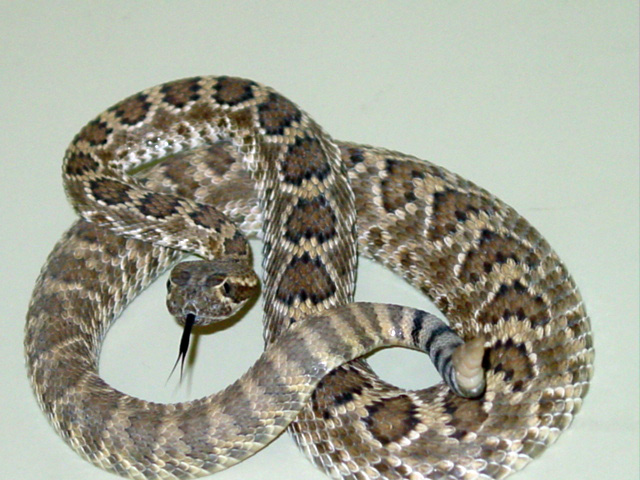
| Appearance | - The species has a large, rounded head, a relatively heavy body, and eyes with vertical pupils. English Wikipedia
- Its tail bears a keratin rattle that gains a new segment whenever the snake sheds its skin. English Wikipedia
- Its coloration generally reflects the color of rocks in its natural environment. English Wikipedia
- Individuals living near predominantly limestone areas tend to be light gray with darker gray bands. English Wikipedia
- Individuals from higher altitudes tend to have darker coloration. English Wikipedia
- The banded rock rattlesnake subspecies has distinctive, clean banding that often has little speckling or mottling. English Wikipedia
| - The species exhibits dorsal coloration ranging from green and brown to gray and yellowish shades. English Wikipedia
- Its back has large, diamond-shaped blotches resembling those of the western diamond-backed rattlesnake. English Wikipedia
- Its dorsal diamond markings lack the abundant dark speckling characteristic of the western diamond-backed rattlesnake. English Wikipedia
- Its crown scales are relatively large and extend behind the supraocular scales in a fan-shaped arrangement. English Wikipedia
|
|---|
| Size | No checked fact yet | |
|---|
| Habitat | - The species commonly inhabits rocky outcrops and talus slopes. English Wikipedia
- Man-made road cuts are frequently used as habitat. English Wikipedia
- The banded rock rattlesnake can take refuge beneath rocks, inside or under stumps, and in animal burrows. nationalzoo.si.edu
| - The species primarily inhabits broad desert valleys and lower mountain slopes. English Wikipedia
- It commonly occurs in sparsely vegetated areas containing creosote, sage, mesquite, cacti, and Joshua trees. English Wikipedia
- In some locations, the species also inhabits juniper woodland and grassland. English Wikipedia
- It generally favors relatively flat, open, dry habitats over densely vegetated or extremely rocky areas. English Wikipedia
- Its habitats extend from near sea level to approximately 2,500 m elevation. English Wikipedia
|
|---|
| Diet | - The species feeds on small mammals, lizards, and occasionally frogs. English Wikipedia
- The diet of the banded rock rattlesnake consists of 55.4% lizards, 28.3% centipedes, 13.8% mammals, 1.9% birds, and 0.6% snakes. pubs.usgs.gov
- Sceloporus species account for 92.4% of the lizards recorded in the banded rock rattlesnake's diet. pubs.usgs.gov
- Sceloporus jarrovii represents an estimated 82.3% of lizard prey records for the banded rock rattlesnake. pubs.usgs.gov
- The banded rock rattlesnake uses venom to subdue prey before swallowing it whole. nationalzoo.si.edu
| |
|---|
| Behaviour | - The species is generally not aggressive. English Wikipedia
- The species relies heavily on camouflage and often refrains from striking or rattling unless physically harassed. English Wikipedia
- The species is primarily nocturnal. English Wikipedia
- The species can be more active at colder temperatures than other rattlesnake species. English Wikipedia
| - The species is primarily active between April and September. English Wikipedia
- It hunts by ambushing its prey. English Wikipedia
- The species is shy and cryptic and generally avoids confrontations with larger animals, including humans. English Wikipedia
- It can strike and bite vigorously when disturbed, particularly when surprised or unable to escape into nearby vegetation or a burrow. English Wikipedia
- The species is preyed upon by coyotes, bobcats, and raptors. English Wikipedia
|
|---|
| Reproduction | - Young generally resemble miniature versions of their parents. English Wikipedia
- Young typically require at least three years to mature. English Wikipedia
- Banded rock rattlesnakes are thought to breed during summer, between late July and late August. nationalzoo.si.edu
- Female banded rock rattlesnakes may produce litters of three to six young. nationalzoo.si.edu
- Banded rock rattlesnake newborns average 21 centimeters in length. nationalzoo.si.edu
| - Courtship begins in late summer or autumn, pauses during winter, and resumes in spring. English Wikipedia
- Females give birth to live young between July and September. English Wikipedia
- A litter contains between two and 17 young, averaging approximately eight. English Wikipedia
|
|---|
| Distribution | - The species occurs in southeastern Arizona, southern New Mexico, and southwestern Texas in the United States. English Wikipedia
- The species also occurs in northern central Mexico. English Wikipedia
| - The species occurs in the southwestern United States, including California, Arizona, western Texas, Nevada, Utah, and New Mexico. English Wikipedia
- In Mexico, the species occurs in Sonora, Chihuahua, and southward across the Mexican Plateau into the states of Mexico, Puebla, and Veracruz. English Wikipedia
- The species is found in the deserts of the southwestern United States and deep into mainland Mexico. English Wikipedia
|
|---|
| Conservation | - The species is classified as Least Concern on the IUCN Red List. English Wikipedia
- The species had a stable population trend when assessed in 2006. English Wikipedia
- The species is listed as threatened in New Mexico. English Wikipedia
- Minor threats to the banded rock rattlesnake include urban development, pet-trade collection, and habitat disruption caused by mining. nationalzoo.si.edu
- The banded rock rattlesnake is common throughout its range and occurs in protected areas, although its wild population status is unknown. nationalzoo.si.edu
| |
|---|
| Uses | - The banded rock rattlesnake subspecies is frequently available in the exotic animal trade. English Wikipedia
- The banded rock rattlesnake is represented in zoos around the world. English Wikipedia
| No checked fact yet |
|---|