Species · Reptiles
Mojave Rattlesnake Crotalus scutulatus
The scientific name of the Mojave Rattlesnake is Crotalus scutulatus. It is a species of reptile in the family Viperidae (viper), order Squamata. The name dates from 1861.
- Scientific name
- Crotalus scutulatus (Kennicott, 1861)
- Common name
- Mojave Rattlesnake
- Genus
- Crotalus
- Family
- Viperidae (Viper)
- Order
- Squamata
- Class
- Reptilia
- Red List category
- LC Least Concern
- Recorded in
- 2 countries
- Name status
- accepted in the Catalogue of Life
Overview
Crotalus scutulatus occurs in the deserts of the southwestern United States and deep into mainland Mexico.
Written 26 November 2026 from the sources listed below. Each statement was checked against the passage it cites; statements that could not be supported were removed.
Appearance
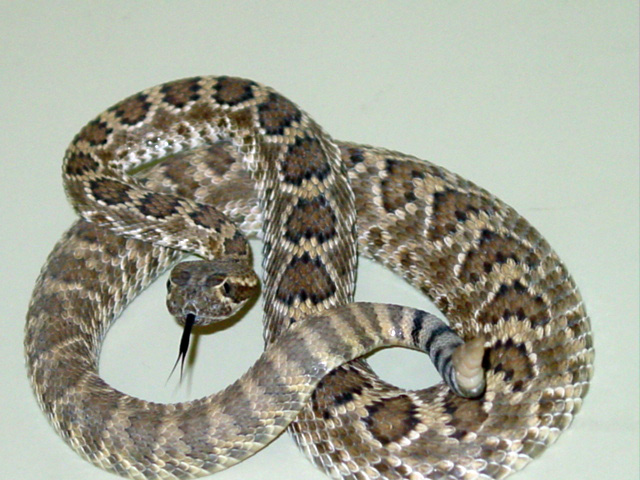
Dorsal coloration ranges from green and brown to gray and yellowish shades. The back has large, diamond-shaped blotches resembling those of the western diamond-backed rattlesnake, but the markings lack its abundant dark speckling.[1][2][3]
The crown scales are relatively large and extend behind the supraocular scales in a fan-shaped arrangement.[4]
Average total length, including the tail, is less than 100 cm. The maximum recorded total length is 123.6 cm for males and 92.2 cm for females.[5][6][7]
Habitat
The Mojave Rattlesnake primarily inhabits broad desert valleys and lower mountain slopes. It commonly occurs in sparsely vegetated areas containing creosote, sage, mesquite, cacti, and Joshua trees.[8][9]
In some locations, it also inhabits juniper woodland and grassland. It generally favors relatively flat, open, dry habitats over densely vegetated or extremely rocky areas.[10][11]
Its habitats extend from near sea level to approximately 2,500 m elevation.[12]
Diet
The Mojave Rattlesnake feeds primarily on small rodents and lizards.[13]
Behaviour
The species is primarily active between April and September and hunts by ambushing its prey.[14][15]
The species is shy and cryptic and generally avoids confrontations with larger animals, including humans. It can strike and bite vigorously when disturbed, particularly when surprised or unable to escape into nearby vegetation or a burrow.[16][17]
Coyotes, bobcats, and raptors prey upon the species.[18]
Reproduction and life cycle
Courtship begins in late summer or autumn, pauses during winter, and resumes in spring.[19]
Females give birth to live young between July and September. A litter contains between two and 17 young, averaging approximately eight.[20][21]
Conservation
The Mojave Rattlesnake is classified as Least Concern on the IUCN Red List. Its population trend was assessed as stable in 2007.[22][23]
Classification of the Mojave Rattlesnake
| Kingdom | Animalia |
|---|---|
| Phylum | Chordata |
| Subphylum | Vertebrata |
| Infraphylum | Gnathostomata |
| Parvphylum | Osteichthyes |
| Megaclass | Tetrapoda |
| Class | Reptilia (Reptile) |
| Order | Squamata (Snakes) |
| Suborder | Serpentes (Snakes) |
| Infraorder | Alethinophidia |
| Family | Viperidae (Viper) |
| Subfamily | Crotalinae |
| Genus | Crotalus (Rattlesnakes) |
| Species | Crotalus scutulatus (Kennicott, 1861) |
Where the Mojave Rattlesnake is found
Checklists and occurrence records place Crotalus scutulatus in 2 countries across North America. GBIF holds 10,048 georeferenced records of it.
Countries
Regions and cities with the most records
- Arizona, United States 3,389
- California, United States 1,549
- Texas, United States 1,002
- Chihuahua, Mexico 622
- New Mexico, United States 557
- Coahuila, Mexico 217
- Nevada, United States 211
- Lancaster, United States 165
- Marana, United States 155
- Rosamond, United States 139
- Victorville, United States 116
- Apple Valley, United States 99
- Sonora, Mexico 98
- Palmdale, United States 94
- Flowing Wells, United States 90
- Nuevo León, Mexico 89
- Zacatecas, Mexico 87
- San Luis Potosí, Mexico 86
- Durango, Mexico 78
- Yucca Valley, United States 74
- Adelanto, United States 73
- Casas Adobes, United States 73
- Hesperia, United States 69
- Sierra Vista, United States 66
- Utah, United States 65
- Drexel Heights, United States 61
- Oro Valley, United States 61
- Barstow Heights, United States 57
- Perote, Mexico 57
- Veracruz, Mexico 53
- Fountain Hills, United States 52
- Barstow, United States 48
- Chihuahua, Mexico 48
- Ridgecrest, United States 47
- Tucson, United States 47
- Summerlin South, United States 46
Range as the checklists state it
USA (S California, S Nevada, Arizona, S New Mexico, W Texas, SW Utah),
A number beside a place is its count of GBIF occurrence records. A place without a number comes from a checklist alone. Records show where a species has been observed or collected, which can include escapes and vagrants.
Common names
English
- Mojave Rattlesnake
- Green Rattlesnake
- Mohave Rattlesnake
Names in 12 other languages
- Chinese
- 小盾響尾蛇
- Czech
- chřestýš mohavský
- Danish
- Mojave-klapperslange
- German
- Mojave-Klapperschlange
- Hungarian
- Mohave-csörgőkígyó
- Italian
- Crotalo di Mojave, Serpente a sonagli di Mojave
- Japanese
- モハベガラガラヘビ
- Portuguese
- Cascavel-do-Mojave
- Russian
- Мойавский ромбический гремучник
- Spanish
- Cascabel del Altiplano, Chiauhcoatl, Víbora de cascabel del Altiplano, Víbora-cascabel del Altiplano, cascabel del Mojave
- Turkish
- Mohave çıngıraklı yılanı
- sei
- cocázni
Synonyms
3 other scientific names have been used for this species and are now treated as synonyms of Crotalus scutulatus.
- Caudisona scutulata Kennicott, 1861
- Crotalus confluentus kellyi Amaral, 1929
- Crotalus salvini Günther, 1895
Subspecies and varieties
- Crotalus scutulatus salvini (Huamantlan Rattlesnake) subspecies
- Crotalus scutulatus scutulatus (Mojave Rattlesnake) subspecies
Related species
-
 Timber RattlesnakeCrotalus horridus
-
 Western Diamondback RattlesnakeCrotalus atrox
-
 SidewinderCrotalus cerastes
-
 Prairie RattlesnakeCrotalus viridis
-
 Western RattlesnakeCrotalus oreganus
-
 Tiger RattlesnakeCrotalus tigris
-
 Black-tailed RattlesnakeCrotalus molossus
-
 Red Diamond RattlesnakeCrotalus ruber
Compare
Questions and answers
What is the scientific name of the Mojave Rattlesnake?
The scientific name of the Mojave Rattlesnake is Crotalus scutulatus. Written with its author, the full name is Crotalus scutulatus (Kennicott, 1861).
Which family does the Mojave Rattlesnake belong to?
Crotalus scutulatus belongs to the family Viperidae, in the order Squamata and the class Reptilia.
Where is the Mojave Rattlesnake found?
Checklists and occurrence records place Crotalus scutulatus in 2 countries: United States and Mexico.
What is the conservation status of the Mojave Rattlesnake?
The IUCN Red List category recorded for Crotalus scutulatus is Least Concern (LC).
What other names does the Mojave Rattlesnake have?
Crotalus scutulatus is also known in English as Green Rattlesnake and Mohave Rattlesnake.
In what habitat does a Mojave rattlesnake live?
The Mojave Rattlesnake primarily inhabits broad desert valleys and lower mountain slopes, especially sparsely vegetated areas containing creosote, sage, mesquite, cacti, and Joshua trees. It also occurs in juniper woodland and grassland in some locations and generally favors relatively flat, open, dry habitats over densely vegetated or extremely rocky areas.[8][9][10][11]
What does a Mojave rattlesnake eat?
The Mojave Rattlesnake feeds primarily on small rodents and lizards.[13]
What is a rattlesnake's diet?
The Mojave Rattlesnake feeds primarily on small rodents and lizards.[13]
Sources
Passages the profile rests on
- The species exhibits dorsal coloration ranging from green and brown to gray and yellowish shades. Source passage: “The dorsal color of C. scutulatus varies from shades of green to browns, grays, and even yellowish.” — English Wikipedia
- Its back has large, diamond-shaped blotches resembling those of the western diamond-backed rattlesnake. Source passage: “C. scutulatus has a row of large diamond-shaped dorsal blotches closely resembling C. atrox” — English Wikipedia
- Its dorsal diamond markings lack the abundant dark speckling characteristic of the western diamond-backed rattlesnake. Source passage: “but lacking the abundant dark speckling, both coarse and fine, found throughout the dorsal surfaces of C. atrox.” — English Wikipedia
- Its crown scales are relatively large and extend behind the supraocular scales in a fan-shaped arrangement. Source passage: “the enlarged scales spill out behind the supraocular scales in a fan shape, usually with a well-defined margin.” — English Wikipedia
- Its average total length, including the tail, is less than 100 cm. Source passage: “grows to an average total length (tail included) of less than 100 cm (3.3 ft)” — English Wikipedia
- The maximum recorded total length for males is 123.6 cm. Source passage: “with a maximum total length of 123.6 cm (4.1 ft) for males” — English Wikipedia
- The maximum recorded total length for females is 92.2 cm. Source passage: “and 92.2 cm (3.0 ft) for females.” — English Wikipedia
- The species primarily inhabits broad desert valleys and lower mountain slopes. Source passage: “Crotalus scutulatus is primarily an inhabitant of broad desert valleys or lower mountain slopes” — English Wikipedia
- It commonly occurs in sparsely vegetated areas containing creosote, sage, mesquite, cacti, and Joshua trees. Source passage: “containing predominantly creosote (Larrea), sage (Ambrosia), mesquite (Prosopis), various cacti (Cactaceae), and Joshua trees (Yucca brevifolia)” — English Wikipedia
- In some locations, the species also inhabits juniper woodland and grassland. Source passage: “as well as juniper (Juniperus) woodland and grassland (Poaceae) habitats in some places.” — English Wikipedia
- It generally favors relatively flat, open, dry habitats over densely vegetated or extremely rocky areas. Source passage: “preferring relatively flat, open, and xeric habitats.” — English Wikipedia
- Its habitats extend from near sea level to approximately 2,500 m elevation. Source passage: “from near sea level to about 2,500 m (8,200 ft) elevation.” — English Wikipedia
- The species feeds primarily on small rodents and lizards. Source passage: “eating mostly small rodents and lizards.” — English Wikipedia
- The species is primarily active between April and September. Source passage: “Crotalus scutulatus is most active from April to September.” — English Wikipedia
- It hunts by ambushing its prey. Source passage: “They are ambush predators” — English Wikipedia
- The species is shy and cryptic and generally avoids confrontations with larger animals, including humans. Source passage: “it is shy, cryptic, and does not seek out confrontations with larger creatures, including humans.” — English Wikipedia
- It can strike and bite vigorously when disturbed, particularly when surprised or unable to escape into nearby vegetation or a burrow. Source passage: “it will strike and bite vigorously when disturbed, especially if surprised or when there is no nearby vegetation or burrow into which the snake can escape.” — English Wikipedia
- The species is preyed upon by coyotes, bobcats, and raptors. Source passage: “this species is routinely preyed upon by larger predators like coyotes, bobcats, and raptors.” — English Wikipedia
- Courtship begins in late summer or autumn, pauses during winter, and resumes in spring. Source passage: “Courtship begins in late summer/fall, is interrupted by winter, and resumes in the spring.” — English Wikipedia
- Females give birth to live young between July and September. Source passage: “Females bear live young” — English Wikipedia
- A litter contains between two and 17 young, averaging approximately eight. Source passage: “from two to 17 (average about eight), from July through September.” — English Wikipedia
- The species is classified as Least Concern on the IUCN Red List. Source passage: “Crotalus scutulatus is classified as Least Concern (LC) on the IUCN Red List of Threatened Species” — English Wikipedia
- Its population trend was assessed as stable in 2007. Source passage: “The population trend was stable when assessed in 2007.” — English Wikipedia
Data
- Catalogue of Life, 2026-10-16 XR cc by
- Global Biodiversity Information Facility CC BY 4.0
- Wikidata CC0
- GeoNames CC BY 4.0
- Wikimedia Commons per image; credit shown with each image
- Within the Catalogue of Life, this name comes from The Reptile Database cc by
References
- Kennicott, R. (1861). On three new forms of rattlesnakes. Proc. Acad. Nat. Sci. Philadelphia 13: 206-207.
- Cope, E. D. (1875). In Yarrow, H.C., Report upon the collections of batrachians and reptiles made in portions of Nevada, Utah, California, Colorado, New Mexico, and Arizona, during the years 871, 1872, 1873, and 1874, Chapter IV, L, pp. 509-584, In: Report upon geographical and geological explorations and surveys west of the the one hundredths meridian, ... Wheeler, Vol. 5, Zoology. Government Printing Office, Washington D.C.
- Günther, A. C. L. G. (1885). Reptilia and Batrachia. Biologia Centrali-Américana. Taylor, & Francis, London, 326 Pp. [Published in Parts from 1885-1902; Reprint by the SSAR 1987].
- Cope, E. D. (1900). The crocodilians, lizards and snakes of North America. Ann. Rep. U.S. Natl. Mus. 1898: 153-1270.
- Amaral, & do, A. (1929). Studies of nearctic ophidia V. On Crotalus confluentus Say, 1823, and its allied forms. Bull. Antivenin Inst. America 2 (4): 86-97.
- Klauber, L. M. (1930). New and renamed subspecies of Crotalus confluentus Say, with remarks on related species. Trans. San Diego Soc. Nat. Hist. 6 (3): 95-144. Link
- Woodbury, Angus M.;Hardy, Ross. (1947). The Mohave rattlesnake in Utah. Copeia 1947 (1): 66.
- Jameson, David H.;Flury, Alvin G. (1949). The reptiles and amphibians of the Sierra Vieja Range of southwestern Texas. Texas Journal of Science 1 (2): 54-77.
- Klauber, Laurence M. (1952). Taxonomic studies on rattlesnakes of Mainland Mexico. Bulletins of the Zoological Society of San Diego (26): 1-143.
- Cook, S.F., Jr. (1955). Rattlesnake hybrids: Crotalus viridis x Crotalus scutulatus. Copeia 1955 (2): 139-141.
- McCoy, C.J., Jr. (1961). Birth Season and Young of Crotalus scutulatus and Agkistrodon contortrix laticinctus. Herpetologica 17 (2): 140.
- Pough, H. (1966). Ecological relationships of rattlesnakes in southeastern Arizona with notes on other species. Copeia 1966 (4): 676-683.
- Loomis, Richard B.;Stephens, Robert C. (1967). Additional notes on snakes taken in or near Joshua Tree National Monument, California. Bulletin of the Southern California Academy of Sciences 66 (1): 1-22.
- Zimmerman, Earl G., and C. William Kilpatrick. (1973). Karyology of North American crotaline snakes (family Viperidae) of the genera Agkistrodon, Sistrurus and Crotalus. Can. J. Genet. Cytol. 15(3):389-395.
- Van Devender, Thomas R.; Lowe, Charles H. Lowe, Jr. (1977). Amphibians and reptiles of Yepomera, Chihuahua, Mexico. Journal of Herpetology 11 (1): 41-50.
- Campbell, J. A. (1979). Crotalus scutulatus (Viperidae) in Jalisco, Mexico. Southwestern Naturalist 24 (4): 683-714.
- Price A H. (1982). Crotalus scutulatus (Kennicott). Mojave rattlesnake. Catalogue of American Amphibians and Reptiles ( 291: 1-2.
- Reynolds, R.P. & Scott Jr., N.J. (1982). Use of a Mammalian Resource by a Chihuahuan Snake Community. In: Scott, N.J. (ed.) Herpetological communities [an SSAR symposium]. US Fish and Wildlife Service, Wildl. Res. Rep. 13: 99-118.
- Glenn, J. L., Straight, R. C., Wolfe, M. C., & Hardy, D. L. (1983). Geographical variation in Crotalus scutulatus scutulatus (Mojave rattlesnake) venom properties. Toxicon 21(1):119-130.
- Webb, R. G. (1984). Herpetogeography in the Mazatlán-Durango Region of the Sierra Madre Occidental, Mexico. Vetrebrate Ecology and Systematics - A Ribute to Henry S. Fitch; Museum of Natural History, University of Kansas, Lawrence, Pp. 217-241.
- Rael, E. D., Knight, R. A., & Zepeda, H. (1984). Electrophoretic variants of Mojave rattlesnake (Crotalus scutulatus scutulatus) venoms and migration differences of Mojave toxin. Toxicon 22(6):980-984.
- Stebbins, R. C. (1985). A Field Guide to Western Reptiles and Amphibians, 2nd ed. Houghton Mifflin, Boston.
- Tanner, Wilmer W. (1985). Snakes of Western Chihuahua. Great Basin Naturalist 45 (4): 615-676.
- Murphy, R. W., & Crabtree, C. B. (1988). Genetic identification of a natural hybrid rattlesnake: Crotalus scutulatus scutulatus x C. viridis viridis. Herpetologica 44 (1): 119-123.
- Hardy, D. L. (1988). The epidemiology of rattlesnake envenomation in Tucson, Arizona: 1973-1980. Tucson Herpetological Society Newsletter 1(4):33-36.
This species in other databases
Page built on 28 November 2026. See how the catalog is made and all sources and licences.
Cite this page
ScientificNames.org. (2026). Crotalus scutulatus (Mojave Rattlesnake). Retrieved November 28, 2026, from https://scientificnames.org/species/crotalus-scutulatus
“Crotalus scutulatus (Mojave Rattlesnake).” ScientificNames.org, 2026, scientificnames.org/species/crotalus-scutulatus. Accessed 28 Nov. 2026.
ScientificNames.org. “Crotalus scutulatus (Mojave Rattlesnake).” Accessed November 28, 2026. https://scientificnames.org/species/crotalus-scutulatus.
@misc{scientificnames_crotalus_scutulatus_mojave_rattlesnake,
  author = {{ScientificNames.org}},
  title = {Crotalus scutulatus (Mojave Rattlesnake)},
  year = {2026},
  url = {https://scientificnames.org/species/crotalus-scutulatus},
  note = {Accessed 2026-11-28}
}