Comparison

New Mexican Ridge-nosed Rattlesnake vs Mojave Rattlesnake

New Mexican Ridge-nosed Rattlesnake (Crotalus willardi) and Mojave Rattlesnake (Crotalus scutulatus) both belong to the genus Crotalus (rattlesnakes) and part ways below it. Both are recorded in 2 countries.

New Mexican Ridge-nosed Rattlesnake

New Mexican Ridge-nosed Rattlesnake

Crotalus willardi

TimVickers, Public domain, via Wikimedia Commons

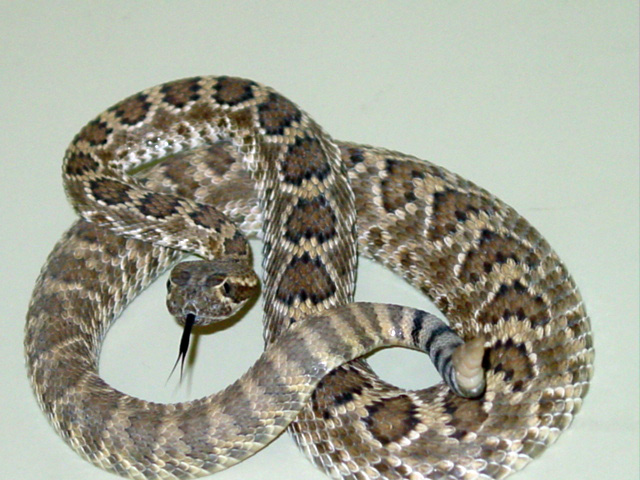
Mojave Rattlesnake

Mojave Rattlesnake

Crotalus scutulatus

Lvthn13 at English Wikipedia (Original text: Self-Created), Public domain, via Wikimedia Commons
Side by side

New Mexican Ridge-nosed RattlesnakeMojave Rattlesnake
Scientific nameCrotalus willardi Meek, 1905Crotalus scutulatus (Kennicott, 1861)
English nameNew Mexican Ridge-nosed RattlesnakeMojave Rattlesnake
GroupReptilesReptiles
ClassReptilia ReptileReptilia Reptile
OrderSquamata SnakesSquamata Snakes
FamilyViperidae ViperViperidae Viper
GenusCrotalus RattlesnakesCrotalus Rattlesnakes
Named in19051861
Red List categoryLeast ConcernLeast Concern
Countries on record2 countries2 countries
GBIF occurrence records975 records10,048 records

Rows where the two agree are shown in grey.

Where each is found

Both recorded in 2 countries

From Catalogue of Life checklists and GBIF occurrence records. A country missing from a list means no record is held, which is not proof of absence.

Checked facts

New Mexican Ridge-nosed RattlesnakeMojave Rattlesnake
Appearance
  • The species has a generally dark brown base coloration with pale or white horizontal stripes. English Wikipedia
  • The species exhibits dorsal coloration ranging from green and brown to gray and yellowish shades. English Wikipedia
  • Its back has large, diamond-shaped blotches resembling those of the western diamond-backed rattlesnake. English Wikipedia
  • Its dorsal diamond markings lack the abundant dark speckling characteristic of the western diamond-backed rattlesnake. English Wikipedia
  • Its crown scales are relatively large and extend behind the supraocular scales in a fan-shaped arrangement. English Wikipedia
Size
  • Individuals of this species measure approximately 30–60 cm in length. English Wikipedia
Habitat
  • The species is rarely found outside high-elevation habitats. English Wikipedia
  • The species inhabits wooded mountain ranges, primarily in the southwestern region. English Wikipedia
  • The species primarily inhabits broad desert valleys and lower mountain slopes. English Wikipedia
  • It commonly occurs in sparsely vegetated areas containing creosote, sage, mesquite, cacti, and Joshua trees. English Wikipedia
  • In some locations, the species also inhabits juniper woodland and grassland. English Wikipedia
  • It generally favors relatively flat, open, dry habitats over densely vegetated or extremely rocky areas. English Wikipedia
  • Its habitats extend from near sea level to approximately 2,500 m elevation. English Wikipedia
Diet
  • The species feeds on small mammals, lizards, birds, and large centipedes. English Wikipedia
  • Juveniles primarily consume large centipedes and lizards. English Wikipedia
  • Adults primarily consume mammals and birds. English Wikipedia
  • Adults of the New Mexico ridge-nosed rattlesnake subspecies primarily prey on small mammals and spiny lizards. ecos.fws.gov
Behaviour
  • The species hunts primarily by ambushing prey while coiled and waiting within striking distance. English Wikipedia
  • The species is primarily active between April and September. English Wikipedia
  • It hunts by ambushing its prey. English Wikipedia
  • The species is shy and cryptic and generally avoids confrontations with larger animals, including humans. English Wikipedia
  • It can strike and bite vigorously when disturbed, particularly when surprised or unable to escape into nearby vegetation or a burrow. English Wikipedia
  • The species is preyed upon by coyotes, bobcats, and raptors. English Wikipedia
Reproduction
  • The species is ovoviviparous and gives birth to live young rather than laying eggs. English Wikipedia
  • Copulation occurs from late summer to early fall. English Wikipedia
  • Gestation lasts approximately four to five months. English Wikipedia
  • Females give birth to between two and nine young, averaging five, in late July or August. English Wikipedia
  • Both sexes appear to reach reproductive maturity at approximately 400 mm in snout-to-vent body length. English Wikipedia
  • Wild females probably reproduce every second or third year. English Wikipedia
  • Courtship begins in late summer or autumn, pauses during winter, and resumes in spring. English Wikipedia
  • Females give birth to live young between July and September. English Wikipedia
  • A litter contains between two and 17 young, averaging approximately eight. English Wikipedia
Distribution
  • The species occurs in the southwestern United States, including California, Arizona, western Texas, Nevada, Utah, and New Mexico. English Wikipedia
  • In Mexico, the species occurs in Sonora, Chihuahua, and southward across the Mexican Plateau into the states of Mexico, Puebla, and Veracruz. English Wikipedia
  • The species is found in the deserts of the southwestern United States and deep into mainland Mexico. English Wikipedia
Conservation
  • The species is classified as Least Concern on the IUCN Red List. English Wikipedia
  • The species had a stable population trend when assessed in 2007. English Wikipedia
  • The New Mexico ridge-nosed rattlesnake subspecies is endangered and listed as threatened by the US Fish and Wildlife Service. English Wikipedia
  • Habitat destruction is identified as a cause of declining populations of the New Mexico ridge-nosed rattlesnake subspecies. English Wikipedia
  • Critical habitat designations have been proposed as recovery measures for the New Mexico ridge-nosed rattlesnake subspecies. English Wikipedia
OtherNo checked fact yet

In brief

New Mexican Ridge-nosed Rattlesnake

The New Mexican Ridge-nosed Rattlesnake (Crotalus willardi Meek, 1905) is a reptile in the family Viperidae, order Squamata, and class Reptilia. It occurs in the southwestern United States and Mexico, mainly in the sky island region. It has a generally dark brown base coloration with pale or white horizontal stripes. Full profile

Mojave Rattlesnake

Crotalus scutulatus occurs in the deserts of the southwestern United States and deep into mainland Mexico. Full profile

Compare something else

Page built on 29 November 2026 from the data on the two species pages, where every source is listed.

Cite this page

ScientificNames.org. (2026). New Mexican Ridge-nosed Rattlesnake vs Mojave Rattlesnake. Retrieved November 29, 2026, from https://scientificnames.org/compare/new-mexican-ridge-nosed-rattlesnake-vs-mojave-rattlesnake