Comparison

Frail Gourami vs Siamese Fighting Fish

Frail Gourami (Ctenops nobilis) and Siamese Fighting Fish (Betta splendens) both belong to the family Osphronemidae (gourami) and part ways below it. Both are recorded in 1 country.
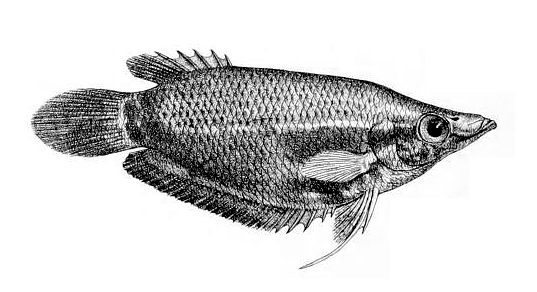
Frail Gourami

Frail Gourami

Ctenops nobilis

Francis Day (1829–1889), Public domain, via Wikimedia Commons

Siamese Fighting Fish

Siamese Fighting Fish

Betta splendens

Henryk Niestrój, CC BY 4.0, via Wikimedia Commons

Side by side

Frail GouramiSiamese Fighting Fish
Scientific nameCtenops nobilis McClelland, 1845Betta splendens Regan, 1910
English nameFrail GouramiSiamese Fighting Fish
GroupFishesFishes
ClassTeleostei TeleostTeleostei Teleost
OrderAnabantiformesAnabantiformes
FamilyOsphronemidae GouramiOsphronemidae Gourami
GenusCtenopsBetta Bettas
Named in18451910
Red List categoryNear ThreatenedVulnerable
Environmentbrackish, freshwaterfreshwater
Countries on record2 countries9 countries
GBIF occurrence records20 records518 records

Rows where the two agree are shown in grey.

Where each is found

Both recorded in 1 country

Only Frail Gourami (1)

Only Siamese Fighting Fish (8)

From Catalogue of Life checklists and GBIF occurrence records. A country missing from a list means no record is held, which is not proof of absence.

Checked facts

Frail GouramiSiamese Fighting Fish
Appearance
  • Wild individuals generally have green, brown, or grey coloration and relatively short fins. English Wikipedia
  • Captive-bred individuals have been selectively developed to display diverse colors and tail types. English Wikipedia
Size
Habitat
  • The species inhabits clear, overgrown, slow-flowing waters. English Wikipedia
  • The species has also been recorded in habitats with little foliage and vegetation. English Wikipedia
  • The species occurs in lakes, ponds, rivers, and streams. inaturalist.org
  • In Bangladesh, the species was observed in a shallow, slow-moving stream with clear water and a substrate of sand and organic detritus. English Wikipedia
  • In the Suthimari River basin of West Bengal, specimens were collected from moderately flowing water with suspended sediment and no aquatic vegetation. English Wikipedia
  • The species experiences seasonal monsoons in its native habitat during June and July. English Wikipedia
  • Recorded habitat temperatures range from 15 to 32 degrees Celsius. English Wikipedia
  • Habitats occupied by the species experience substantial seasonal changes in water conditions, volume, and flow. English Wikipedia
  • The species has been collected in the Suthimari River basin of West Bengal in early September during the early afternoon. English Wikipedia
  • The species inhabits shallow freshwater environments with abundant vegetation, including marshes, floodplains, and rice fields. English Wikipedia
  • The species occurs in slowly flowing or stagnant waters, including overgrown ponds, rice paddies, and polluted streams. animaldiversity.org
  • The species is associated with shallow, still freshwater habitats, including rice paddies and seasonally flooded areas. pmc.ncbi.nlm.nih.gov
  • Wild individuals favor aquatic vegetation and floating foliage such as fallen leaves and water lilies. English Wikipedia
Diet
  • The species is carnivorous and feeds on zooplankton, small crustaceans, and aquatic insect larvae. English Wikipedia
  • Wild individuals primarily consume insects that fall into the water. animaldiversity.org
  • The species can consume rotifers, infusorians, and water fleas. English Wikipedia
  • The species captures food using several methods, including snapping, scooping, grazing, jumping, and spitting. animaldiversity.org
Behaviour
  • Juveniles exhibit social behaviour while growing. English Wikipedia
  • Mature individuals exhibit high aggression toward members of their own species and potentially other fish. English Wikipedia
  • The male carries eggs in its mouth during parental care. English Wikipedia
  • Males substantially reduce or stop feeding while carrying eggs. English Wikipedia
  • Males exhibit highly territorial behavior and frequently engage in aggressive interactions with other males. English Wikipedia
  • Female individuals can also become territorial toward other females when confined. English Wikipedia
  • Male individuals display aggression by spreading their fins, erecting their gill covers, and beating their tails laterally. pmc.ncbi.nlm.nih.gov
  • Visual stimuli alone can trigger aggressive responses in males. pmc.ncbi.nlm.nih.gov
  • Wild individuals generally stop fighting within a few minutes when one fish retreats. English Wikipedia
  • Males construct bubble nests at the water surface before mating. English Wikipedia
  • The species can breathe atmospheric air using a specialized labyrinth organ. pmc.ncbi.nlm.nih.gov
  • The labyrinth organ enables the species to tolerate low oxygen levels and poor water quality. English Wikipedia
Reproduction
  • The species reproduces through mouth brooding. English Wikipedia
  • The female collects the eggs after laying them and transfers them from her mouth for the male to carry. English Wikipedia
  • The male holds the eggs with his anal fin before placing them in his mouth. English Wikipedia
  • The egg-transfer process continues until all eggs have been laid. English Wikipedia
  • The parents guard the breeding area during the egg-laying process. English Wikipedia
  • Eggs remain in the male's mouth for approximately 7–20 days. English Wikipedia
  • The male releases free-swimming fry after the mouth-brooding period. English Wikipedia
  • The egg-holding ritual can continue for many hours. English Wikipedia
  • Young or inexperienced individuals learn how to hold eggs without swallowing them. English Wikipedia
  • Males construct bubble nests from mucus-coated bubbles blown at the water surface. pmc.ncbi.nlm.nih.gov
  • Spawning involves external fertilization, with females releasing eggs that are fertilized before sinking. pmc.ncbi.nlm.nih.gov
  • Male individuals retrieve approximately 90% of fallen eggs using their mouths and transfer them to the bubble nest. pmc.ncbi.nlm.nih.gov
  • Spawning takes an average of approximately five hours. pmc.ncbi.nlm.nih.gov
  • Egg incubation lasts approximately 24–48 hours, depending on water temperature. animaldiversity.org
  • Newly hatched larvae can remain in the bubble nest for up to three days. pmc.ncbi.nlm.nih.gov
  • Individuals can reach sexual maturity at approximately four to five months of age. English Wikipedia
  • Males provide parental care by retrieving fallen eggs and larvae and returning them to the bubble nest. pmc.ncbi.nlm.nih.gov
DistributionNo checked fact yet
ConservationNo checked fact yet
  • Wild populations are classified as vulnerable by the IUCN. English Wikipedia
  • Habitat destruction and pollution associated with urban and agricultural development threaten wild populations. English Wikipedia
  • Chemical and agricultural runoff and contamination from sewage-borne medication residues threaten the species' natural habitats. English Wikipedia
Uses
  • The species is widely kept as an ornamental aquarium fish. English Wikipedia
  • The species is used as a model organism in behavioral, endocrinological, neurobiological, genetic, developmental, and evolutionary research. pmc.ncbi.nlm.nih.gov
  • The species has historically been bred and used for staged fighting competitions. pmc.ncbi.nlm.nih.gov
Similar speciesNo checked fact yet

In brief

Frail Gourami

The Frail Gourami is Ctenops nobilis McClelland, 1845, the only known member of its genus. It is native to northeastern India and Bangladesh, with recorded occurrences in Sikkim, West Bengal, Bihar, Assam, and Nepal. It reproduces through mouth brooding, with males carrying the eggs in their mouths until the fry are released. Full profile

Siamese Fighting Fish

The Siamese Fighting Fish is a carnivorous fish that feeds on zooplankton, small crustaceans, and aquatic insect larvae. It inhabits shallow freshwater environments, including marshes, floodplains, rice fields, and slowly flowing or stagnant waters. It can breathe atmospheric air using a specialized labyrinth organ that enables it to tolerate low oxygen levels and poor water quality. Full profile

Compare something else

Page built on 28 November 2026 from the data on the two species pages, where every source is listed.

Cite this page

ScientificNames.org. (2026). Frail Gourami vs Siamese Fighting Fish. Retrieved November 28, 2026, from https://scientificnames.org/compare/frail-gourami-vs-siamese-fighting-fish