Species · Fishes
Frail Gourami Ctenops nobilis
The scientific name of the Frail Gourami is Ctenops nobilis. It is a species of fish in the family Osphronemidae (gourami), order Anabantiformes. The name dates from 1845.
- Scientific name
- Ctenops nobilis McClelland, 1845
- Common name
- Frail Gourami
- Genus
- Ctenops
- Family
- Osphronemidae (Gourami)
- Order
- Anabantiformes
- Class
- Teleostei
- Red List category
- NT Near Threatened
- Environment
- brackish, freshwater
- Recorded in
- 2 countries
- Name status
- accepted in the Catalogue of Life
Overview
The Frail Gourami is Ctenops nobilis McClelland, 1845, the only known member of its genus. It is native to northeastern India and Bangladesh, with recorded occurrences in Sikkim, West Bengal, Bihar, Assam, and Nepal. It reproduces through mouth brooding, with males carrying the eggs in their mouths until the fry are released.
Written 27 November 2026 from the sources listed below. Each statement was checked against the passage it cites; statements that could not be supported were removed.
Reproduction and life cycle
The Frail Gourami reproduces through mouth brooding. After laying the eggs, the female collects them and transfers them from her mouth for the male to carry. The male holds each egg with his anal fin before placing it in his mouth.[1][2][3]
The egg-transfer process continues until all eggs have been laid, while the parents guard the breeding area. The egg-holding ritual can continue for many hours.[4][5][6]
The eggs remain in the male's mouth for approximately 7–20 days. After the mouth-brooding period, the male releases free-swimming fry.[7][8]
Young or inexperienced individuals learn to hold eggs without swallowing them.[9]
Uses
The Frail Gourami is only rarely represented in the aquarium trade.[10]
Similar species
Ctenops nobilis is the only known member of the genus Ctenops.[11]
Appearance
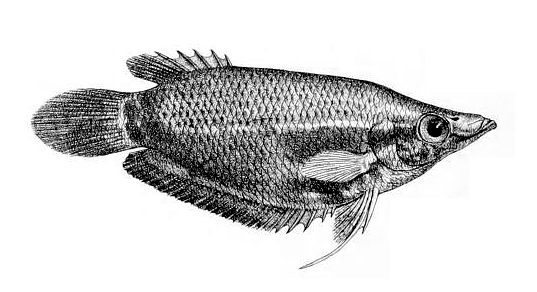
Females have slimmer heads and jaws than males. Males develop rounder jaws associated with mouth brooding.[12][13]
Males develop a cryptic marble pattern while carrying eggs.[14]
The species reaches a maximum recorded length of 10 cm.[15]
Habitat
The Frail Gourami inhabits clear, overgrown, slow-flowing waters and has also been recorded in habitats with little foliage and vegetation. It occurs in lakes, ponds, rivers, and streams.[16][17][18]
In Bangladesh, the species was observed in a shallow, slow-moving stream with clear water and a substrate of sand and organic detritus.[19]
In the Suthimari River basin of West Bengal, specimens were collected from moderately flowing water with suspended sediment and no aquatic vegetation. Collection took place in early September during the early afternoon.[20][21]
Recorded habitat temperatures range from 15 to 32 degrees Celsius. Habitats occupied by the species experience substantial seasonal changes in water conditions, volume, and flow.[22][23]
The species experiences seasonal monsoons in its native habitat during June and July.[24]
Diet
The Frail Gourami is described as a micro-predator.[25]
Behaviour
Juveniles exhibit social behaviour while growing. Mature individuals exhibit high aggression toward members of their own species and potentially other fish.[26][27]
Males substantially reduce or stop feeding while carrying eggs in their mouths during parental care.[28][29]
Classification of the Frail Gourami
| Kingdom | Animalia |
|---|---|
| Phylum | Chordata |
| Subphylum | Vertebrata |
| Infraphylum | Gnathostomata |
| Parvphylum | Osteichthyes |
| Gigaclass | Actinopterygii |
| Superclass | Actinopteri |
| Class | Teleostei (Teleost) |
| Order | Anabantiformes |
| Suborder | Anabantoidei |
| Family | Osphronemidae (Gourami) |
| Subfamily | Luciocephalinae |
| Genus | Ctenops |
| Species | Ctenops nobilis McClelland, 1845 |
Where the Frail Gourami is found
Checklists and occurrence records place Ctenops nobilis in 2 countries. GBIF holds 20 georeferenced records of it.
Countries
Regions and cities with the most records
A number beside a place is its count of GBIF occurrence records. A place without a number comes from a checklist alone. Records show where a species has been observed or collected, which can include escapes and vagrants.
Common names
English
- Frail Gourami
- Noble Gourami
Names in 1 other language
- Russian
- Нитеносец
Synonyms
2 other scientific names have been used for this species and are now treated as synonyms of Ctenops nobilis.
- Osphromenus nobilis (McClelland, 1845)
- Osphronemus nobilis (McClelland, 1845)
Related species
-
 Siamese Fighting FishBetta splendens
-
 Giant GouramiOsphronemus goramy
-
 Honey GouramiTrichogaster chuna
-
 Paradise FishMacropodus opercularis
-
 Dwarf GouramiTrichogaster lalius
-
 Three Spot GouramiTrichopodus trichopterus
-
 Pearl GouramiTrichopodus leerii
-
 Pygmy GouramiTrichopsis pumila
Compare
Questions and answers
What is the scientific name of the Frail Gourami?
The scientific name of the Frail Gourami is Ctenops nobilis. Written with its author, the full name is Ctenops nobilis McClelland, 1845.
Which family does the Frail Gourami belong to?
Ctenops nobilis belongs to the family Osphronemidae, in the order Anabantiformes and the class Teleostei.
Where is the Frail Gourami found?
Checklists and occurrence records place Ctenops nobilis in 2 countries: India and Bangladesh.
What is the conservation status of the Frail Gourami?
The IUCN Red List category recorded for Ctenops nobilis is Near Threatened (NT).
What other names does the Frail Gourami have?
Ctenops nobilis is also known in English as Noble Gourami.
Sources
Passages the profile rests on
- The species reproduces through mouth brooding. Source passage: “is a mouth brooding species of gourami” — English Wikipedia
- The female collects the eggs after laying them and transfers them from her mouth for the male to carry. Source passage: “The female, after laying the eggs, diligently collects every one of them and expels them from her mouth for the male to hold” — English Wikipedia
- The male holds the eggs with his anal fin before placing them in his mouth. Source passage: “for the male to hold with his anal fin and place in his mouth.” — English Wikipedia
- The egg-transfer process continues until all eggs have been laid. Source passage: “They continue this process until every egg is laid” — English Wikipedia
- The parents guard the breeding area during the egg-laying process. Source passage: “and guard the area at the same time.” — English Wikipedia
- The egg-holding ritual can continue for many hours. Source passage: “The ritual can last for many hours.” — English Wikipedia
- Eggs remain in the male's mouth for approximately 7–20 days. Source passage: “The eggs stay in his mouth for about 7–20 days” — English Wikipedia
- The male releases free-swimming fry after the mouth-brooding period. Source passage: “and then release free-swimming fry.” — English Wikipedia
- Young or inexperienced individuals learn how to hold eggs without swallowing them. Source passage: “as they gain knowledge of how to hold the eggs properly without swallowing them.” — English Wikipedia
- The species is only rarely represented in the aquarium trade. Source passage: “It is only seldom found in the aquarium trade” — English Wikipedia
- Ctenops nobilis is the only known member of its genus. Source passage: “The frail gourami is the only known member of its genus.” — English Wikipedia
- Females have slimmer heads and jaws than males. Source passage: “Females have a slimmer head and jaw shape compared to males.” — English Wikipedia
- Males develop a rounder jaw associated with mouth brooding. Source passage: “Males have a rounder jaw for mouth brooding (carrying eggs in the mouth).” — English Wikipedia
- Males develop a cryptic marble pattern while carrying eggs. Source passage: “The males are then the parental egg-bearer and gain a cryptic and strange marble patterning.” — English Wikipedia
- The species reaches a maximum recorded length of 10 cm. Source passage: “It grows to a length of 10 cm (3.9 in).” — English Wikipedia
- The species inhabits clear, overgrown, slow-flowing waters. Source passage: “These micro-predators live in the clear, overgrown, slow-flowing waters” — English Wikipedia
- The species has also been recorded in habitats with little foliage and vegetation. Source passage: “This adaptive species have also been recorded where foliage and vegetation is scarce.” — English Wikipedia
- The species occurs in lakes, ponds, rivers, and streams. Source passage: “found in lakes, ponds, rivers, and streams” — inaturalist.org
- In Bangladesh, the species was observed in a shallow, slow-moving stream with clear water and a substrate of sand and organic detritus. Source passage: “in a slow-moving, shallow stream containing clear water with a substrate of sand and organic detritus” — English Wikipedia
- In the Suthimari River basin of West Bengal, specimens were collected from moderately flowing water with suspended sediment and no aquatic vegetation. Source passage: “relatively clear, moderately-flowing water with some suspended sediment and there was no aquatic vegetation present.” — English Wikipedia
- The species has been collected in the Suthimari River basin of West Bengal in early September during the early afternoon. Source passage: “In the Suthimari River basin, West Bengal frail gouramis were collected in early September in the early afternoon” — English Wikipedia
- Recorded habitat temperatures range from 15 to 32 degrees Celsius. Source passage: “Temperatures range from 59–90 degrees Fahrenheit, or 15–32 degrees Celsius” — English Wikipedia
- Habitats occupied by the species experience substantial seasonal changes in water conditions, volume, and flow. Source passage: “Its habitats are subject to severe seasonal changes in water change, volume, and flow.” — English Wikipedia
- The species experiences seasonal monsoons in its native habitat during June and July. Source passage: “during the months of June and July, monsoons are common.” — English Wikipedia
- The species is described as a micro-predator. Source passage: “These micro-predators live in the clear, overgrown, slow-flowing waters” — English Wikipedia
- Juveniles exhibit social behaviour while growing. Source passage: “As these fish grow as juveniles, socialization is shown” — English Wikipedia
- Mature individuals exhibit high aggression toward members of their own species and potentially other fish. Source passage: “with high levels of aggression to others of their kind and potentially other fish as well.” — English Wikipedia
- The male carries eggs in its mouth during parental care. Source passage: “The males are then the parental egg-bearer” — English Wikipedia
- Males substantially reduce or stop feeding while carrying eggs. Source passage: “Feeding then is greatly reduced in the male, or ceases altogether.” — English Wikipedia
Data
- Catalogue of Life, 2026-10-16 XR cc by
- Global Biodiversity Information Facility CC BY 4.0
- Wikidata CC0
- GeoNames CC BY 4.0
- Wikimedia Commons per image; credit shown with each image
- Within the Catalogue of Life, this name comes from World Register of Marine Species cc by
References
- McClelland, J. (1845). Description of four species of fishes from the rivers at the foot of the Boutan Mountains. Calcutta Journal of Natural History, v. 5 (no. 18): 274–282. where the name was published
This species in other databases
- Catalogue of Life 326SM
- Wikidata Q523125
- iNaturalist 98773
- WoRMS urn:lsid:marinespecies.org:taxname:280455
- ITIS 638745
Page built on 28 November 2026. See how the catalog is made and all sources and licences.
Cite this page
ScientificNames.org. (2026). Ctenops nobilis (Frail Gourami). Retrieved November 28, 2026, from https://scientificnames.org/species/ctenops-nobilis
“Ctenops nobilis (Frail Gourami).” ScientificNames.org, 2026, scientificnames.org/species/ctenops-nobilis. Accessed 28 Nov. 2026.
ScientificNames.org. “Ctenops nobilis (Frail Gourami).” Accessed November 28, 2026. https://scientificnames.org/species/ctenops-nobilis.
@misc{scientificnames_ctenops_nobilis_frail_gourami,
  author = {{ScientificNames.org}},
  title = {Ctenops nobilis (Frail Gourami)},
  year = {2026},
  url = {https://scientificnames.org/species/ctenops-nobilis},
  note = {Accessed 2026-11-28}
}