| Appearance | - The dhole has a reddish coat, with the brightest coloration occurring during winter. English Wikipedia
- The dhole's winter coat has a rusty-red back with brownish highlights on the head, neck and shoulders. English Wikipedia
- The dhole's lower limbs are whitish and have dark brownish bands on their front surfaces. English Wikipedia
- The dhole has a fluffy reddish-ocher tail with a dark brown tip. English Wikipedia
- The dhole's summer coat is shorter, coarser and darker than its winter coat. English Wikipedia
- Adult dhole dorsal and lateral guard hairs measure 20–30 mm long. English Wikipedia
- The dhole has a broad skull, a prominent sagittal crest and strongly developed masseter muscles. English Wikipedia
- The dhole has six lower cheek teeth rather than seven. English Wikipedia
- The dhole's upper molars have a single internal cusp. English Wikipedia
- The dhole has a rusty-red coat and a pale underside. animaldiversity.org
- Newborn dholes have sooty-brown coloration that changes to adult coloration by three months of age. animaldiversity.org
- Dholes generally have dark, bushy tails that are almost always black. animaldiversity.org
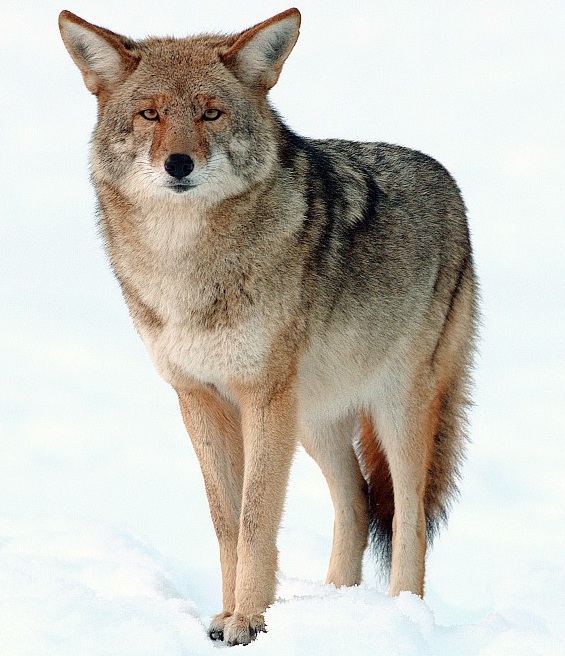
| - The coyote typically has a coat combining light gray, reddish or fulvous, black, and white coloration. English Wikipedia
- Coyotes have pointed ears, a narrow muzzle, and a bushy tail with a black tip. nps.gov
- Coyotes generally have a grey-brown coat with black-tipped hairs along their backs. nps.gov
- The coyote has longer ears and a relatively larger braincase than the gray wolf. English Wikipedia
- Coyotes carry their tails downward when walking or running. English Wikipedia
|
|---|
| Size | | - Male coyotes typically weigh between 8 and 20 kg. English Wikipedia
- Female coyotes typically weigh between 7 and 18 kg. English Wikipedia
- Adult coyotes have an average total body length, including the tail, of 1.0 to 1.35 m. English Wikipedia
- The coyote's tail measures approximately 40 cm in length. English Wikipedia
- The average shoulder height of coyotes ranges from 18 to 23 inches. nps.gov
- Coyotes average approximately 20 to 35 pounds in weight according to the Jewel Cave National Monument account. nps.gov
- Northern coyote subspecies average approximately 18 kg, compared with 11.5 kg for southern Mexican subspecies. English Wikipedia
|
|---|
| Habitat | - Dholes primarily inhabit forested areas in alpine zones in India, Myanmar, Indochina, Indonesia and China. English Wikipedia
- Dholes occur in dense forest steppes and thick jungle habitats in plains and hills. animaldiversity.org
- Dholes use jungle roads, riverbeds, clearings and paths as resting places during the day. animaldiversity.org
- Dholes construct their dens near streambeds or among rocks. animaldiversity.org
- Dholes have been recorded at elevations of approximately 2,500–4,000 m in Yanchiwan National Nature Reserve, China. English Wikipedia
| |
|---|
| Diet | - Wild sambar deer and chital were the principal dhole prey by biomass in the studied Central Indian landscape, contributing 61.08% and 19.08%, respectively. pmc.ncbi.nlm.nih.gov
- Sambar and chital accounted for 39.28% and 13.83%, respectively, of the prey consumed by number in the Central Indian study. pmc.ncbi.nlm.nih.gov
- Dholes preferentially hunt large and medium-sized ungulates. English Wikipedia
- Dholes prey on deer and wild cattle through cooperative hunting. wildlife.cornell.edu
- Dholes eat wild berries, insects and lizards. animaldiversity.org
- Dhole packs prey on mammals ranging from rodents to deer. animaldiversity.org
- Wild pigs, hares, wild goats, sheep and occasionally monkeys are among the dhole's preferred prey. animaldiversity.org
| - Coyotes preferentially prey on Dall's sheep, white-tailed deer, eastern cottontail rabbits, and California voles. pmc.ncbi.nlm.nih.gov
- Coyotes avoid preying on small mammals, including carnivorans and arboreal species. pmc.ncbi.nlm.nih.gov
- Coyotes consume deer, rabbits, hares, rodents, birds, reptiles, amphibians, fish, and invertebrates. English Wikipedia
- Coyotes occasionally consume fruits and vegetables. English Wikipedia
- Coyotes in the southern United States may consume more frogs than coyotes in other regions. nps.gov
- Coyotes in the Yukon may consume more berries. nps.gov
- Vegetation consumption by coyotes is greatest during summer and autumn. research.fs.usda.gov
|
|---|
| Behaviour | - Dholes are highly social animals that live in clans containing multiple breeding females. English Wikipedia
- Dhole clans usually contain approximately 12 individuals, although groups exceeding 40 individuals have been recorded. English Wikipedia
- Dholes are diurnal pack hunters. English Wikipedia
- Dholes use vocalizations, calls and whistles to maintain contact and social cohesion within their packs. wildlife.cornell.edu
- Dholes are particularly fond of water and sometimes sit in shallow pools. animaldiversity.org
- Dhole packs cooperate in hunting and caring for their young. animaldiversity.org
- Dholes generally show little aggression toward members of their own packs. animaldiversity.org
- Dholes generally retreat when they see a person. animaldiversity.org
| - Coyotes can live either in family units or in loosely organized packs of unrelated individuals. English Wikipedia
- Coyotes can hunt either individually or in groups. pmc.ncbi.nlm.nih.gov
- Coyotes may form groups of five to six adults under favorable conditions. nps.gov
- Coyote packs containing more than ten animals have been observed. nps.gov
- Coyotes may establish and defend territories or survive as nonterritorial transient individuals. pmc.ncbi.nlm.nih.gov
- Coyotes characteristically produce howls that rapidly change in tone and pitch. English Wikipedia
|
|---|
| Reproduction | | |
|---|
| Distribution | No checked fact yet | - Coyotes are native to North America. English Wikipedia
- Coyotes occur throughout North and Central America. animaldiversity.org
- Coyotes have expanded their geographic range by approximately 40 percent over the past 120 years. research.fs.usda.gov
- Coyotes currently occur in every US state except Hawaii and extend as far north as the Arctic. nps.gov
- Coyotes were first sighted in eastern Panama in 2013. English Wikipedia
|
|---|
| Conservation | - The dhole is classified as Endangered on the IUCN Red List. English Wikipedia
- The global dhole population is estimated to contain fewer than 2,500 mature individuals. English Wikipedia
- Dhole populations are decreasing. English Wikipedia
- Habitat loss, prey depletion, competition, persecution and disease transmission from domestic dogs contribute to dhole population declines. English Wikipedia
- Dholes have lost approximately 82% of their original range. pmc.ncbi.nlm.nih.gov
- Dholes are susceptible to rabies, canine distemper virus and sarcoptic mange. wildlife.cornell.edu
- Domestic dog distemper outbreaks have coincided with local declines in dhole numbers. wildlife.cornell.edu
| - The coyote is classified as Least Concern by the International Union for Conservation of Nature. English Wikipedia
- Human persecution is a major cause of coyote mortality. nps.gov
- Trapping for their pelts is one of the major causes of coyote mortality throughout their range. nps.gov
- Coyotes have expanded their range despite substantial persecution related to actual or perceived livestock predation. pmc.ncbi.nlm.nih.gov
|
|---|
| Name origin | No checked fact yet | |
|---|