Comparison
Jimsonweed vs Hairy Thorn-apple
Jimsonweed (Datura stramonium) and Hairy Thorn-apple (Datura wrightii) both belong to the genus Datura (jimsonweed) and part ways below it. Both are recorded in 5 countries.
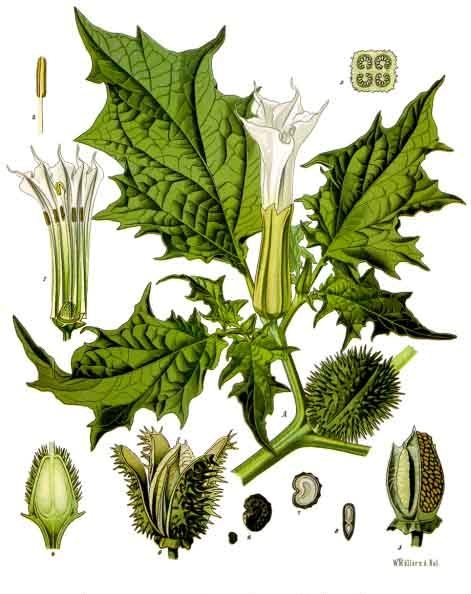
Jimsonweed
Datura stramonium
Franz Eugen Köhler, Köhler's Medizinal-Pflanzen, Public domain, via Wikimedia Commons


Side by side
| Jimsonweed | Hairy Thorn-apple | |
|---|---|---|
| Scientific name | Datura stramonium L. | Datura wrightii Regel |
| English name | Jimsonweed | Hairy Thorn-apple |
| Group | Flowering plants | Flowering plants |
| Class | Magnoliopsida | Magnoliopsida |
| Order | Solanales | Solanales |
| Family | Solanaceae Nightshades | Solanaceae Nightshades |
| Genus | Datura Jimsonweed | Datura Jimsonweed |
| Countries on record | 149 countries | 5 countries |
| GBIF occurrence records | 176,154 records | 38,136 records |
Rows where the two agree are shown in grey.
Where each is found
Both recorded in 5 countries
Only Jimsonweed (144)
- Afghanistan
- Albania
- Algeria
- Andorra
- Angola
- Anguilla
- Argentina
- Armenia
- Australia
- Austria
- Bahamas
- Barbados
- Belarus
- Belgium
- Belize
- Benin
- Bermuda
- Bhutan
- Bolivia
- Bonaire, Saint Eustatius and Saba
- Brazil
- Bulgaria
- Cabo Verde
- Central African Republic
- Chad
- Chile
- China
- Colombia
- Costa Rica
- Croatia
- Cuba
- Cyprus
- Czechia
- Denmark
- Dominican Republic
- Ecuador
- Egypt
- El Salvador
- Estonia
- Eswatini
- Ethiopia
- Fiji
- France
- French Guiana
- Georgia
- Germany
- Ghana
- Gibraltar
- Guadeloupe
- Guatemala
- Guernsey
- Guinea
- Haiti
- Honduras
- Hungary
- India
- Iran
- Iraq
- Ireland
- Israel
- Italy
- Ivory Coast
- Jamaica
- Japan
- Jersey
- Kazakhstan
- Kenya
- Kosovo
- Kyrgyzstan
- Laos
- Latvia
- Lebanon
- Lesotho
- Libya
- Liechtenstein
- Lithuania
- Luxembourg
- Madagascar
- Malawi
- Mali
- Malta
- Martinique
- Mauritania
- Mauritius
- Montenegro
- Montserrat
- Morocco
- Mozambique
- Myanmar
- Namibia
- Nepal
- New Caledonia
- New Zealand
- Nicaragua
- Nigeria
- North Macedonia
- Norway
- Pakistan
- Panama
- Peru
- Poland
- Portugal
- Puerto Rico
- Romania
- Russia
- Saint Barthelemy
- Saint Helena
- Saint Kitts and Nevis
- San Marino
- Saudi Arabia
- Serbia
- Seychelles
- Slovakia
- Slovenia
- South Africa
- South Korea
- South Sudan
- Sri Lanka
- Sudan
- Sweden
- Switzerland
- Syria
- Taiwan
- Tajikistan
- Tanzania
- Thailand
- The Netherlands
- Togo
- Tonga
- Trinidad and Tobago
- Tunisia
- Turkey
- Turkmenistan
- Turks and Caicos Islands
- U.S. Virgin Islands
- Uganda
- Ukraine
- United Arab Emirates
- United Kingdom
- Uzbekistan
- Venezuela
- Yemen
- Zambia
- Zimbabwe
From Catalogue of Life checklists and GBIF occurrence records. A country missing from a list means no record is held, which is not proof of absence.
Checked facts
| Jimsonweed | Hairy Thorn-apple | |
|---|---|---|
| Appearance |
| No checked fact yet |
| Habitat |
| No checked fact yet |
| Behaviour |
| No checked fact yet |
| Reproduction |
| No checked fact yet |
| Distribution |
| No checked fact yet |
| Conservation |
| No checked fact yet |
| Uses |
| No checked fact yet |
| Name origin |
| No checked fact yet |
| Other |
| No checked fact yet |
In brief
Jimsonweed
Datura stramonium L. is an annual flowering herb in the family Solanaceae, commonly called jimsonweed. It is native to Central America and grows wild in warm and temperate regions worldwide. It is distinguished by its fragrant, trumpet-shaped flowers and spiny seed capsules containing numerous black seeds. Full profile
Compare something else
Page built on 24 November 2026 from the data on the two species pages, where every source is listed.
Cite this page
ScientificNames.org. (2026). Jimsonweed vs Hairy Thorn-apple. Retrieved November 24, 2026, from https://scientificnames.org/compare/jimsonweed-vs-hairy-thorn-apple
“Jimsonweed vs Hairy Thorn-apple.” ScientificNames.org, 2026, scientificnames.org/compare/jimsonweed-vs-hairy-thorn-apple. Accessed 24 Nov. 2026.
ScientificNames.org. “Jimsonweed vs Hairy Thorn-apple.” Accessed November 24, 2026. https://scientificnames.org/compare/jimsonweed-vs-hairy-thorn-apple.
@misc{scientificnames_jimsonweed_vs_hairy_thorn_apple,
  author = {{ScientificNames.org}},
  title = {Jimsonweed vs Hairy Thorn-apple},
  year = {2026},
  url = {https://scientificnames.org/compare/jimsonweed-vs-hairy-thorn-apple},
  note = {Accessed 2026-11-24}
}