Species · Flowering plants
Jimsonweed Datura stramonium
The scientific name of the Jimsonweed is Datura stramonium. It is a species of flowering plant in the family Solanaceae (nightshades), order Solanales.
- Scientific name
- Datura stramonium L.
- Common name
- Jimsonweed
- Genus
- Datura
- Family
- Solanaceae (Nightshades)
- Order
- Solanales
- Class
- Magnoliopsida
- Recorded in
- 149 countries
- Name status
- accepted in the Catalogue of Life
Overview
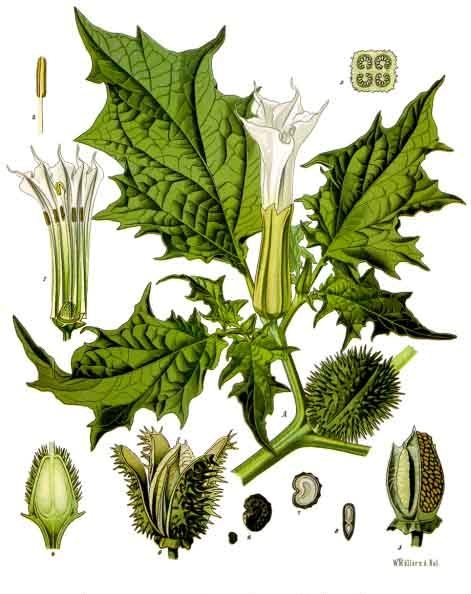
Datura stramonium L. is an annual flowering herb in the family Solanaceae, commonly called jimsonweed. It is native to Central America and grows wild in warm and temperate regions worldwide. It is distinguished by its fragrant, trumpet-shaped flowers and spiny seed capsules containing numerous black seeds.
Written 24 November 2026 from the sources listed below. Each statement was checked against the passage it cites; statements that could not be supported were removed.
Habitat
Jimsonweed occurs in waste ground and cultivated land and prefers nitrogen-enriched habitats. It grows along roadsides and in old fields, pastures, barnyards, hog lots, waste places, and gardens.[1][2]
The species also occurs around livestock enclosures enriched with dung. In Europe, it grows as a weed in garbage dumps and wastelands.[3][4]
Jimsonweed is native to Central America and has become naturalized in parts of the Old World following its early introduction. It grows wild in warm and temperate regions worldwide and is reported from almost everywhere in the United States except the North and West, with its greatest prevalence in the South.[5][6][7][8]
Behaviour
The flowers generally open at night and emit a pleasant fragrance. Nocturnal moths feed on the flowers.[9][10]
The plant's strong unpleasant odor and taste discourage animals from grazing it when alternative forage is available.[11]
Reproduction and life cycle
Jimsonweed produces egg-shaped seed capsules measuring approximately 3 to 8 cm in diameter. When mature, the capsules split into four chambers containing dozens of small black seeds each, or split into four segments and scatter numerous poisonous black, kidney-shaped seeds.[12][13][14]
The seeds are thought to be dispersed by birds through their droppings. They can remain dormant underground for years and germinate following soil disturbance.[15][16]
Conservation
Jimsonweed is described as an aggressive invasive weed in temperate and tropical climates worldwide.[17]
Uses
Jimsonweed has frequently been used in traditional medicine to treat various ailments. Atropine obtained from the plant has been used in treatments for Parkinson's disease, peptic ulcers, diarrhea, and bronchial asthma.[18][19]
The plant has been used as a hallucinogen to induce intense visionary experiences. Native Americans and other groups have used it for ceremonial and spiritual purposes.[20][21]
Classification of the Jimsonweed
| Kingdom | Plantae |
|---|---|
| Subkingdom | Pteridobiotina |
| Phylum | Tracheophyta |
| Class | Magnoliopsida |
| Order | Solanales |
| Family | Solanaceae (Nightshades) |
| Subfamily | Solanoideae |
| Tribe | Datureae |
| Genus | Datura (Jimsonweed) |
| Species | Datura stramonium L. |
Where the Jimsonweed is found
Checklists and occurrence records place Datura stramonium in 149 countries across Africa, Asia, Europe, North America, Oceania and South America. GBIF holds 176,154 georeferenced records of it.
Countries where it is native or its origin is not stated
- Bermuda 7
- El Salvador 12
- Guatemala 49
- Mexico 2,614
- New Zealand 540
- Russia 711
- Saint Barthelemy 4
- Saint Kitts and Nevis 5
- The Netherlands 23,957
- Turks and Caicos Islands 3
- U.S. Virgin Islands 9
Countries where it has been introduced
- Afghanistan 29
- Albania 57
- Algeria 63
- Andorra 7
- Angola 17
- Anguilla 2
- Argentina 100
- Armenia 30
- Australia 2,207
- Austria 2,505
- Bahamas 7
- Barbados 2
- Belarus 86
- Belgium 20,633
- Belize 1
- Benin 23
- Bhutan 40
- Bolivia 470
- Bonaire, Saint Eustatius and Saba 6
- Brazil 645
- Bulgaria 121
- Cabo Verde 14
- Canada 616
- Central African Republic 12
- Chad 3
- Chile 419
- China 1,794
- Colombia 128
- Costa Rica 13
- Croatia 234
- Cuba 25
- Cyprus 12
- Czechia 1,973
- Denmark 896
- Dominican Republic 22
- Ecuador 485
- Egypt 35
- Estonia 51
- Eswatini 10
- Ethiopia 490
- Fiji 2
- France 37,029
- French Guiana 2
- Georgia 143
- Germany 15,067
- Ghana 10
- Gibraltar 2
- Greece 280
- Guadeloupe 8
- Guernsey 11
- Guinea 11
- Haiti 10
- Honduras 18
- Hungary 1,014
- India 240
- Iran 35
- Iraq 10
- Ireland 7
- Israel 587
- Italy 2,472
- Ivory Coast 9
- Jamaica 17
- Japan 295
- Jersey 16
- Kazakhstan 37
- Kenya 749
- Kosovo 5
- Kyrgyzstan 53
- Laos 4
- Latvia 12
- Lebanon 13
- Lesotho 55
- Libya 9
- Liechtenstein 6
- Lithuania 41
- Luxembourg 128
- Madagascar 75
- Malawi 37
- Mali 3
- Malta
- Martinique 8
- Mauritania 3
- Mauritius 1
- Montenegro 34
- Montserrat 3
- Morocco 122
- Mozambique 15
- Myanmar 3
- Namibia 47
- Nepal 162
- New Caledonia 8
- Nicaragua 49
- Nigeria 13
- North Macedonia 11
- Norway 611
- Pakistan 63
- Panama 1
- Peru 269
- Poland 1,303
- Portugal 2,893
- Puerto Rico 8
- Romania 1,922
- Saint Helena 9
- San Marino
- Saudi Arabia 25
- Serbia 135
- Seychelles
- Slovakia 1,095
- Slovenia 82
- South Africa 2,013
- South Korea 225
- South Sudan
- Spain 8,656
- Sri Lanka 1
- Sudan 16
- Sweden 5,395
- Switzerland 2,074
- Syria 2
- Taiwan 23
- Tajikistan 9
- Tanzania 437
- Thailand 4
- Togo 3
- Tonga 8
- Trinidad and Tobago 1
- Tunisia 9
- Turkey 286
- Turkmenistan 11
- Uganda 165
- Ukraine 584
- United Arab Emirates 1
- United Kingdom 9,833
- United States 16,637
- Uzbekistan 54
- Venezuela 18
- Yemen 16
- Zambia 30
- Zimbabwe 32
Regions and cities with the most records
- England, United Kingdom 8,597
- Centre-Val de Loire, France 5,345
- Gelderland, The Netherlands 5,024
- Occitanie, France 4,794
- Auvergne-Rhône-Alpes, France 4,744
- Haarlem, The Netherlands 4,260
- Hoofddorp, The Netherlands 4,190
- Leiden, The Netherlands 4,079
- Catalonia, Spain 3,415
- Nijmegen, The Netherlands 3,369
- Île-de-France, France 2,927
- Delft, The Netherlands 2,908
- North Rhine-Westphalia, Germany 2,897
- Rijswijk, The Netherlands 2,858
- Arnhem, The Netherlands 2,837
- The Hague, The Netherlands 2,784
- Pays de la Loire, France 2,758
- Mechelen, Belgium 2,650
- Gent, Belgium 2,594
- Borgerhout, Belgium 2,447
- Antwerp, Belgium 2,436
- Beveren, Belgium 2,422
- Deurne, Belgium 2,384
- Sint-Niklaas, Belgium 2,300
- Merksem, Belgium 2,214
- Bavaria, Germany 2,186
- Bourgogne-Franche-Comté, France 2,152
- Dendermonde, Belgium 2,141
- Hauts-de-France, France 2,066
- Jette, Belgium 2,041
- Zoetermeer, The Netherlands 2,037
- Schaerbeek, Belgium 2,024
- Lower Saxony, Germany 1,956
- Woluwe-Saint-Lambert, Belgium 1,935
- Aalst, Belgium 1,930
- Brussels, Belgium 1,902
26 more countries have a few records outside this range
These countries hold a few records of Datura stramonium but lie outside the range the checklists give for it. Such records are often zoo or garden specimens, museum material or vagrants, so the species is not counted as occurring there.
- Azerbaijan 15
- Bosnia and Herzegovina 37
- Botswana 21
- Burundi 13
- Cameroon 21
- Democratic Republic of the Congo 61
- Equatorial Guinea 7
- Eritrea 9
- Finland 271
- Hong Kong 9
- Indonesia 9
- Isle of Man 53
- Jordan 6
- Kuwait 38
- Moldova 25
- Niger 6
- Norfolk Island 7
- North Korea 6
- Oman 4
- Palestinian Territory 10
- Paraguay 3
- Reunion 12
- Rwanda 62
- Senegal 3
- Somalia 17
- Uruguay 4
Range as the checklists state it
England [I] (England [I], Wales [I], Isle of Man [I], Scotland [I], Orkney Isl. [I], Isles of Scilly [I]); Ireland [I] (Ireland [I], Northern Ireland [I]); Denmark [I]; Norway [I]; Sweden [I]; Netherlands [I]; Belgium [I]; Luxembourg [I]; Germany [I]; Switzerland [I]; Liechtenstein [I]; Austria [I]; Poland [I]; Czech Republic [I]; Slovakia [I]; Hungary [I]; Portugal [I]; Spain [I]; Andorra [I]; Gibraltar [I]; France [I]; Channel Isl. [I] (Alderney [I], Guernsey [I], Jersey [I], Sark [I]); Corsica [I]; Sardinia [I]; Italy [I]; Sicily [I]; Malta [I]; San Marino [I]; Slovenia [I]; Croatia [I]; Bosnia & Hercegovina [I]; Montenegro [I]; Serbia [I]; Kosovo [I]; North Macedonia [I]; Albania [I]; Romania [I]; Bulgaria [I]; European Turkey [I]; Greece [I]; Crete [I]; Estonia [I]; Latvia [I]; Lithuania [I]; Belarus [I]; European Russia [I]; European Russia [I]; Ukraine [I]; Crimea [I]; Morocco [I]; Algeria [I]; Tunisia [I]; Libya [I]; Egypt [I] (Nile Delta [I], Nile Valley [I], NW-coastal Egypt [I]); Azores [I] (Santa Maria Isl. [I], Sao Miguel Isl. [I], Terceira [I], Graciosa [I], Sao Jorge [I], Pico [I], Faial [I], Corvo Isl. [I]); Madeira [I] (Madeira Isl. [I], Porto Santo Isl. [I]); Canary Isl. [I] (Fuerteventura [I], Gran Canaria [I], Tenerife [I], La Gomera [I], La Palma [I]); Cape Verde Isl. [I] (Santo Antao Isl. [I], Ilha de Sao Nicolau [I], Sal Isl. [I], Ilha da Boa Vista [I], Ilha de Maio [I], Ilha de Sao Tiago [I], Fogo Isl. [I], Ilha Brava [I]); Mauritania [I]; Guinea [I]; Mali [I]; Ivory Coast [I]; Ghana [I]; Togo [I]; Benin [I]; Nigeria [I]; Congo [Brazzaville] [I]; Central African Republic [I]; Chad [I]; Sudan [I]; South Sudan [I]; Ethiopia [I]; Uganda [I]; Kenya [I]; Tanzania [I]; Angola [I]; Zambia [I]; Malawi [I]; Zimbabwe [I]; Mozambique [I]; Namibia [I]; South Africa [I] (widespread); Lesotho [I]; Eswatini [Swaziland] [I]; Ascension Isl. [I]; St. Helena [I]; Madagascar [I]; Mauritius [I]; La Réunion [I]; Agalega Isl. [I]; Seychelles [I]; Siberia [I] (Altay [I], W-Siberia [I]); Russian Far East [I] (Primorye [I]); Kazakhstan [I]; Turkmenistan [I]; Uzbekistan [I]; Kyrgyzstan [I]; Tajikistan [I]; Northern Caucasus [I]; Northern Caucasus [I]; Georgia [Caucasus] [I]; Armenia [I]; East Aegaean Isl. [I] (incl. Rhodos [I]); Turkey [I] (E-Anatolia [I], Inner Anatolia [I], N-Anatolia [I], NE-Anatolia [I], SE-Anatolia [I], SSW-Anatolia [I], W-Anatolia [I], WN-Anatolia [I]); Iraq [I] (NW-Iraq [I]); Iran [I] (E-Iran [I], NE-Iran: Mts. [I], N-Iran [I], Iranian Aserbaijan [I], W-Iran [I]); Afghanistan [I]; Cyprus [I] (C-Mountains [I], E-Cyprus [I], N-Cyprus [I]); Lebanon [I] (Antilebanon [I], C-Lebanon [I], coastal W-Lebanon [I]); Syria [I] (coastal W-Syria [I]); Israel [I] (Rift Valley [I], N-Israel [I]); Saudi Arabia [I] (C-Saudi Arabia [I], NE-Saudi Arabia [I], N-Saudi Arabia [I], Nafud Desert [I], Hejaz [I], Asir [I], Nejd Desert [I]); United Arab Emirates [I]; Yemen [I] (N-Inner Yemen [I], SW-Yemen [I], Tihama [I], W-Yemen [I]); China [I]; South Korea [I]; Japan [I]; Taiwan [I]; Pakistan [I]; Nepal [I]; Bhutan [I]; India [I] (throughout); Sri Lanka [I]; Nicobar Isl. [I] (Central Nicobar Isl. [I], Great Nicobar Isl. [I], Little Nicobar Isl. [I]); Myanmar [I]; Thailand [I]; Laos [I]; Jawa [I]; Australia [I] (Western Australia [I], South Australia [I], Queensland [I], New South Wales [I], Victoria [I], Tasmania [I]); Lord Howe Isl. [I]; Norfolk Isl. [I]; New Caledonia [I]; Tonga [I] (Vava'u [I]); Fiji [I]; Hawaii [I] (Kauai [I], Oahu [I], Molokai [I], Maui [I], Hawaii Isl. [I]); Canada [I] (Alberta [I], British Columbia [I], Manitoba [I], New Brunswick [I], Nova Scotia [I], Ontario [I], Prince Edward Isl. [I], Québec [I], Saskatchewan [I]); USA [I] (Alabama [I], Arkansas [I], Arizona [I], California [I], Colorado [I], Connecticut [I], District of Columbia [I], Delaware [I], Florida [I], Georgia [I], Iowa [I], Idaho [I], Illinois [I], Indiana [I], Kansas [I], Kentucky [I], Louisiana [I], Massachusetts [I], Maryland [I], Maine [I], Michigan [I], Minnesota [I], Missouri [I], Mississippi [I], Montana [I], North Carolina [I], North Dakota [I], Nebraska [I], New Hampshire [I], New Jersey [I], New Mexico [I], Nevada [I], New York [I], Ohio [I], Oklahoma [I], Oregon [I], Pennsylvania [I], Rhode Island [I], South Carolina [I], South Dakota [I], Tennessee [I], Texas [I], Utah [I], Virginia [I], Vermont [I], Washington State [I], Wisconsin [I], West Virginia [I]); Mexico (Aguascalientes, Baja California Sur, Chiapas, Chihuahua, Coahuila, Colima, Ciudad de Mexico, Durango, Guanajuato, Guerrero, Hidalgo, Jalisco, México State, Michoacán, Morelos, Nayarit, Nuevo León, Oaxaca, Puebla, Queretaro, Quintana Roo, San Luis Potosí, Sinaloa, Sonora, Tabasco, Tamaulipas, Tlaxcala, Veracruz, Zacatecas); Belize [I]; Honduras [I]; Nicaragua [I]; Costa Rica [I]; Panama [I]; Bahamas [I]; Turks & Caicos Isl. [I]; Cuba [I]; Jamaica [I]; Dominican Republic [I]; Haiti [I]; Puerto Rico [I]; Virgin Isl. [I]; Anguilla [I]; St. Barthélémy [I]; St. Kitts [I]; Antigua [I]; Montserrat [I]; Guadeloupe [I]; Martinique [I]; St. Vincent [I]; Barbados [I]; Trinidad & Tobago [I]; Bonaire [I]; Colombia [I]; Venezuela [I]; ?French Guiana[I]; Ecuador [I]; Galápagos [I]; Galápagos [I]; Peru [I]; Bolivia [I]; Brazil [I]; Argentina [I] (Córdoba [I], Corrientes [I], Entre Rios [I], Neuquén [I], Rio Negro [I], Santiago del Estero [I], Santa Fe Prov. [I]); Chile [I] (Arica y Parinacota [I], Tarapacá [I], Antofagasta [I], Atacama [I], Coquimbo [I], Valparaíso [I], Metropolitana de Santiago [I], O'Higgins [I], Maule [I], Ñuble [I], Biobío [I], Araucanía [I]); Juan Fdz. Isl. [I]
A number beside a place is its count of GBIF occurrence records. A place without a number comes from a checklist alone. Records show where a species has been observed or collected, which can include escapes and vagrants.
Common names
English
- Jimsonweed
- Fireweed
- Jamestown Weed
- Thorn-Apple
- Common Thorn-apple
- False Castor-oil
- Moonflower
- Purple Thorn-apple
Names in 13 other languages
- Afrikaans
- gewone stinkblaar
- Chinese
- man tuo luo
- Danish
- Almindelig engletrompet, Pigæble
- Dutch
- Doornappel
- Finnish
- okahulluruoho
- French
- datura stramoine, dature, herbe aux sorciers, herbe des taupes, pomme épineuse, stramoine, stramoine commune
- German
- Stechapfel, Weißer Stechapfel
- Italian
- indormia, stramonio comune
- Norwegian Bokmål
- piggeple
- Portuguese
- estramónio, figueira-do-diabo
- Spanish
- datura manzana, tapa, toloache
- Swedish
- slät violspikklubba, spikklubba, violspikklubba
- Welsh
- Afal Dreiniog, Afalau Dreiniog, Dalen Meiwyn, Meiwyn
Synonyms
38 other scientific names have been used for this species and are now treated as synonyms of Datura stramonium.
- Datura bernhardii Lundstr.
- Datura bertolonii Parl. ex Guss.
- Datura cabanesii P.Fourn.
- Datura capensis Bernh.
- Datura ferocissima Cabanès & P.Fourn.
- Datura hybrida Ten.
- Datura inermis Juss. ex Jacq.
- Datura loricata Sieber ex Bernh.
- Datura lurida Salisb.
- Datura microcarpa Godr.
- Datura parviflora Salisb.
- Datura praecox Godr.
- Datura pseudostramonium Sieber ex Bernh.
- Datura stramonium Wall.
- Datura stramonium Thunb.
- Datura stramonium Vell.
- Datura stramonium f. godronii (Danert) Geerinck & Walravens
- Datura stramonium f. inermis (Juss. ex Jacq.) Hupke
- Datura stramonium var. canescens Wall.
- Datura stramonium var. chalybaea W.D.J.Koch
- Datura stramonium var. godronii Danert
- Datura stramonium var. gordonii Danert
- Datura stramonium var. inermis (Juss. ex Jacq.) C.E.Lundstr.
- Datura stramonium var. inermis (Juss.) Fernald
- Datura tatula var. tatula
- Datura wallichii Dunal
- Stramonium foetidum Scop.
- Stramonium globosum Bubani
- Stramonium laeve Moench
- Stramonium spinosum Gilib.
- Stramonium spinosum Lam.
- Stramonium vulgare Hill
- Stramonium vulgare Moench
- Stramonium vulgatum Gaertn.
- Datura ferox Nees ambiguous synonym
- Datura laevis L.fil. ambiguous synonym
- Datura laevis Schkuhr ambiguous synonym
- Datura muricata Godr. ambiguous synonym
Subspecies and varieties
- Datura stramonium var. stramonium variety
- Datura stramonium var. tatula variety
Related species
-
 Hairy Thorn-appleDatura wrightii
-
 MetelDatura metel
-
 Angel's-TrumpetsDatura ferox
-
 Oak-leaf DaturaDatura quercifolia
- Swamp DaturaDatura ceratocaula
- FireweedDatura innoxia
- Pruinose Thorn AppleDatura pruinosa
- Datura discolor
Compare
Questions and answers
What is the scientific name of the Jimsonweed?
The scientific name of the Jimsonweed is Datura stramonium. Written with its author, the full name is Datura stramonium L..
Which family does the Jimsonweed belong to?
Datura stramonium belongs to the family Solanaceae, in the order Solanales and the class Magnoliopsida.
Where is the Jimsonweed found?
Checklists and occurrence records place Datura stramonium in 149 countries, including The Netherlands, Mexico, Russia, New Zealand, Guatemala and El Salvador.
What other names does the Jimsonweed have?
Datura stramonium is also known in English as Fireweed, Jamestown Weed, Thorn-Apple, Common Thorn-apple, False Castor-oil and Moonflower.
Is fireweed toxic to humans?
All parts of jimsonweed contain dangerous levels of tropane alkaloids, including atropine, hyoscyamine, and scopolamine. The seeds, fruits, and leaves contain the highest levels of alkaloids and are common sources of poisoning. Human poisoning can result from consuming the seeds or sucking nectar from the flowers.[22][23][24]
What is special about fireweed?
Jimsonweed has large, fragrant, trumpet-shaped flowers that generally open at night. Its spiny seed capsules split into four segments and scatter numerous poisonous black seeds.[9][25][14][26]
How invasive is fireweed?
Jimsonweed is described as an aggressive invasive weed in temperate and tropical climates worldwide.[17]
Where did fireweed get its name?
The common name jimsonweed derives from the name of Jamestown, Virginia. The genus name Datura derives from the Hindi word dhatūra, ultimately originating from Sanskrit dhattūra.[27][28]
What is the habitat of Datura stramonium?
Jimsonweed occurs in waste ground and cultivated land, preferring nitrogen-enriched habitats. It grows along roadsides, in old fields, pastures, barnyards, hog lots, waste places, gardens, and around livestock enclosures enriched with dung. In Europe, it also grows in garbage dumps and wastelands.[3][4][1][2]
What is Datura stramonium used for?
Jimsonweed has been used in traditional medicine to treat various ailments and as a hallucinogen to induce intense visionary experiences. Native Americans and other groups have used it for ceremonial and spiritual purposes. Atropine obtained from the plant has been used in treatments for Parkinson's disease, peptic ulcers, diarrhea, and bronchial asthma.[18][20][21][19]
Sources
Passages the profile rests on
- The species occurs in waste ground and cultivated land and prefers nitrogen-enriched habitats. Source passage: “Waste ground and cultivated land, preferring nitrogen-enriched habitats” — sites.ext.vt.edu
- The species occurs along roadsides, in old fields, pastures, barnyards, hog lots, waste places, and gardens. Source passage: “along roadsides, old fields, pastures, barnyards, hog lots, waste places, and in gardens.” — sites.ext.vt.edu
- The species occurs along roadsides and around livestock enclosures enriched with dung. Source passage: “where it is found along roadsides and at dung-rich livestock enclosures.” — English Wikipedia
- In Europe, it grows as a weed in garbage dumps and wastelands. Source passage: “In Europe, it is found as a weed in garbage dumps and wastelands” — English Wikipedia
- The species is native to Central America. Source passage: “Datura stramonium is native to Central America” — English Wikipedia
- The species has become naturalized in parts of the Old World following its early introduction. Source passage: “was spread widely to the Old World early where it has also become naturalized.” — English Wikipedia
- The species grows wild in warm and temperate regions worldwide. Source passage: “Today, it grows wild in all the world's warm and temperate regions” — English Wikipedia
- The species is reported from almost everywhere in the United States except the North and West, with its greatest prevalence in the South. Source passage: “Found almost everywhere in the US. except in the North and West; most common in the south.” — sites.ext.vt.edu
- The flowers generally open at night and emit a pleasant fragrance. Source passage: “The flowers open at night, emitting a pleasant fragrance” — English Wikipedia
- Nocturnal moths feed on the flowers. Source passage: “and are fed upon by nocturnal moths.” — English Wikipedia
- The plant's strong unpleasant odor and taste discourage animals from grazing it when alternative forage is available. Source passage: “Due to Jimsonweed's strong unpleasant odor and taste animals avoid grazing it unless other more desirable forage species are not available.” — sites.ext.vt.edu
- The plant produces egg-shaped seed capsules measuring approximately 3 to 8 cm in diameter. Source passage: “The egg-shaped seed capsule is 3 to 8 cm (1–3 in) in diameter” — English Wikipedia
- Mature seed capsules split into four chambers containing dozens of small black seeds each. Source passage: “At maturity, it splits into four chambers, each with dozens of small, black seeds.” — English Wikipedia
- When ripe, its fruit capsules split into four segments and scatter numerous poisonous black, kidney-shaped seeds. Source passage: “when the fruit is ripe the pods burst open splitting into 4 segments and scatter numerous poisonous black, kidney-shaped seeds.” — sites.ext.vt.edu
- The seeds are thought to be dispersed by birds through their droppings. Source passage: “the seed is thought to be carried by birds and spread in their droppings.” — English Wikipedia
- Its seeds can remain dormant underground for years and germinate following soil disturbance. Source passage: “Its seeds can lie dormant underground for years and germinate when the soil is disturbed.” — English Wikipedia
- The species is described as an aggressive invasive weed in temperate and tropical climates worldwide. Source passage: “It is an aggressive invasive weed in temperate climates and tropical climates across the world.” — English Wikipedia
- The species has frequently been used in traditional medicine to treat various ailments. Source passage: “D. stramonium has frequently been employed in traditional medicine to treat a variety of ailments.” — English Wikipedia
- Atropine obtained from the plant has been used in treatments for Parkinson's disease, peptic ulcers, diarrhea, and bronchial asthma. Source passage: “Atropine, a substance in Jimsonweed has been used in treating Parkinson's disease, peptic ulcers, diarrhea, and bronchial asthma.” — sites.ext.vt.edu
- The species has been used as a hallucinogen to induce intense visionary experiences. Source passage: “It has also been used as a hallucinogen (of the anticholinergic/antimuscarinic, deliriant type), taken entheogenically to cause intense, sacred or occult visions.” — English Wikipedia
- Native Americans and other groups have used the plant for ceremonial and spiritual purposes. Source passage: “Jimsonweed has been used by Native Americans and others for drug-induced ceremonial and spiritual purposes.” — sites.ext.vt.edu
- All parts of the plant contain dangerous levels of tropane alkaloids, including atropine, hyoscyamine, and scopolamine. Source passage: “All parts of Datura plants contain dangerous levels of the tropane alkaloids atropine, hyoscyamine, and scopolamine” — English Wikipedia
- The seeds, fruits, and leaves contain the highest levels of alkaloids and are common sources of poisoning. Source passage: “the seeds, fruit, and leaves contain the highest level of alkaloids and are the usual source of poisoning” — sites.ext.vt.edu
- Human poisoning can result from consuming the seeds or sucking nectar from the flowers. Source passage: “Human poisoning results from sucking the nectar from flowers or consuming the seeds.” — sites.ext.vt.edu
- Its fruit is a spiny, egg-shaped capsule covered with short, sharp spines. Source passage: “fruit are a spiny egg-shaped capsule covered with short, sharp spines” — sites.ext.vt.edu
- Its flowers are large, fragrant, trumpet-shaped or funnel-shaped, and white to pinkish. Source passage: “Flowers are large and trumpet or funnel-shaped (tubular), white to pinkish” — sites.ext.vt.edu
- The common name jimsonweed derives from the name of Jamestown, Virginia. Source passage: “This name derives from Jamestown, Virginia” — English Wikipedia
- The genus name Datura derives from the Hindi word dhatūra, ultimately originating from Sanskrit dhattūra. Source passage: “The genus name is derived from the plant's Hindi name, dhatūra, ultimately from Sanskrit dhattūra” — English Wikipedia
Data
- Catalogue of Life, 2026-10-16 XR cc by
- Global Biodiversity Information Facility CC BY 4.0
- Wikidata CC0
- GeoNames CC BY 4.0
- Wikimedia Commons per image; credit shown with each image
- Within the Catalogue of Life, this name comes from Synonymic Checklists of the Vascular Plants of the World cc by
References
- L. (1753). Sp. Pl. [Linnaeus] 1: 179 (1753). where the name was published
This species in other databases
Page built on 24 November 2026. See how the catalog is made and all sources and licences.
Cite this page
ScientificNames.org. (2026). Datura stramonium (Jimsonweed). Retrieved November 24, 2026, from https://scientificnames.org/species/datura-stramonium
“Datura stramonium (Jimsonweed).” ScientificNames.org, 2026, scientificnames.org/species/datura-stramonium. Accessed 24 Nov. 2026.
ScientificNames.org. “Datura stramonium (Jimsonweed).” Accessed November 24, 2026. https://scientificnames.org/species/datura-stramonium.
@misc{scientificnames_datura_stramonium_jimsonweed,
  author = {{ScientificNames.org}},
  title = {Datura stramonium (Jimsonweed)},
  year = {2026},
  url = {https://scientificnames.org/species/datura-stramonium},
  note = {Accessed 2026-11-24}
}