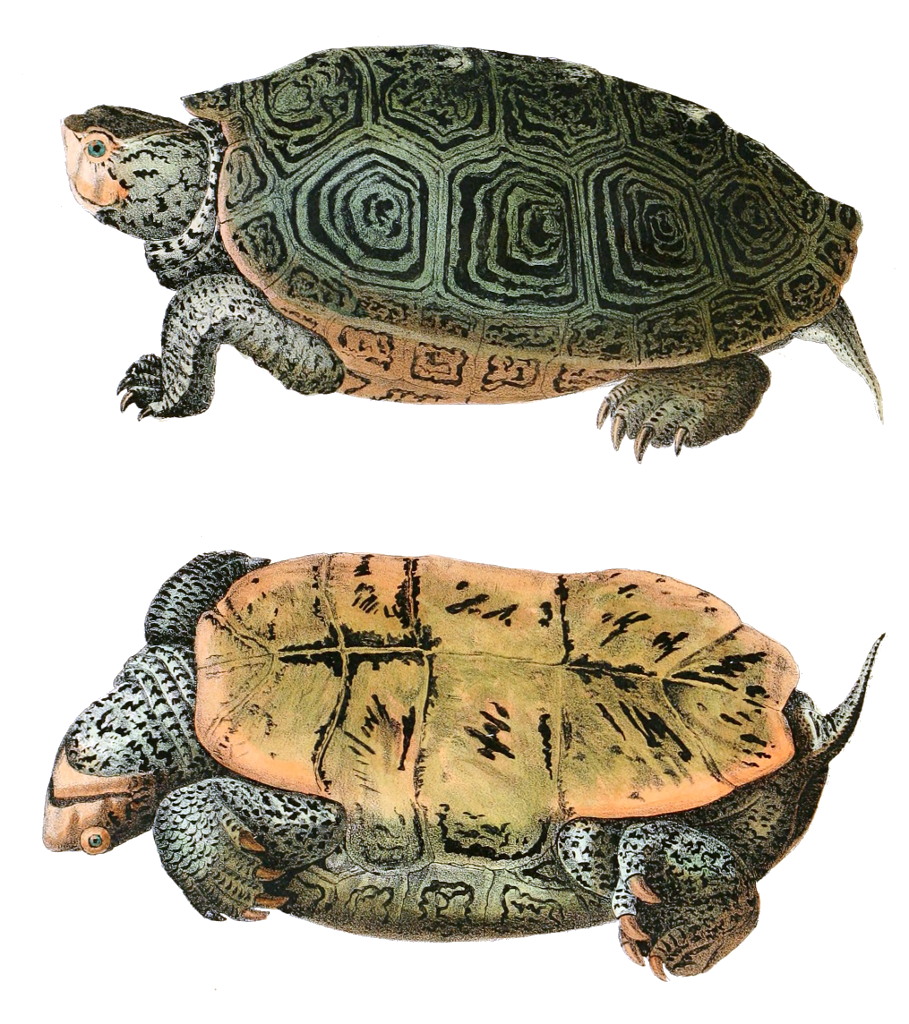
| Appearance | - The chicken turtle has an elongated, pear-shaped carapace with a yellowish net-like pattern across its upper surface. English Wikipedia
- The chicken turtle's carapace ranges in color from dark green to brown. English Wikipedia
- The chicken turtle has an unusually long neck that can approach the length of its shell. English Wikipedia
- The chicken turtle has a broad yellow stripe on each foreleg. English Wikipedia
- The chicken turtle's head and neck have light-colored stripes, while its tail and rear legs have vertical yellow markings. English Wikipedia
- The chicken turtle has webbed feet with claw-tipped digits. English Wikipedia
- The chicken turtle's upper shell has a ridged or wrinkled texture. English Wikipedia
- The chicken turtle's skin generally ranges from olive to brown to black. English Wikipedia
- Female chicken turtles are larger and heavier than males, whereas males have longer, thicker tails. English Wikipedia
- Chicken turtle hatchlings have rounder shells and brighter shell and skin coloration than adults. English Wikipedia
| - The species has a diamond-shaped pattern on the upper surface of its shell, although its overall coloration and pattern vary considerably. English Wikipedia
- Its carapace is generally wider at the rear than at the front and has a longitudinal central ridge. English Wikipedia
- Its carapace ranges from brown to grey, while its plastron is lighter in coloration. English Wikipedia
- Its body coloration can be grey, brown, yellow, or white. English Wikipedia
- Almost all individuals have distinctive irregular black markings or spots on their heads and bodies. English Wikipedia
- The species has large webbed feet. English Wikipedia
|
|---|
| Size | | |
|---|
| Habitat | - Chicken turtles inhabit shallow, still or slow-moving freshwater bodies with abundant vegetation and muddy substrates. English Wikipedia
- Chicken turtles commonly occupy ponds, oxbow lakes, drainage ditches, borrow pits, marshes, swales, cypress swamps, and Carolina bays. English Wikipedia
- Chicken turtles generally prefer water no deeper than approximately 70 cm, although they can inhabit ponds up to 2 m deep. English Wikipedia
- Chicken turtles strongly prefer freshwater and generally avoid brackish water. English Wikipedia
- Chicken turtles frequently occupy temporary wetlands that dry out during summer or drought. English Wikipedia
- Chicken turtles can inhabit water ranging from a few centimeters to more than 2 m deep. animaldiversity.org
- Chicken turtles bask on logs, rocks, and other structures emerging from the water. animaldiversity.org
| - The species inhabits brackish coastal tidal marshes. English Wikipedia
- In most of its range, the species inhabits Spartina marshes that flood during high tides. English Wikipedia
- In Florida, the species also inhabits mangrove swamps. English Wikipedia
- South Florida diamondback terrapins use subtropical mangrove creek and island habitats in Everglades National Park. pubs.usgs.gov
- The species can tolerate freshwater and full-strength ocean water, although adults prefer intermediate salinities. English Wikipedia
- The species is exclusively estuarine. pubs.usgs.gov
|
|---|
| Diet | - Chicken turtles primarily consume invertebrates, including crayfish, dragonflies, and spiders. English Wikipedia
- Chicken turtles also consume tadpoles, carrion, and occasional plant material. English Wikipedia
- Chicken turtles consume aquatic insects, crustaceans, tadpoles, fish, and plants. animaldiversity.org
- Chicken turtles can be almost completely carnivorous during their first year of life. animaldiversity.org
- Chicken turtles use suction generated by their hyoid apparatus to draw food into their throats. animaldiversity.org
| - The species feeds on fish, crustaceans, marine worms, snails, clams, barnacles, mussels, other mollusks, insects, and carrion. English Wikipedia
- The species sometimes consumes small quantities of plant material, including algae. English Wikipedia
- Gastropods, crabs, and bivalves are the dominant food categories of diamondback terrapins in South Florida mangrove habitats. pubs.usgs.gov
- Food sources in South Florida terrapins differ more according to habitat than to body size class. pubs.usgs.gov
- Decapod crustacean remains occurred in all 13 fecal samples examined from the Florida East Coast subspecies. digitalcommons.fau.edu
- Decapod crustaceans accounted for 96.3% of the fecal mass in the examined Florida East Coast terrapins. digitalcommons.fau.edu
- The examined Florida East Coast terrapins also consumed small quantities of vegetation, bivalves, gastropods, and insects. digitalcommons.fau.edu
|
|---|
| Behaviour | - Chicken turtles are active during daylight hours. animaldiversity.org
- Chicken turtles spend considerable time basking and have been recorded with cloacal temperatures of 25.5–25.6 °C while active. animaldiversity.org
- Chicken turtles move onto land to escape drying aquatic habitats and burrow into soil. animaldiversity.org
- Chicken turtles hibernate in soft mud and vegetation in northern parts of their range. animaldiversity.org
- Florida chicken turtles remain active throughout the year. animaldiversity.org
- Male chicken turtles generally travel farther than females when moving on land. animaldiversity.org
- A marked chicken turtle was recorded moving 612 m over eight months. animaldiversity.org
- Male chicken turtles court females by vibrating their foreclaws against the females' faces. animaldiversity.org
| - The species is a strong swimmer. English Wikipedia
- The species can remain in full-strength salt water for extended periods. English Wikipedia
- Terrapins can obtain freshwater by drinking the surface layer that accumulates over salt water after rainfall. English Wikipedia
- Terrapins can raise their heads and open their mouths to catch falling raindrops. English Wikipedia
- Individuals tend to remain in the same areas for most or all of their lives rather than undertaking long-distance migrations. English Wikipedia
- The species generally hibernates during colder months in the mud of creeks and marshes. English Wikipedia
|
|---|
| Reproduction | - Female chicken turtles excavate cylindrical nests on land in different soil types. animaldiversity.org
- Female chicken turtles lay two clutches annually in South Carolina, with 5–15 eggs per clutch. animaldiversity.org
- Florida chicken turtles produce clutches containing 2–19 eggs. animaldiversity.org
- Chicken turtle eggs measure 28–40 mm long and weigh 8.7–13.3 g. animaldiversity.org
- Chicken turtle eggs laid during autumn are generally larger than those laid in spring. animaldiversity.org
- Chicken turtle eggs hatch after 152 days at 29 °C in South Carolina. animaldiversity.org
- Chicken turtle eggs hatch after 78–89 days at temperatures of 25–29 °C in Florida. animaldiversity.org
- Chicken turtles do not provide parental care after laying their eggs. animaldiversity.org
- Chicken turtles in South Carolina have nesting seasons extending from February to May and August to November. animaldiversity.org
- Chicken turtle eggs can remain in the nest through winter before hatching. animaldiversity.org
- Chicken turtle hatchlings may emerge a year or more after their eggs were laid. srelherp.uga.edu
- Male chicken turtles typically reach sexual maturity during their second or third year. animaldiversity.org
- Female chicken turtles reach sexual maturity after approximately five years of growth. animaldiversity.org
| - Adults mate in early spring. English Wikipedia
- Females lay clutches containing 4–22 eggs in sand dunes during early summer. English Wikipedia
- Eggs generally hatch 60–85 days after being laid, depending on incubation temperature and nest depth. English Wikipedia
- Females can produce up to three egg clutches annually in the wild. English Wikipedia
- Females can produce up to five egg clutches annually in captivity. English Wikipedia
- Female terrapins can mate with multiple males and retain sperm for years. English Wikipedia
- The sex of hatchlings depends on incubation temperature. English Wikipedia
- Male terrapins generally reach sexual maturity at 2–3 years of age. English Wikipedia
- Female terrapins generally reach sexual maturity at 6–7 years, while northern populations may take 8–10 years. English Wikipedia
|
|---|
| Distribution | - Chicken turtles occur throughout the southeastern United States, extending from the Atlantic coastal plain westward toward the Mississippi River and beyond. English Wikipedia
- The chicken turtle's range extends westward into Missouri, Oklahoma, and central Texas. English Wikipedia
- Chicken turtles occur in coastal areas from Virginia to Texas and northward into Oklahoma and Arkansas. animaldiversity.org
| - The species occurs along the Atlantic and Gulf coasts of the United States, from Cape Cod to Texas. English Wikipedia
- The species also has a naturally established population in Bermuda. English Wikipedia
|
|---|
| Conservation | - Chicken turtle populations are considered stable throughout their range. animaldiversity.org
- Habitat destruction threatens chicken turtles by reducing suitable areas for foraging, migration, and hibernation. animaldiversity.org
- Chicken turtles are sometimes killed by vehicles while migrating between habitats. animaldiversity.org
- Chicken turtles are vulnerable to habitat loss because they depend on temporary wetlands and use both aquatic and terrestrial environments. srelherp.uga.edu
| - The IUCN classifies the species as Vulnerable because its population numbers are decreasing across most of its range. English Wikipedia
- The species is listed as endangered in Rhode Island. English Wikipedia
- The species is listed as threatened in Massachusetts. English Wikipedia
- Crab traps cause substantial mortality among diamondback terrapins along the New Jersey coast. English Wikipedia
- Coastal development has destroyed or altered more than 75% of the salt marshes historically inhabited by the species. English Wikipedia
- Rising ocean levels threaten the remaining salt marsh habitat. English Wikipedia
|
|---|
| Uses | - Chicken turtles were historically sold in southern United States food markets for their meat. animaldiversity.org
| - Diamondback terrapins were historically consumed as a delicacy in the early twentieth century. English Wikipedia
|
|---|
| Similar species | - The chicken turtle resembles the painted turtle and some species of cooter in overall appearance. English Wikipedia
- The chicken turtle can be distinguished from painted turtles and cooters by its unusually long neck. English Wikipedia
- Despite sharing some morphological features with Blanding's turtle, the chicken turtle is not closely related to it according to DNA analysis. English Wikipedia
| No checked fact yet |
|---|
| Name origin | - The common name chicken turtle apparently refers to the flavor of its meat. animaldiversity.org
| No checked fact yet |
|---|