Species · Reptiles
Chicken Turtle Deirochelys reticularia
The scientific name of the Chicken Turtle is Deirochelys reticularia. It is a species of reptile in the family Emydidae (terrapins), order Testudines. The name dates from 1801.
- Scientific name
- Deirochelys reticularia (Latreille, 1801)
- Common name
- Chicken Turtle
- Genus
- Deirochelys
- Family
- Emydidae (Terrapins)
- Order
- Testudines
- Class
- Reptilia
- Environment
- freshwater
- Recorded in
- 1 country
- Name status
- accepted in the Catalogue of Life

Overview
The Chicken Turtle inhabits freshwater wetlands across the southeastern United States, with a range extending westward into Missouri, Oklahoma, and central Texas.
Written 26 November 2026 from the sources listed below. Each statement was checked against the passage it cites; statements that could not be supported were removed.
Appearance
The Chicken Turtle has an elongated, pear-shaped carapace with a yellowish net-like pattern across its upper surface. Its carapace ranges from dark green to brown and has a ridged or wrinkled texture.[1][2][3]
Its unusually long neck can approach the length of its shell. The head and neck have light-colored stripes, each foreleg has a broad yellow stripe, and the tail and rear legs have vertical yellow markings.[4][5][6]
The Chicken Turtle has webbed feet with claw-tipped digits, and its skin generally ranges from olive to brown to black.[7][8]
Females are larger and heavier than males, while males have longer, thicker tails. Females are typically 1.5 times larger than males.[9][10]
Adult Chicken Turtles generally measure approximately 10–25 cm in length, with an average adult length of approximately 13 cm. Their carapace width is approximately 65 percent of its length.[11][12][13]
Females of the eastern subspecies can reach 26 cm in length, while the species can grow to a maximum length of 25.4 cm.[14][15]
Hatchlings measure approximately 28–32 mm and weigh 8–9 g. They have rounder shells and brighter shell and skin coloration than adults.[16][17]
Habitat
The Chicken Turtle inhabits shallow, still or slow-moving freshwater bodies with abundant vegetation and muddy substrates. Common habitats include ponds, oxbow lakes, drainage ditches, borrow pits, marshes, swales, cypress swamps, and Carolina bays.[18][19]
It generally prefers water no deeper than approximately 70 cm, although it can inhabit ponds up to 2 m deep and waters ranging from a few centimeters to more than 2 m deep. It strongly prefers freshwater and generally avoids brackish water.[20][21][22]
Chicken Turtles frequently occupy temporary wetlands that dry out during summer or drought. They bask on logs, rocks, and other structures emerging from the water.[23][24]
Diet
The Chicken Turtle primarily consumes invertebrates, including crayfish, dragonflies, spiders, aquatic insects, and other crustaceans. Its diet also includes tadpoles, fish, carrion, and occasional plant material.[25][26][27]
During their first year of life, Chicken Turtles can be almost completely carnivorous. They use suction generated by their hyoid apparatus to draw food into their throats.[28][29]
Behaviour
Chicken Turtles are active during daylight hours and spend considerable time basking. Active individuals have been recorded with cloacal temperatures of 25.5–25.6 °C.[30][31]
They move onto land to escape drying aquatic habitats and burrow into soil. In northern parts of their range, they hibernate in soft mud and vegetation, while Florida Chicken Turtles remain active throughout the year.[32][33][34]
Males generally travel farther than females when moving on land. One marked Chicken Turtle was recorded moving 612 m over eight months.[35][36]
Male Chicken Turtles court females by vibrating their foreclaws against the females' faces.[37]
Reproduction and life cycle
Female Chicken Turtles excavate cylindrical nests on land in different soil types. In South Carolina, females lay two clutches annually, with 5–15 eggs per clutch, while Florida Chicken Turtles produce clutches containing 2–19 eggs.[38][39][40]
Chicken Turtle eggs measure 28–40 mm long and weigh 8.7–13.3 g. Eggs laid during autumn are generally larger than those laid in spring.[41][42]
In South Carolina, eggs hatch after 152 days at 29 °C. In Florida, they hatch after 78–89 days at temperatures of 25–29 °C.[43][44]
Chicken Turtles do not provide parental care after laying their eggs. In South Carolina, nesting seasons extend from February to May and August to November.[45][46]
Eggs can remain in the nest through winter before hatching, and hatchlings may emerge a year or more after their eggs were laid.[47][48]
Males typically reach sexual maturity during their second or third year. Females reach sexual maturity after approximately five years of growth.[49][50]
Conservation
Chicken Turtle populations are considered stable throughout their range. Habitat destruction threatens the species by reducing suitable areas for foraging, migration, and hibernation.[51][52]
Chicken Turtles are vulnerable to habitat loss because they depend on temporary wetlands and use both aquatic and terrestrial environments. They are sometimes killed by vehicles while migrating between habitats.[53][54]
Uses
Chicken Turtles were historically sold in southern United States food markets for their meat.[55]
Similar species
The Chicken Turtle resembles the painted turtle and some species of cooter in overall appearance. Its unusually long neck distinguishes it from painted turtles and cooters.[56][57]
Although the Chicken Turtle shares some morphological features with Blanding's turtle, DNA analysis indicates that the two are not closely related.[58]
Classification of the Chicken Turtle
| Kingdom | Animalia |
|---|---|
| Phylum | Chordata |
| Subphylum | Vertebrata |
| Infraphylum | Gnathostomata |
| Parvphylum | Osteichthyes |
| Megaclass | Tetrapoda |
| Class | Reptilia (Reptile) |
| Order | Testudines (Turtle) |
| Suborder | Cryptodira |
| Superfamily | Testudinoidea |
| Family | Emydidae (Terrapins) |
| Genus | Deirochelys (Chicken Turtles) |
| Species | Deirochelys reticularia (Latreille, 1801) |
Where the Chicken Turtle is found
Checklists and occurrence records place Deirochelys reticularia in 1 country across North America. GBIF holds 2,343 georeferenced records of it.
Countries
Regions and cities with the most records
- Florida, United States 907
- Georgia, United States 85
- Texas, United States 81
- Gainesville, United States 78
- Alabama, United States 73
- South Carolina, United States 71
- Louisiana, United States 70
- Golden Gate, United States 47
- North Carolina, United States 39
- East Naples, United States 34
- Mississippi, United States 32
- Alafaya, United States 30
- Bonita Springs, United States 29
- Naples, United States 29
- Titusville, United States 29
- Oviedo, United States 28
- Temple Terrace, United States 28
- University, United States 28
- Wesley Chapel, United States 27
- Homestead, United States 25
- Lake Magdalene, United States 25
- Carrollwood, United States 24
- Carrollwood Village, United States 24
- East Lake-Orient Park, United States 24
- Lutz, United States 24
- Northdale, United States 24
- Greater Northdale, United States 23
- Sanford, United States 23
- Citrus Park, United States 20
- Egypt Lake-Leto, United States 20
- Plant City, United States 20
- Valrico, United States 20
- Brandon, United States 19
- Casselberry, United States 19
- Lake Mary, United States 19
- Tallahassee, United States 19
Range as the checklists state it
USA (SE Virginia, along the Atlantic coastal Plain in S North Carolina, South Carolina, Georgia, Florida, along the Gulf Coastal Plain in Alabama, Mississippi, Louisiana, E Texas; Oklahoma, Arkansas, SE Missouri)
A number beside a place is its count of GBIF occurrence records. A place without a number comes from a checklist alone. Records show where a species has been observed or collected, which can include escapes and vagrants.
Common names
English
- Chicken Turtle
Names in 10 other languages
- Arabic
- سلحفاة الدجاج
- Chinese
- 雞龜
- Czech
- želva síťovaná
- Dutch
- Netschildpad
- French
- Émyde réticulée
- German
- Langhals-Schmuckschildkröte
- Hungarian
- hosszúnyakú ékszerteknős
- Japanese
- アミメガメ
- Russian
- Длинношеяя черепаха
- Spanish
- Tortuga pollo
Synonyms
4 other scientific names have been used for this species and are now treated as synonyms of Deirochelys reticularia.
- Chrysemys reticulata Boulenger, 1889
- Testudo reticularia Latreille ex Sonnini & Latreille, 1801
- Testudo reticulata Daudin, 1802
- Testudo reticulata Bosc
Subspecies and varieties
- Deirochelys reticularia chrysea (Florida Chicken Turtle) subspecies
- Deirochelys reticularia miaria (Western Chicken Turtle) subspecies
- Deirochelys reticularia reticularia (Eastern Chicken Turtle) subspecies
Related species
-
 Painted TurtleChrysemys picta
-
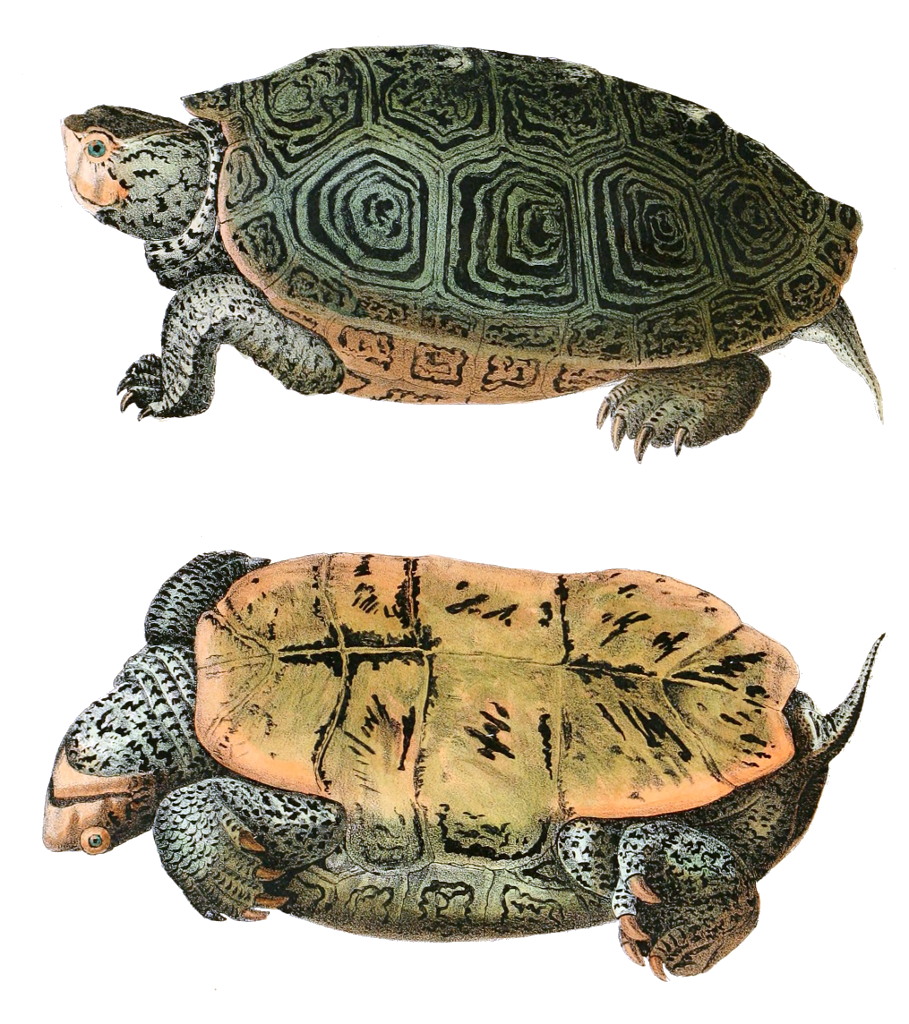 Diamondback TerrapinMalaclemys terrapin
-
 Pond SliderTrachemys scripta
-
 Blanding's TurtleEmydoidea blandingii
-
 Common Box TurtleTerrapene carolina
-
 Wood TurtleGlyptemys insculpta
-
 Bog TurtleGlyptemys muhlenbergii
-
 Spotted TurtleClemmys guttata
Compare
Questions and answers
What is the scientific name of the Chicken Turtle?
The scientific name of the Chicken Turtle is Deirochelys reticularia. Written with its author, the full name is Deirochelys reticularia (Latreille, 1801).
Which family does the Chicken Turtle belong to?
Deirochelys reticularia belongs to the family Emydidae, in the order Testudines and the class Reptilia.
Where is the Chicken Turtle found?
Checklists and occurrence records place Deirochelys reticularia in 1 country: United States.
Why do they call it a chicken turtle?
The common name apparently refers to the flavor of its meat. Chicken Turtles were historically sold in southern United States food markets for their meat.[55][59]
How big does a chicken turtle get?
Adult Chicken Turtles generally measure approximately 10–25 cm in length, with an average adult length of approximately 13 cm. Females of the eastern subspecies can reach 26 cm in length.[11][12][14]
What do chicken turtles eat?
Chicken Turtles primarily eat invertebrates, including crayfish, dragonflies, spiders, aquatic insects, and crustaceans. They also consume tadpoles, fish, carrion, and occasional plant material.[25][26][27]
Where does the chicken turtle live?
Chicken Turtles inhabit freshwater wetlands throughout the southeastern United States, with their range extending into Missouri, Oklahoma, and central Texas. They commonly occupy ponds, oxbow lakes, drainage ditches, borrow pits, marshes, swales, cypress swamps, and Carolina bays.[19][60][61][62]
Sources
Passages the profile rests on
- The chicken turtle has an elongated, pear-shaped carapace with a yellowish net-like pattern across its upper surface. Source passage: “The carapace of the chicken turtle is elongated and pear-shaped, with the rear half noticeably wider than the front.” — English Wikipedia
- The chicken turtle's carapace ranges in color from dark green to brown. Source passage: “It ranges from dark green to brown in color, and features a distinctive yellowish net-like pattern across its entire upper surface.” — English Wikipedia
- The chicken turtle's upper shell has a ridged or wrinkled texture. Source passage: “The scutes of the upper shell have a ridged or wrinkled texture and are rough to the touch.” — English Wikipedia
- The chicken turtle has an unusually long neck that can approach the length of its shell. Source passage: “has an unusually long neck that is close to the length of its shell.” — English Wikipedia
- The chicken turtle has a broad yellow stripe on each foreleg. Source passage: “One of the distinguishing features of D. reticularia is a broad yellow stripe on the forelegs.” — English Wikipedia
- The chicken turtle's head and neck have light-colored stripes, while its tail and rear legs have vertical yellow markings. Source passage: “The skin of the neck and head also has light stripes, although narrower, while the tail and rear legs show vertical yellow markings.” — English Wikipedia
- The chicken turtle has webbed feet with claw-tipped digits. Source passage: “the digits of the feet are webbed and tipped with claws.” — English Wikipedia
- The chicken turtle's skin generally ranges from olive to brown to black. Source passage: “it is generally reported to be darker than the carapace, varying from olive to brown to black.” — English Wikipedia
- Female chicken turtles are larger and heavier than males, whereas males have longer, thicker tails. Source passage: “the females are larger and heavier than males, although the males have longer, thicker tails.” — English Wikipedia
- Female chicken turtles are typically 1.5 times larger than males. Source passage: “Females are typically 1.5 times larger than males.” — animaldiversity.org
- Adult chicken turtles generally measure approximately 10–25 cm in length. Source passage: “Adults vary in length from around 10–25 cm (4–10 in)” — English Wikipedia
- The average adult chicken turtle measures approximately 13 cm long. Source passage: “with an average length of around 13 cm (5 in).” — English Wikipedia
- The chicken turtle's carapace width is approximately 65 percent of its length. Source passage: “The width of the carapace is roughly 65 percent of its length.” — English Wikipedia
- Females of the eastern subspecies can reach 26 cm in length. Source passage: “females up to 26.0 cm (10.2 in).” — English Wikipedia
- Chicken turtles can grow to a maximum length of 25.4 cm. Source passage: “They grow up to 25.4 cm long.” — animaldiversity.org
- Chicken turtle hatchlings have rounder shells and brighter shell and skin coloration than adults. Source passage: “The shell is much rounder than the adults', and the shell and skin are considerably brighter in color” — English Wikipedia
- Chicken turtle hatchlings measure approximately 28–32 mm and weigh 8–9 g. Source passage: “Chicken turtle hatchlings measure approximately 28–32 mm (1.1–1.3 in) and weigh around 8–9 g” — English Wikipedia
- Chicken turtles inhabit shallow, still or slow-moving freshwater bodies with abundant vegetation and muddy substrates. Source passage: “Chicken turtles inhabit shallow, still or slow-moving bodies of water with plenty of vegetation and a muddy substrate.” — English Wikipedia
- Chicken turtles commonly occupy ponds, oxbow lakes, drainage ditches, borrow pits, marshes, swales, cypress swamps, and Carolina bays. Source passage: “such as shallow ponds, oxbow lakes, drainage ditches, borrow pits, marshes, swales, cypress swamps, and Carolina bays.” — English Wikipedia
- Chicken turtles generally prefer water no deeper than approximately 70 cm, although they can inhabit ponds up to 2 m deep. Source passage: “prefers water with a maximum depth of around 70 cm (2.3 ft), but it is known to inhabit ponds up to 2 m (6.6 ft) deep.” — English Wikipedia
- Chicken turtles strongly prefer freshwater and generally avoid brackish water. Source passage: “it strongly favors fresh water, avoiding brackish water wherever possible.” — English Wikipedia
- Chicken turtles can inhabit water ranging from a few centimeters to more than 2 m deep. Source passage: “They have been found at water depths of a few centimeters to more than 2 m.” — animaldiversity.org
- Chicken turtles frequently occupy temporary wetlands that dry out during summer or drought. Source passage: “Often these are ephemeral or temporary wetlands that readily dry out during the summer or in periods of drought.” — English Wikipedia
- Chicken turtles bask on logs, rocks, and other structures emerging from the water. Source passage: “They bask on logs, rocks, and other emergent structures.” — animaldiversity.org
- Chicken turtles primarily consume invertebrates, including crayfish, dragonflies, and spiders. Source passage: “feeds mostly on invertebrates such as crayfish, dragonflies and spiders” — English Wikipedia
- Chicken turtles also consume tadpoles, carrion, and occasional plant material. Source passage: “but is also known to eat tadpoles, carrion and occasionally plant material.” — English Wikipedia
- Chicken turtles consume aquatic insects, crustaceans, tadpoles, fish, and plants. Source passage: “They eat primarily crustaceans, aquatic insects, tadpoles, fish, and plants.” — animaldiversity.org
- Chicken turtles can be almost completely carnivorous during their first year of life. Source passage: “During their first year of life they may be almost completely carnivorous.” — animaldiversity.org
- Chicken turtles use suction generated by their hyoid apparatus to draw food into their throats. Source passage: “Chicken turtles use their well-developed hyoid apparatus to create suction that pulls food items into their throats.” — animaldiversity.org
- Chicken turtles are active during daylight hours. Source passage: “They are active during the day.” — animaldiversity.org
- Chicken turtles spend considerable time basking and have been recorded with cloacal temperatures of 25.5–25.6 °C while active. Source passage: “active turtles have been recorded with cloacal temperatures of 25.5 to 25.6 degrees Celsius.” — animaldiversity.org
- Chicken turtles move onto land to escape drying aquatic habitats and burrow into soil. Source passage: “readily travel onto land to burrow into the soil and escape dry conditions.” — animaldiversity.org
- Chicken turtles hibernate in soft mud and vegetation in northern parts of their range. Source passage: “Chicken turtles hibernate in the soft mud and vegetation of bodies of water in the northern parts of their range.” — animaldiversity.org
- Florida chicken turtles remain active throughout the year. Source passage: “Florida chicken turtles remain active throughout the year.” — animaldiversity.org
- Male chicken turtles generally travel farther than females when moving on land. Source passage: “Males generally move farther than females.” — animaldiversity.org
- A marked chicken turtle was recorded moving 612 m over eight months. Source passage: “A single, marked chicken turtle moved 612 meters in a period of 8 months.” — animaldiversity.org
- Male chicken turtles court females by vibrating their foreclaws against the females' faces. Source passage: “Males court female chicken turtles by vibrating their foreclaws against the female's face.” — animaldiversity.org
- Female chicken turtles excavate cylindrical nests on land in different soil types. Source passage: “Females excavate cylindrical nests on land in a variety of soil types, from sandy to heavy soils.” — animaldiversity.org
- Female chicken turtles lay two clutches annually in South Carolina, with 5–15 eggs per clutch. Source passage: “Females lay 2 clutches each year in South Carolina, with 5 to 15 elliptical eggs per clutch” — animaldiversity.org
- Florida chicken turtles produce clutches containing 2–19 eggs. Source passage: “in Florida clutch size is 2 to 19 (average 9).” — animaldiversity.org
- Chicken turtle eggs measure 28–40 mm long and weigh 8.7–13.3 g. Source passage: “measuring 28 to 40 mm long and weighing 8.7 to 13.3 g.” — animaldiversity.org
- Chicken turtle eggs laid during autumn are generally larger than those laid in spring. Source passage: “Eggs laid in the fall are usually larger than those laid in spring.” — animaldiversity.org
- Chicken turtle eggs hatch after 152 days at 29 °C in South Carolina. Source passage: “Eggs hatch in 152 days at 29 degrees Celsius in South Carolina” — animaldiversity.org
- Chicken turtle eggs hatch after 78–89 days at temperatures of 25–29 °C in Florida. Source passage: “and in 78 to 89 days at 25 to 29 degrees Celsius in Florida.” — animaldiversity.org
- Chicken turtles do not provide parental care after laying their eggs. Source passage: “Parents do not help the young once the eggs are laid.” — animaldiversity.org
- Chicken turtles in South Carolina have nesting seasons extending from February to May and August to November. Source passage: “from winter to early spring (February to May) and fall to early winter (August to November).” — animaldiversity.org
- Chicken turtle eggs can remain in the nest through winter before hatching. Source passage: “Some eggs may overwinter in the nest before hatching.” — animaldiversity.org
- Chicken turtle hatchlings may emerge a year or more after their eggs were laid. Source passage: “Eggs overwinter in the nest and emerge a year or more after eggs were laid.” — srelherp.uga.edu
- Male chicken turtles typically reach sexual maturity during their second or third year. Source passage: “usually during their second or third year.” — animaldiversity.org
- Female chicken turtles reach sexual maturity after approximately five years of growth. Source passage: “Females mature at carapace lengths of 14.1 to 16 cm, after about 5 years of growth.” — animaldiversity.org
- Chicken turtle populations are considered stable throughout their range. Source passage: “Chicken turtle populations are currently considered stable throughout their range” — animaldiversity.org
- Habitat destruction threatens chicken turtles by reducing suitable areas for foraging, migration, and hibernation. Source passage: “Habitat destruction reduces suitable habitat for foraging, migration, and hibernation.” — animaldiversity.org
- Chicken turtles are sometimes killed by vehicles while migrating between habitats. Source passage: “Chicken turtles are sometimes killed on roads as they migrate between habitats.” — animaldiversity.org
- Chicken turtles are vulnerable to habitat loss because they depend on temporary wetlands and use both aquatic and terrestrial environments. Source passage: “the reliance of this species on temporary wetlands and its extensive use of both aquatic and terrestrial habitats make it potentially vulnerable to habitat loss and degradation.” — srelherp.uga.edu
- Chicken turtles were historically sold in southern United States food markets for their meat. Source passage: “Chicken turtles were once found in the food markets of the southern United States for their meat.” — animaldiversity.org
- The chicken turtle resembles the painted turtle and some species of cooter in overall appearance. Source passage: “The chicken turtle resembles the painted turtle (Chrysemys picta) and some species of cooter (genus Pseudemys) in appearance” — English Wikipedia
- The chicken turtle can be distinguished from painted turtles and cooters by its unusually long neck. Source passage: “but has an unusually long neck that is close to the length of its shell.” — English Wikipedia
- Despite sharing some morphological features with Blanding's turtle, the chicken turtle is not closely related to it according to DNA analysis. Source passage: “DNA analysis has shown they are not closely related.” — English Wikipedia
- The common name chicken turtle apparently refers to the flavor of its meat. Source passage: “Their common name, "chicken" turtle, refers to their taste.” — animaldiversity.org
- Chicken turtles occur throughout the southeastern United States, extending from the Atlantic coastal plain westward toward the Mississippi River and beyond. Source passage: “The chicken turtle is found throughout the southeastern United States;” — English Wikipedia
- The chicken turtle's range extends westward into Missouri, Oklahoma, and central Texas. Source passage: “its territory reaches as far north as Missouri and as far west as Oklahoma and central Texas.” — English Wikipedia
- Chicken turtles occur in coastal areas from Virginia to Texas and northward into Oklahoma and Arkansas. Source passage: “Deirochelys reticularia is found in coastal areas from Virginia to Texas and northward into Oklahoma and Arkansas.” — animaldiversity.org
Data
- Catalogue of Life, 2026-10-16 XR cc by
- Global Biodiversity Information Facility CC BY 4.0
- Wikidata CC0
- GeoNames CC BY 4.0
- Wikimedia Commons per image; credit shown with each image
- Within the Catalogue of Life, this name comes from The Reptile Database cc by
References
- Sonnini and Latreille, 1801 where the name was published
- Latreille, P. A. (1802). In: C.N.S. Sonnini de Manoncourt and P.A. Latreille. Histoire Naturelle des Reptiles, avec Figures Déssinnées d’après Nature. Vol. 1. Détérville, Paris, Xx + 280 P. [1802].
- Say, T. (1824). On the fresh water and land Tortoises of the United States. J. Acad. Nat. Sci. Philadelphia 4 (2): 203-219.
- Duméril, A.M.C., and G. Bibron. (1835). Erpétologie Générale ou Histoire Naturelle Complète des Reptiles, Vol. 2. Librairie Encyclopédique de Roret, Paris, Iv + 680 P.
- Agassiz, & Louis. (1857). Contributions to the Natural History of the United States of America. vol. 1. Little, Brown & Co., Boston, Lii + 452 Pp.
- Gray, J. E. (1863). Notes on American Emydidae, and Professor Agassiz’s observations on my Catalogue of them. Ann. Mag. Nat. Hist. (3) 12: 176-183.
- Lönnberg, & Einar. (1894). Notes on reptiles and batrachians collected in Florida in 1892 and 1893. Proc. US Natl. Mus. 17 (1003): 317-339.
- Allen, Morrow J. (1932). A survey of the Amphibians and reptiles of Harrison County, Mississippi. American Museum Novitates (542): 1-20.
- Harper, & Francis. (1940). Some works of Bartram, Daudin, Latreille, and Sonnini, and their bearing upon North American herpetological nomenclature. American Midland Naturalist 23 (3): 692-723.
- Cagle, F.R. & J. Tihen. (1948). Retention of Eggs by the Turtle Deirochelys reticularia. Copeia 1948 (1): 66.
- Schwartz, & Albert. (1956). Geographic variation in the chicken turtle Deirochelys reticularia Latreille. Zoological Series of Field Museum of Natural History 34 (41): 461-503.
- McCoy, Clarence J.;Richmond, Neil D. (1965). Herpetological Type-specimens in Carnegie Museum. [type catalogue]. Annals of the Carnegie Museum 38: 233-264 [1966].
- Gibbons, J. W. (1969). Ecology and population dynamics of the chicken turtle, Deirochelys reticularia. Copeia 1969 (4): 669-676.
- Zug, George R.;Schwartz, Albert. (1971). Deirochelys, D. reticularia. Catalogue of American Amphibians and Reptiles (107): 1-3.
- Jackson, C. G., Jr. (1974). An unusual pattern of cervical central articulation in Deirochelys reticularia. Copeia 1974 (3): 788.
- Gibbons, J. W., & Greene, J. L. (1978). Selected aspects of the ecology of the chicken turtle, Deirochelys reticularia (Latreille)(Reptilia, Testudines, Emydidae). Journal of Herpetology 12 (2): 237-241.
- Ernst,C.H. and Barbour,R.W. (1989). Turtles of the World. Smithsonian Institution Press, Washington D.C. - London.
- Conant, R., & Collins, J. T. (1991). A Field Guide to Reptiles and Amphibians of Eastern/Central North America, 3rd ed. Houghton Mifflin (Boston/New York), Xx + 450 P.
- Mitchell, J. C. (1994). The reptiles of Virginia. Virginia Department of Game and Inland Fisheries, ca. 350 Pp.
- Buhlmann, K. A. (1995). Habitat Use, Terrestrial Movements, and Conservation of the Turtle, Deirochelys reticularia in Virginia. Journal of Herpetology 29 (2): 173-181.
- Palmer, W. M., & Braswell, A. L. (1995). Reptiles of North Carolina. Univ. North Carolina Press.
- Buhlmann, K.A., T.K. Lynch, J.W. Gibbons & J.L. Greene. (1995). Prolonged Egg Retention in the Turtle Deirochelys reticularia in South Carolina. Herpetologica 51 (4): 457-462.
- Demuth, J.P. & K.A. Buhlmann. (1997). Diet of the Turtle Deirochelys reticularia on the Savannah River Site, South Carolina. Journal of Herpetology 31 (3): 450-453.
- Mitchell, J. C., & Reay, K. K. (1999). Atlas of amphibians and reptiles in Virginia. Specialty Publication 1, VA Dept of Game and Fisheries, 122 Pp.
- Bartlett, R. D., & Bartlett, P. (1999). A Field Guide to Texas Reptiles and Amphibians. Gulf Publishing Co., Houston, Texas, 331 Pp.
This species in other databases
- Catalogue of Life 34FDC
- Wikidata Q262146
- iNaturalist 39762
- WoRMS urn:lsid:marinespecies.org:taxname:1358289
- ITIS 173786
Page built on 28 November 2026. See how the catalog is made and all sources and licences.
Cite this page
ScientificNames.org. (2026). Deirochelys reticularia (Chicken Turtle). Retrieved November 28, 2026, from https://scientificnames.org/species/deirochelys-reticularia
“Deirochelys reticularia (Chicken Turtle).” ScientificNames.org, 2026, scientificnames.org/species/deirochelys-reticularia. Accessed 28 Nov. 2026.
ScientificNames.org. “Deirochelys reticularia (Chicken Turtle).” Accessed November 28, 2026. https://scientificnames.org/species/deirochelys-reticularia.
@misc{scientificnames_deirochelys_reticularia_chicken_turtle,
  author = {{ScientificNames.org}},
  title = {Deirochelys reticularia (Chicken Turtle)},
  year = {2026},
  url = {https://scientificnames.org/species/deirochelys-reticularia},
  note = {Accessed 2026-11-28}
}