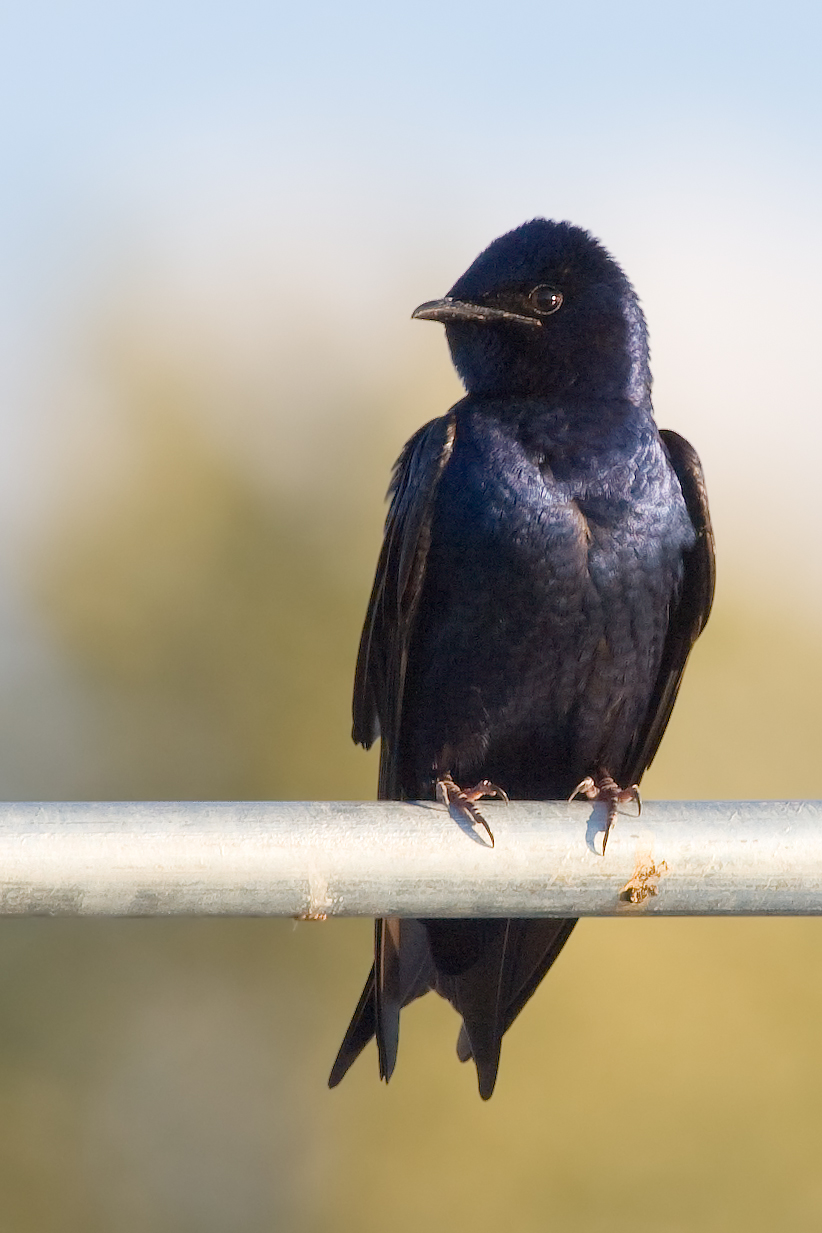
| Appearance | - Adult birds of the nominate subspecies have dark steel-blue upperparts, a contrasting white rump, grey-washed white underparts and a slightly forked tail. English Wikipedia
- The tail and upperwings are brownish-black, while the underwings are grey-brown. English Wikipedia
- Its legs and feet are brownish-pink and covered with white feathers, its eyes are brown and its bill is black. English Wikipedia
- Males are somewhat whiter underneath than females, particularly when their plumage is fresh. English Wikipedia
- Juveniles have less glossy plumage, dark brown upperparts and grey-white underparts. English Wikipedia
- The Himalayan subspecies has brighter blue upperparts and a whiter rump than the nominate subspecies. English Wikipedia
- The species has a rippling metallic trill or sibilant twitter as its song and a dry metallic call that often has two or three syllables. English Wikipedia
| - Adult males have entirely black plumage with a glossy steel-blue sheen. English Wikipedia
- Adult females have dark upperparts with some steel-blue sheen and lighter underparts. English Wikipedia
- Adult purple martins have slightly forked tails. English Wikipedia
- Adult plumage develops over a period of two years in both sexes. English Wikipedia
- Subadult males develop randomly distributed black chest feathers while moulting into adult plumage. English Wikipedia
|
|---|
| Size | | |
|---|
| Habitat | - The species prefers valleys and gorges in mountainous regions and coastal cliffs that provide natural caves or crevices for nesting. English Wikipedia
- The species also breeds on large man-made structures, including temples, hotels and power stations. English Wikipedia
- In wintering areas, the species generally moves to lower-altitude open or hilly country. English Wikipedia
- The Himalayan subspecies occurs at elevations between 1,500 and 5,000 metres, mainly between 2,400 and 4,000 metres. English Wikipedia
- The species has been recorded at elevations up to 2,565 metres in Thailand during winter. English Wikipedia
| - Purple martins breed in open areas throughout eastern North America and at some western coastal locations between British Columbia and Mexico. English Wikipedia
- Western populations use natural nesting cavities, including old woodpecker holes and cavities in saguaro cacti. English Wikipedia
- Purple martins in Missouri and the eastern United States depend on artificial nesting sites. extension.missouri.edu
- Purple martins prefer nesting boxes situated near bodies of water. extension.missouri.edu
- Purple martins prefer nesting sites near human activity. extension.missouri.edu
|
|---|
| Diet | - The Asian house martin feeds on small insects caught in flight, usually at high elevations in the air. English Wikipedia
- Its diet includes small flies, aphids and winged ants. English Wikipedia
- Other insects consumed include Lepidoptera, beetles and lacewings. English Wikipedia
- The species sometimes collects terrestrial springtails and Lepidoptera larvae from the ground. English Wikipedia
| - Purple martins are insectivores that primarily catch insects while flying. English Wikipedia
- Their diet includes beetles, moths, dragonflies, butterflies, horseflies, leafhoppers and wasps. extension.missouri.edu
- Mosquitoes account for less than one percent of the purple martin's diet. extension.missouri.edu
- Purple martins have been documented feeding on invasive fire ants. English Wikipedia
|
|---|
| Behaviour | - The Asian house martin is a migratory passerine bird. English Wikipedia
- The species breeds in colonies beneath overhangs on vertical cliffs, generally keeping individual nests separate. English Wikipedia
- Its nests are generally mud structures shaped like deep cones and lined with grasses or feathers. English Wikipedia
- The species frequently leaves its nest enclosure incomplete, producing an open nest. English Wikipedia
- The Himalayan subspecies has also been recorded building shallow cup-shaped nests. English Wikipedia
- In one Russian study, half of the nests in the Baikal research area were open-type nests. English Wikipedia
- Some individuals remain around hot springs in Japan during winter. English Wikipedia
| - Purple martins are known for fast and agile flight involving both rapid flapping and gliding. English Wikipedia
- When approaching nesting sites, purple martins dive at high speed with their wings tucked. English Wikipedia
- Purple martins produce chirping, chortling, rattling and croaking vocalizations. English Wikipedia
- Outside the breeding season, purple martins form large flocks and roost together. English Wikipedia
- Purple martins generally migrate over land through Mexico and Central America. English Wikipedia
- Purple martins exhibit strong fidelity to successful nesting locations and often return annually. English Wikipedia
- Adult male purple martins arrive at breeding sites before females and establish territories. English Wikipedia
|
|---|
| Reproduction | - The usual clutch contains three or four eggs, although clutches of up to six eggs occasionally occur. English Wikipedia
- Both sexes participate in nest construction, egg incubation and feeding the chicks. English Wikipedia
| |
|---|
| Distribution | - The nominate subspecies breeds in southeastern Russia, the Kuril Islands, Japan and occasionally Korea. English Wikipedia
- The nominate subspecies migrates through eastern China and winters in the Malay Peninsula, Borneo, the Philippines, Java and Sumatra. English Wikipedia
- The Himalayan subspecies breeds in the Himalayas from Afghanistan east to Sikkim and north into Tibet and western and central China. English Wikipedia
- The Himalayan subspecies mainly winters at lower elevations in the Himalayan foothills, with some birds reaching northeastern India and northeastern and southeastern Bangladesh. English Wikipedia
- Smaller numbers of the Himalayan subspecies winter in Myanmar and northern Thailand. English Wikipedia
- The subspecies D. d. nigrimentalis breeds in southeastern China and southern Siberia. English Wikipedia
- The species has an extent of occurrence of 16,500,000 square kilometres for its resident and breeding range. datazone.birdlife.org
| - The breeding range includes the eastern United States and southeastern Canada. English Wikipedia
- The breeding range also includes the coastal Pacific Northwest, Baja California, Arizona and New Mexico. English Wikipedia
- Purple martins winter in Brazil, Bolivia and parts of Peru. English Wikipedia
- Purple martins migrate to North America in spring to breed. English Wikipedia
|
|---|
| Conservation | - The Asian house martin is classified as Least Concern by the IUCN. English Wikipedia
- The species has a large geographic range that does not appear to be contracting, and its population appears stable. English Wikipedia
- The total population of the species is unknown. English Wikipedia
- The species is locally abundant and appears to be expanding northwards in southern Siberia. English Wikipedia
| - Purple martins are classified as a species of least concern by the IUCN. English Wikipedia
- Purple martin populations experienced a severe decline during the twentieth century. English Wikipedia
- Competition for nesting cavities from European starlings and house sparrows is a threat to purple martins. English Wikipedia
|
|---|
| Similar species | - Compared with the common house martin, the Asian house martin has darker underparts and a less deeply forked tail. English Wikipedia
| No checked fact yet |
|---|
| Other | No checked fact yet | - The California breeding range of the purple martin is highly localized. nrm.dfg.ca.gov
|
|---|