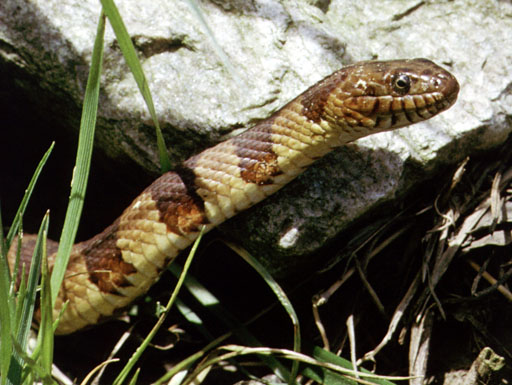
| Appearance | - The species typically has a brown, dark brown, or dark olive-green body with a black net-like dorsal pattern composed of vaguely diamond-shaped spots. English Wikipedia
- The underside is generally yellow or light brown and often has black blotches. English Wikipedia
- The dorsal scales are strongly keeled, giving the snake a rough texture. English Wikipedia
- The species usually has 25 or 27 dorsal scale rows at midbody. English Wikipedia
- Adult males possess multiple papillae on the underside of the chin. English Wikipedia
- Newborn individuals are often lighter in color than adults, making their patterns more conspicuous. English Wikipedia
- The species has a light grayish-brown body with a dark chain-like pattern extending along its length. floridamuseum.ufl.edu
- The belly is yellowish and marked with dark half-moons. floridamuseum.ufl.edu
- The dorsal pattern consists of central dark blotches connected to alternating lateral blotches by short diagonal lines. floridamuseum.ufl.edu
| - The species has a brown, gray, reddish, or brownish-black body with dark crossbands on the neck and dark blotches along the rest of the body. English Wikipedia
- The species' coloration generally darkens with age, and its body pattern may become difficult to distinguish. English Wikipedia
- The belly can be white, yellow, or gray and usually has reddish or black crescent-shaped markings. English Wikipedia
- Adult individuals can become almost entirely black. English Wikipedia
- The species has keeled scales and a divided anal plate. animaldiversity.org
- Juveniles have reddish-brown saddles against a tan, brown, or gray background. animaldiversity.org
- The species has 21–25 scales at midbody. animaldiversity.org
- Juvenile individuals have dark crossbands against a light-brown, tan, or gray background. in.gov
|
|---|
| Size | | No checked fact yet |
|---|
| Habitat | - The species is commonly found near slow-moving streams, rivers, ponds, and swamps. English Wikipedia
- Across other parts of its range, the species occupies a wide variety of freshwater habitats. floridamuseum.ufl.edu
- The species prefers aquatic habitats with overhanging vegetation. floridamuseum.ufl.edu
| - The species inhabits streams, lakes, ponds, and wetlands. English Wikipedia
- Juveniles typically occupy smaller streams adjacent to the larger waterways inhabited by adults. English Wikipedia
- The species uses rivers, streams, sloughs, lakes, ponds, bogs, marshes, and impoundments. animaldiversity.org
- Northern water snakes prefer open areas with basking opportunities and relatively still water. animaldiversity.org
- Individuals may shelter beneath flat rocks, logs, and boards when not basking or searching for food. animaldiversity.org
- The species prefers warm, permanent, shallow water with access to basking locations. in.gov
|
|---|
| Diet | - The species primarily consumes fish, with fish accounting for up to 98.5% of ingested food volume in the cited dietary study. academia.edu
- The species feeds almost exclusively on freshwater fishes and frogs. floridamuseum.ufl.edu
- The species captures prey with its jaws, subdues it, and swallows it without constriction. floridamuseum.ufl.edu
| - The species feeds on small fish, tadpoles, frogs, worms, leeches, crayfish, large insects, mollusks, annelids, salamanders, other snakes, turtles, small birds, and mammals. English Wikipedia
- The species is both carnivorous and a scavenger. animaldiversity.org
- Northern water snakes swallow their prey alive rather than constricting it. animaldiversity.org
- The species also consumes frogs, toads, salamanders, and carrion in Indiana. in.gov
|
|---|
| Behaviour | - When foraging, individuals may hang from branches over water and dip their heads beneath the surface while searching for prey. English Wikipedia
- Individuals frequently bask on branches over water and escape by dropping into the water when approached. English Wikipedia
- When approached, individuals typically flee into the water, dive, and swim away. floridamuseum.ufl.edu
- When threatened, individuals may hiss and flatten their heads and bodies to appear larger. English Wikipedia
- Individuals may bite when grabbed or pinned and release foul-smelling musk from glands near the tail. floridamuseum.ufl.edu
- Biting is primarily a defensive response to intentional disturbance or handling. floridamuseum.ufl.edu
- The species is typically nocturnal but may become more active during daylight in spring and autumn. floridamuseum.ufl.edu
- The species is not considered venomous. English Wikipedia
| - The species is active both during daylight and nighttime. English Wikipedia
- The species commonly basks on rocks, stumps, and brush. English Wikipedia
- The species uses smell and sight to locate prey. English Wikipedia
- The species commonly dives into the water when disturbed while basking. English Wikipedia
- When cornered or captured, the species generally defends itself. English Wikipedia
- Northern water snakes are more active during daylight hours despite being observed both day and night. animaldiversity.org
- When escaping predators, northern water snakes may dive and anchor themselves to vegetation or logs underwater. animaldiversity.org
- When threatened, northern water snakes flatten their bodies and jaws and strike and bite. animaldiversity.org
- The species may release foul-smelling musk and defecate when threatened. animaldiversity.org
- The species may flatten its head and strike when cornered or restrained. in.gov
|
|---|
| Reproduction | - The species is ovoviviparous. English Wikipedia
- Adults breed during spring, and females give birth in late summer or early autumn. English Wikipedia
- Newborn individuals measure approximately 20–25 cm in length. English Wikipedia
- Females in other parts of the species' range typically give birth to 8–62 young between August and September. floridamuseum.ufl.edu
- Interbreeding with other water snake species whose ranges overlap is not known. English Wikipedia
| |
|---|
| Distribution | - The native range includes the central United States and northern Mexico. English Wikipedia
- In the United States, the species occurs in Texas, Oklahoma, Kansas, Iowa, Louisiana, Arkansas, Missouri, Illinois, Indiana, Tennessee, Mississippi, Georgia, and Alabama. English Wikipedia
- In Mexico, the species occurs in Coahuila, Nuevo León, Tamaulipas, and Veracruz. English Wikipedia
| No checked fact yet |
|---|
| Conservation | - The species is not classified as endangered or threatened in the first document. English Wikipedia
- Human persecution resulting from mistaken identification as venomous snakes is identified as the main threat to the species. English Wikipedia
| - Introduced common watersnakes in California are considered invasive and may compete with the threatened giant garter snake. English Wikipedia
- The species may threaten vulnerable fish and amphibians through excessive predation. English Wikipedia
- The Lake Erie watersnake subspecies was removed from the United States Federal List of Endangered and Threatened Wildlife on August 16, 2011. English Wikipedia
- The Lake Erie watersnake population increased to 11,980 individuals by 2009. English Wikipedia
|
|---|
| Uses | No checked fact yet | - The species may benefit sport fishing by consuming diseased and dying fish and reducing fish overpopulation. animaldiversity.org
- The species may cause problems for fish hatcheries and fish farms. animaldiversity.org
|
|---|
| Similar species | - The species is frequently mistaken for the venomous cottonmouth because of its defensive behaviour and overlapping habitat. English Wikipedia
- The species may also be mistaken for rattlesnakes because of its brown or tan coloration and diamond-shaped pattern. English Wikipedia
| - The common watersnake is frequently mistaken for the venomous cottonmouth. English Wikipedia
- The common watersnake has round pupils and lacks heat-sensing pits, distinguishing it from the cottonmouth. English Wikipedia
|
|---|
| Other | - The species was first described under the name Tropidonotus rhombifer in 1852. English Wikipedia
- The species is frequently kept in captivity in states where keeping native reptiles is legal, although its pet-trade market value is low. English Wikipedia
- Captive individuals may become docile with regular handling. English Wikipedia
| - The species is nonvenomous and harmless to humans. English Wikipedia
- The saliva contains a mild hemotoxic anticoagulant that can increase bleeding from bites. English Wikipedia
|
|---|